William Crosbie, Scottish Artist
Welcome to the wonderful work of William Crosbie.
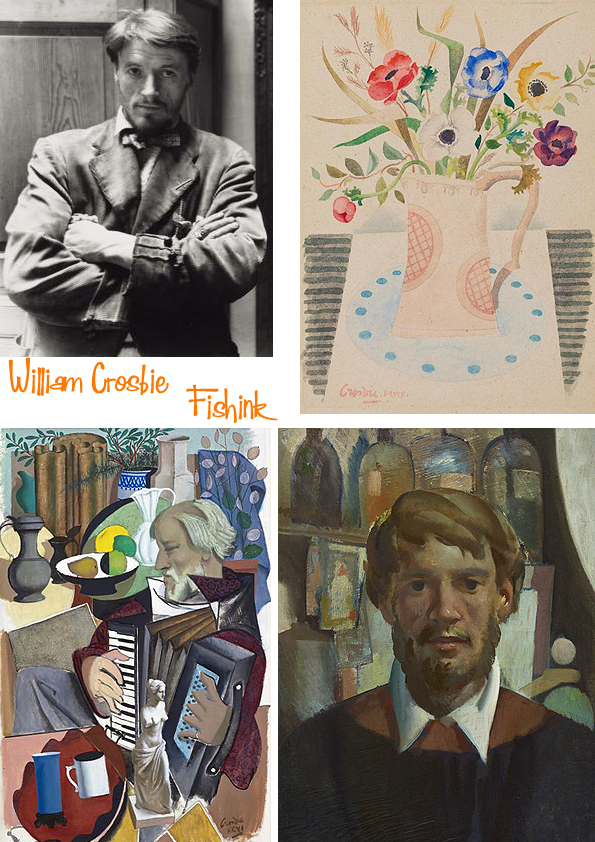
William was born in Hankow, China, in 1915, of Scottish parents. The family returned to Glasgow in 1926, where Bill attended Glasgow Academy and, in 1932, entered Glasgow School of Art. On graduating in 1935, he was awarded the Haldane Traveling Scholarship and set off for Paris, where he gained admission to the studio of Fernand Leger and was able to study under the master; he described his time there as ”one of my proudest experiences”. When his scholarship ended Bill was offered a job with the Archaeological Institute’s expedition to the newly excavated Temple of the Bulls and Temple of Sakhara in Egypt, where he copied the friezes on the temple walls.
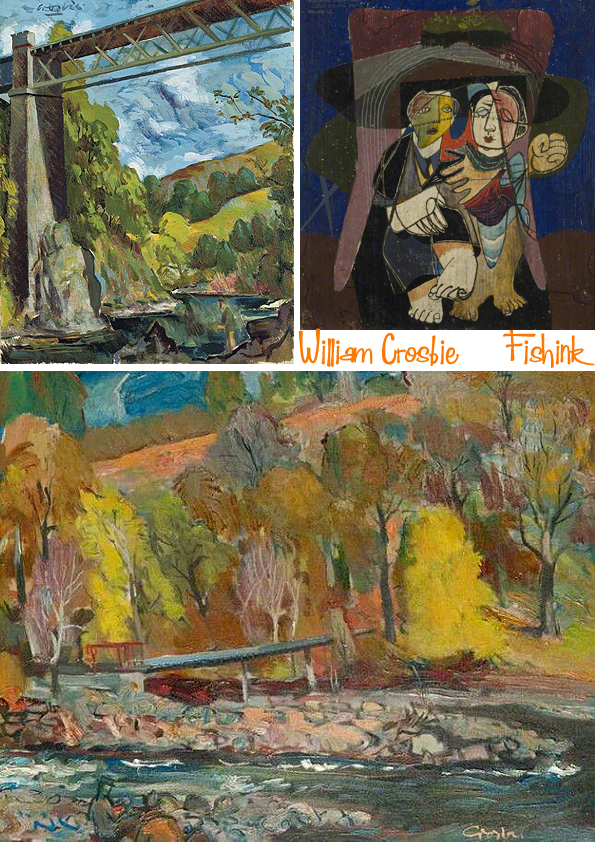
In 1939, Bill returned to Glasgow where he set up his studio at 12 Ruskin Lane, a studio originally designed for Sir David Cameron. During the war he served in the Merchant Navy, though he continued to produce paintings through these years. He was also at the centre of what he once described as ”a little local Renaissance”, which included luminaries such as Hugh MacDiarmid, J D Fergusson, James Bridie, T J Honeyman, and Basil Spence. Other ”regulars” at his studio were the refugee artists Jankel Adler and Josef Herman, as well as Duncan Macrae (whose portrait by Crosbie is now hanging in the People’s Palace).
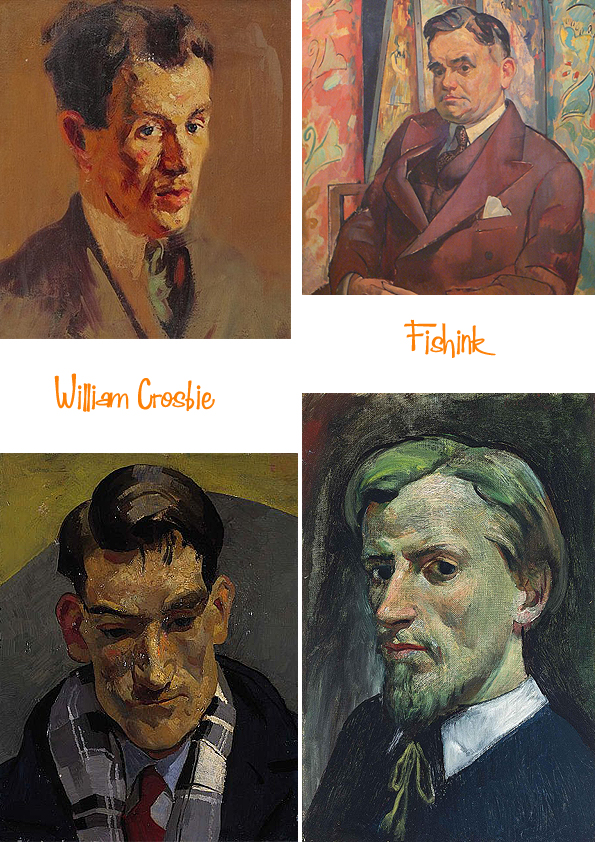
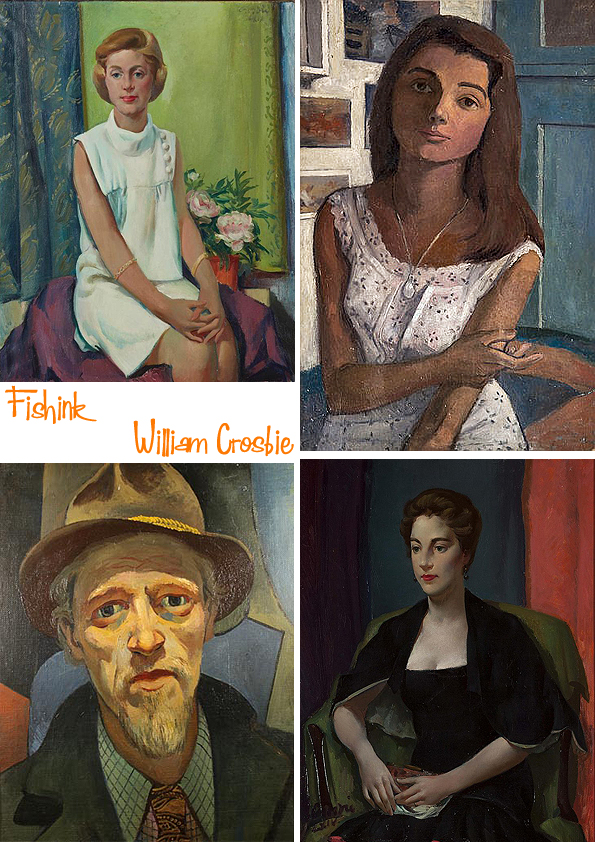
After the war Bill made his London debut at the Reid and Lefevre gallery in 1946 in a joint exhibition with the English surrealist painter John Armstrong.
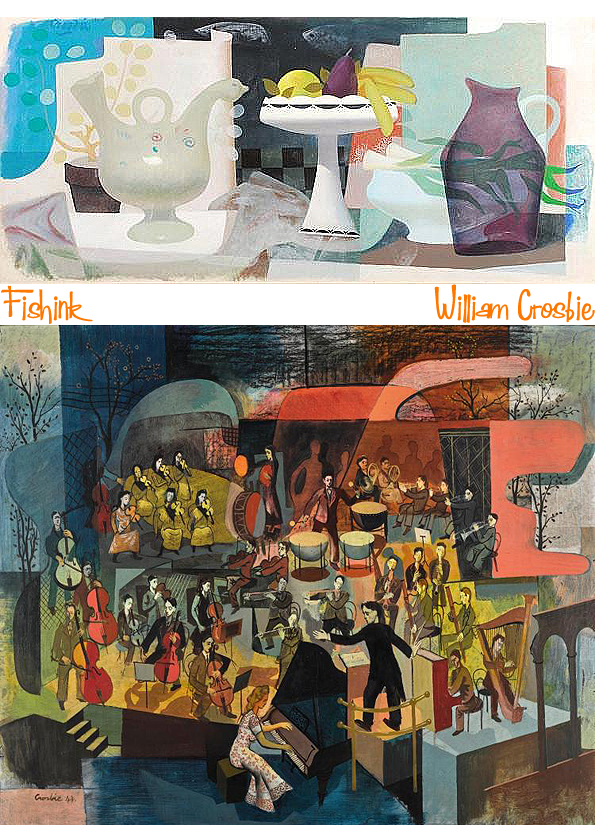
An important part of Crosbie’s work after the war were his mural paintings, largely commissioned through his association with architects like Basil Spence and Jack Coia. These included works for the ”Britain Can Make It Exhibition” in 1946 and the ”Festival of Britain” in 1951; there were also many murals and altarpieces for churches of all denominations. He was involved in book illustrations for the publisher William MacLellan and even designed the set of a ballet for George Chisholm.
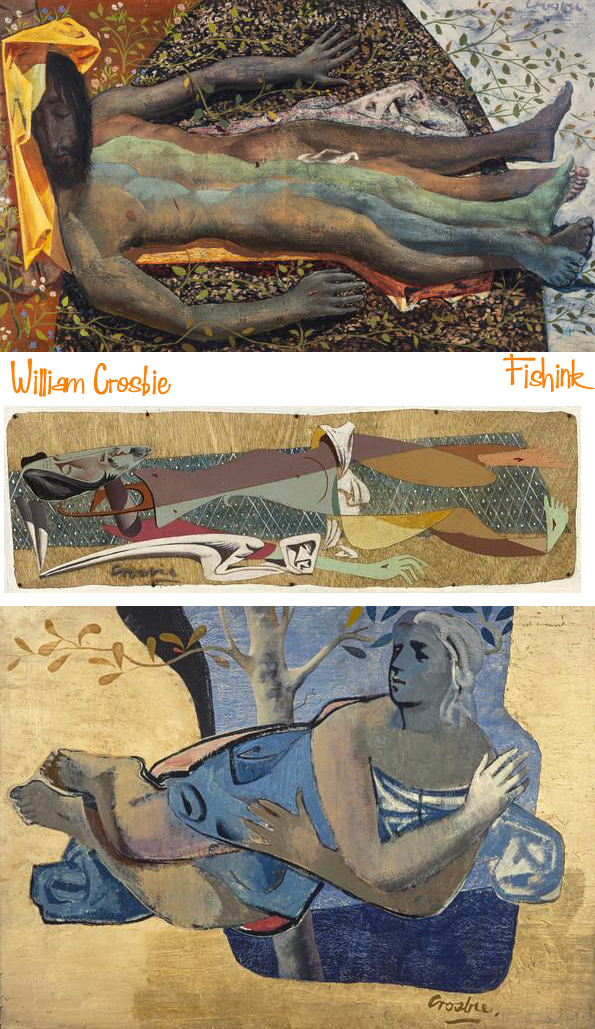
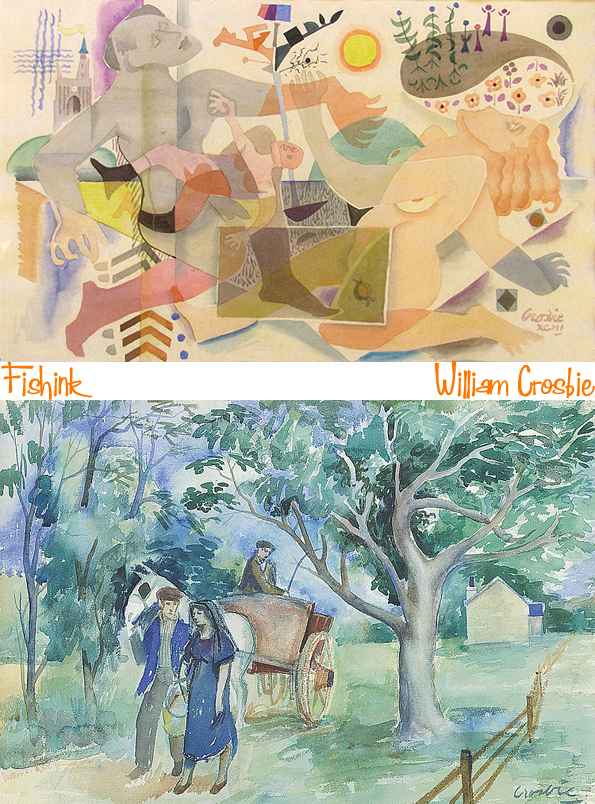
He exhibited on a regular basis with the Annan Gallery in Glasgow from the war until the 1970s and in Edinburgh with Aitken Dott’s. From the 1980s he showed with Ewan Mundy in Glasgow. Academic recognition came in 1953 with his election as an associate of the Royal Scottish Academy and subsequently as an academician. In Glasgow he was a proud member of, and annual exhibitor at, the Royal Glasgow Institute, and he was also a former president and long-time member of the Glasgow Art Club.
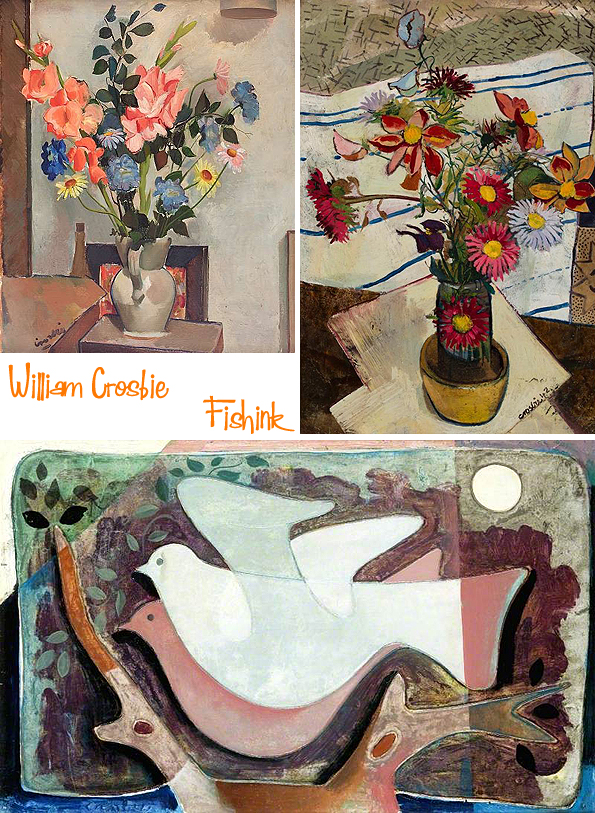
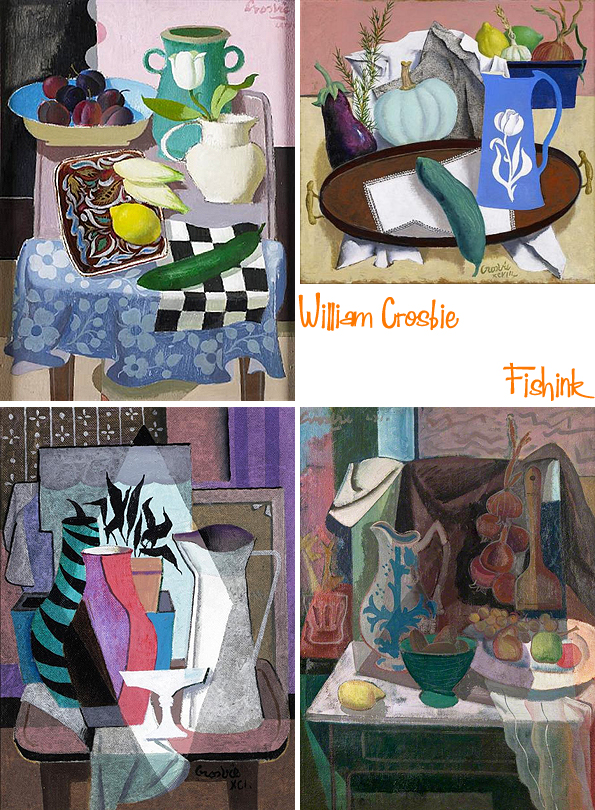
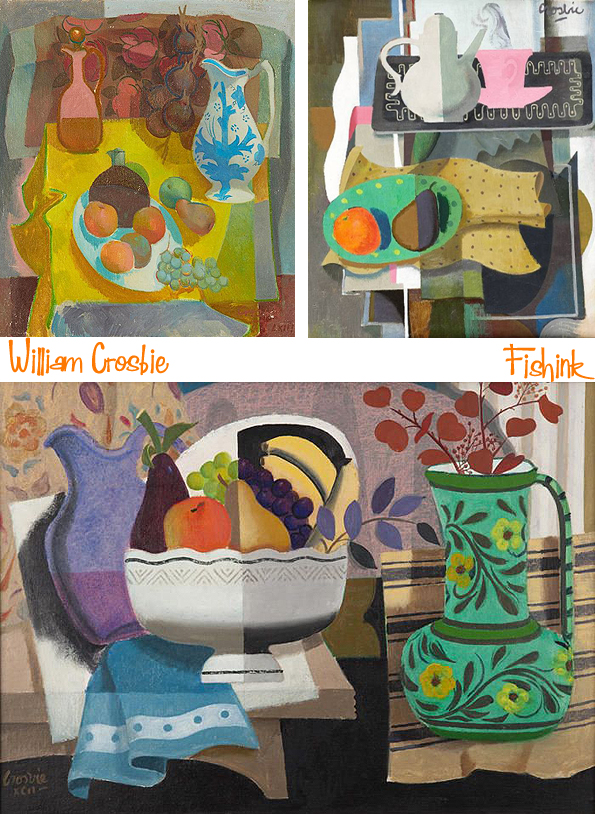
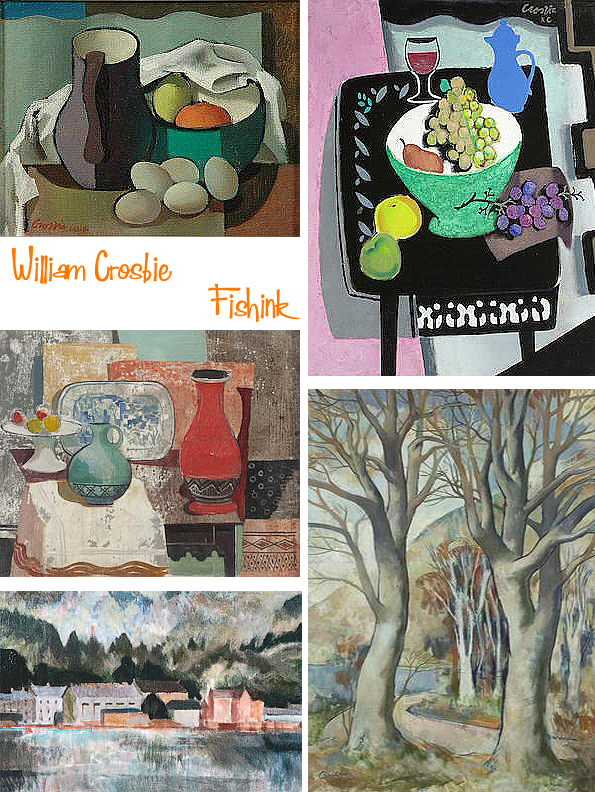
There were major retrospective exhibitions of Crosbie’s work at Aitken Dott’s in 1980, Ewan Mundy’s, 1990, and Perth Museum and Art Gallery, 1990.
His paintings hang in all the major museums and galleries in Scotland as well as the Royal Collection and the British Museum in London, and in private collections throughout the United Kingdom and abroad.
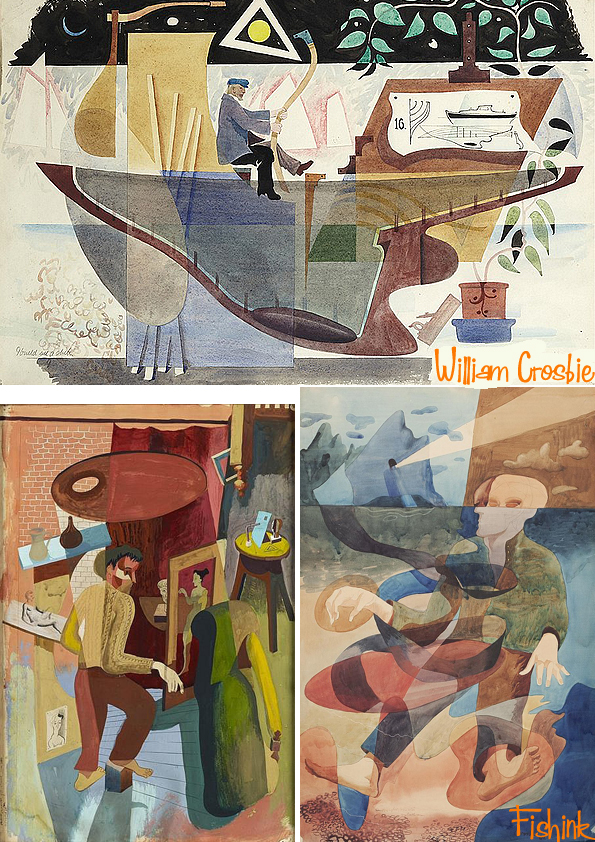
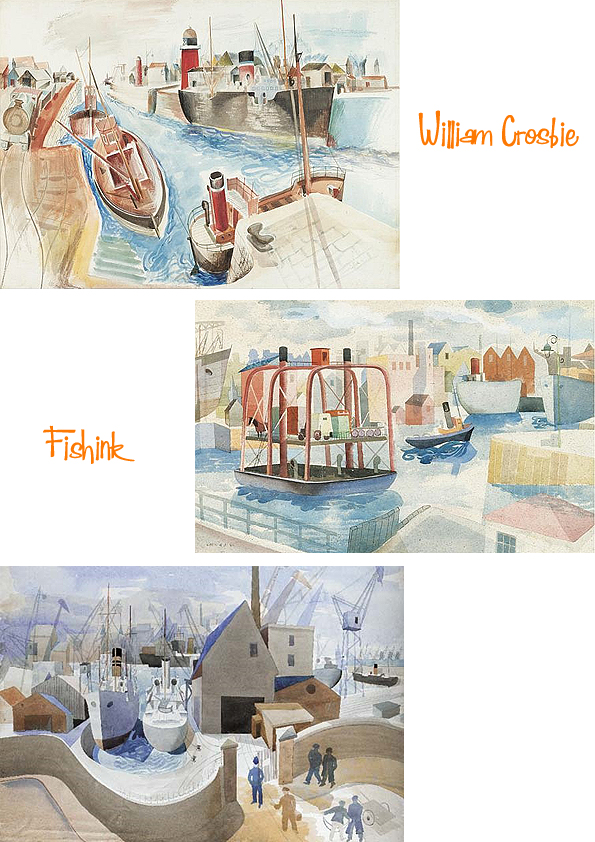
Some of his work has a flavour of Ravilious about them, like these watercolours below.
William’s own words are perhaps his best epitaph: ”Devotion to the muse and the life it has led me has meant I have enjoyed a richness of texture not readily to hand to the majority of my fellow citizens.” He was one of the finest and most singular Scottish painters of the twentieth century. He passed away in 1999 at the age of 84.
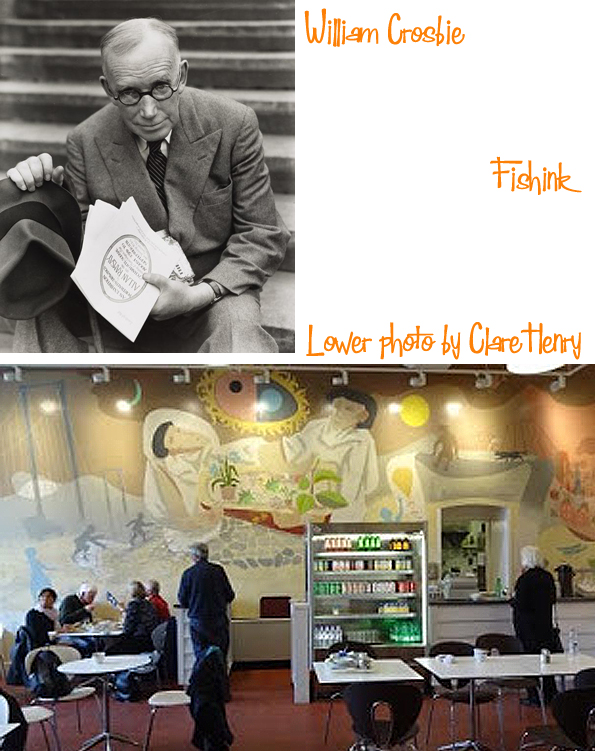
The City Art Gallery’s Cafe used to be covered with a stunning mural by William which started to fade and peel and has consequently been covered up, this is a photo of part of it , in it’s heyday. Thanks to Clare Henry for the photo.
If you have any suggestions for blog-posts for an artist who’s work you consider would fit with the style I tend to show on Fishink Blog (1950’s 60’s), then please let me know. I won’t guarantee to use them but It’s always interesting to see who gets nominated : )


 fishinkblog.com
Thank you so much for highlighting the works of William Crosbie…..an amazing artist.I contacted you several years ago when on a visit to Edinburgh’s City Art Gallery Cafe I saw to my horror that,as it first appeared,William Crosbie’s stunning wall murals had been covered in blue paint.After contacting Edinburgh City Council,I was assured that it had been covered with a false wall painted blue and the murals were protected.Given that there had been no damp proof course in place before the false wall was installed and the lower sections of the murals were already peeling, I dread to think what must now be festering away behind that wall.Edinburgh City of Culture??? Huh!!
Thanks for this post. Lovely work – and I wasn’t aware of him!.
Well done. Keep up the good work!
Best regards,
Tony.
Cheers Tony