Cyril Edward Power and Sybil Andrews
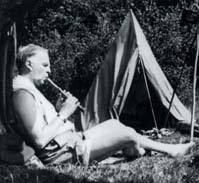
Cyril Edward Power 7 December 1872 – 25 May 1951 was born in London. He trained as an architect
with his father’s firm, won RIBA’s Soane Medallion in 1900; then continued practising until
World War I, when he served with the Royal Flying Corps.

In 1921 he met Sybil Andrews, with whom he maintained a close and somewhat informal working
relationship which lasted some 20 years. Power and Sybil Andrews enrolled at Heatherley’s School of
Fine Art, London in 1925 when he was also elected a Fellow of the Royal Historical Society.

Power also helped Iain McNab and Claude Flight set up The Grosvenor School of Modern Art
in Warwick Square, London. By now Power was busy as a printmaker and watercolourist, showing
at pioneering Redfern Gallery print exhibitions in 1930s. Later in his life he turned to painting in oils
with a palette knife. Exhibited at RA, RBA, Goupil Gallery and Royal Glasgow Institute.
A retrospective exhibition was held at Redfern Gallery in 1998.

I love the way that his rowers here almost look like a stained glass panel or a textile floral print.
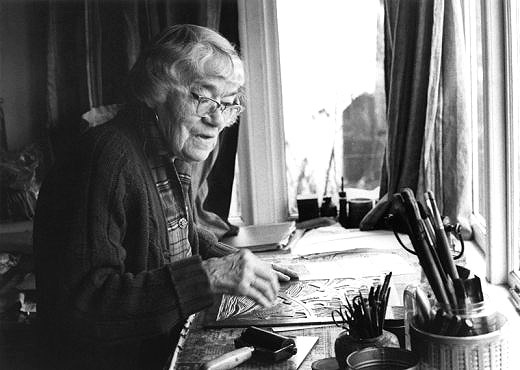
Sybil Andrews 19 April 1898 – 21 December 1992 was a printmaker, painter, graphic artist
and educator, who was born in Bury St. Edmonds, Suffolk, England.
She moved to London (England) in 1922. In 1947, she emigrated to Campbell River ,Vancouver Island,
British Columbia, Canada,where she worked, taught and lived for the rest of her life.

Her mediums were the colour linocut, etching, posters, pastels, ink, watercolour, monoprint and oil.
Her subjects were human activity (at work, sports, travel, etc.), figures, animals, genre, allegory,
architecture and landscape. Her style was Art Deco, Futurism, Cubism and Vorticism.
Her work is identified by a simple format, clean lines, distortion, vivid colours, drama and rhythm.
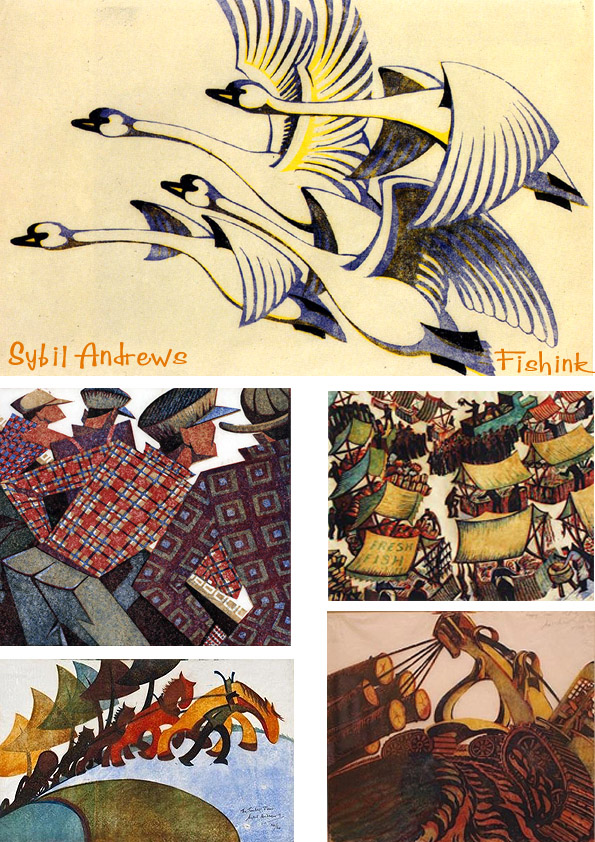
She said “The colour linocut was just the medium for me, being interested in dynamics and ideas
and patterns… It is impossible to be fussy with lines, you have to simplify, you are forced to simplify
your idea to its fundamentals.”
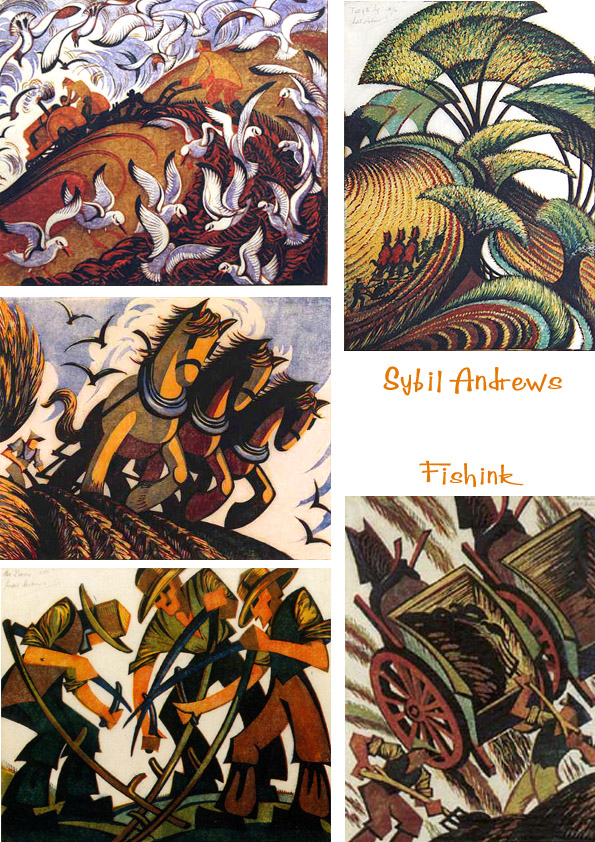
Andrews produced 76 linocuts in her life, of which 43 were made from 1929 to 1939, which is considered
to be her best period. Her work with figures on the land is both dynamic and a real capture of the times.
I love the way she captures the striding ploughing horses from such a low perspective that it makes them
appear to be thundering towards you whilst working the land. Great dynamic illustration.

Naturally Cyril and Sybils’ work went on to be very influential. It strikes me of an odd joining of russian
war posters mixed with the beauty of a Samuel Palmers’ rustic landscape ! lol

 fishinkblog.com
Jaw dropping… where to start?
I have never seen or even heard of either of these two artists so this was a real education. LOVE their work – it’s amazing because it’s so pattern like and yet still firmly a ‘painting’ of a scene.
I think reading your blog is going to up my performance at dinner parties because I’ll be able to talk about unknown artists!!
Cheers 🙂
Claire you made me laugh with your dinner party reference. I on the other hand, just need to start getting the party invites first ! lol Glad to hear my blogging doesn’t fall on deaf ‘eyes’ as it were.
I am sure I have just seen a greeting card, printed by the group that print Angie Levin…..with a design that could b possibly be Sybil’s ?
The company is called Art Angels and you could be right !