Susan and Richard Parkinson Ceramics
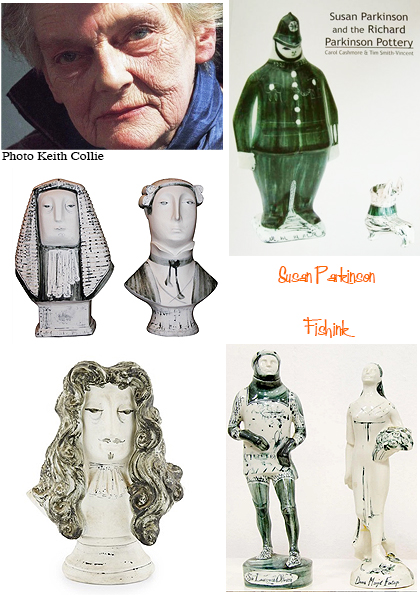
Susan Elizabeth Parkinson was born in 1925 in Calcutta, the younger daughter of a wine merchant (who was also honorary secretary of the Bombay Natural History Society) and his wife. When she was 5 the family left India for a farmhouse in Kent, but she never forgot sailing off Bombay with her father, who would suddenly drop anchor to watch seabirds and who would play Bach on a wind-up gramophone. Her artistic ability was evident at prep school, but she struggled with some academic subjects, realising in later life that she was dyslexic, a concept that when she was a child was scarcely understood. Art was both a solace and a passion, and after art school she studied sculpture under Professors Frank Dobson and John Skeaping at the Royal College of Art, where she became the first sculpture student to win the Life Drawing Prize.
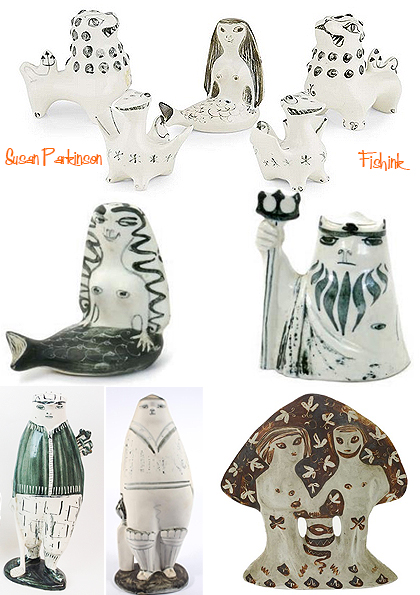
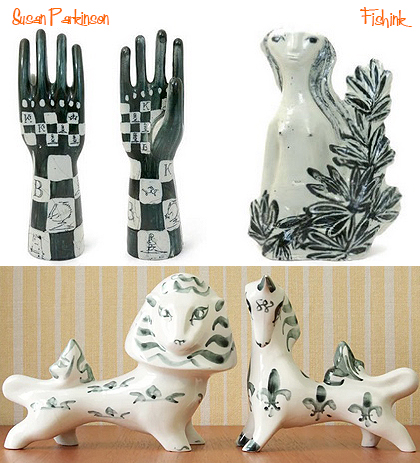
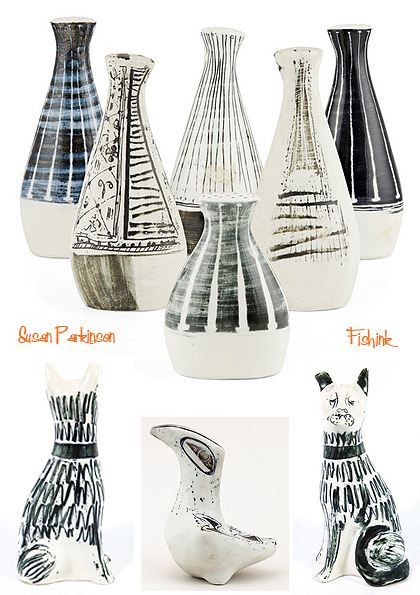
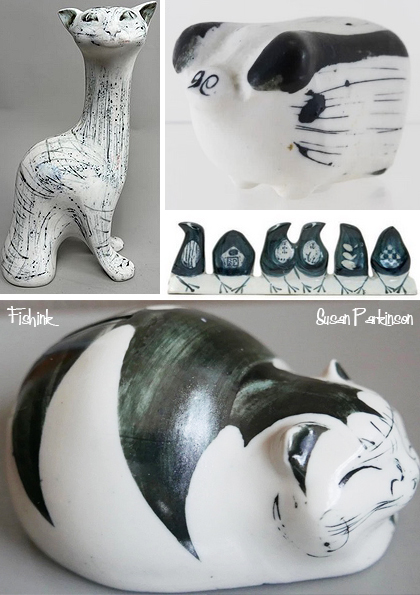
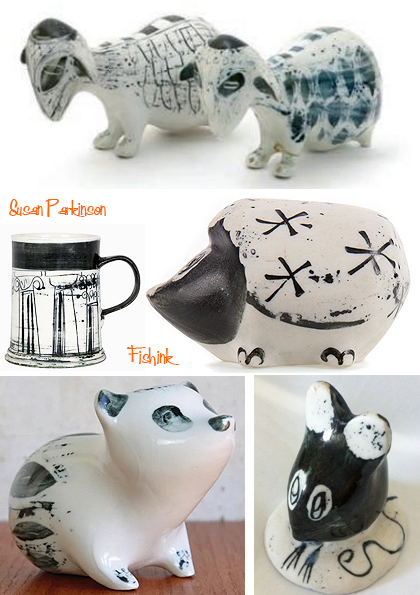
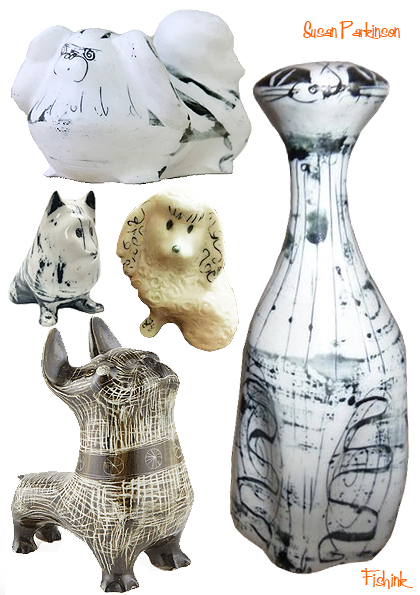
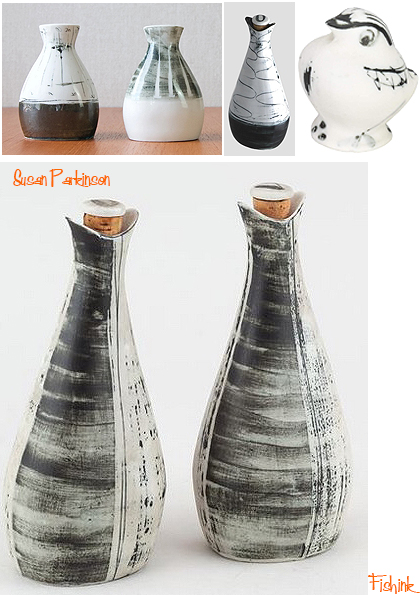
In 1949 she married the potter Richard Parkinson and moved with him to an oasthouse in Kent where, in 1951, she helped to launch the Richard Parkinson Pottery. They had an early success with a whimsical porcelain lion and unicorn, originally intended to be marketed in connection with the 1951 Festival of Britain. Unable to produce a sufficient run in time, they had them approved instead, with the addition of an E II R monogram, as commemorative pieces for the Queen’s Coronation in 1953.
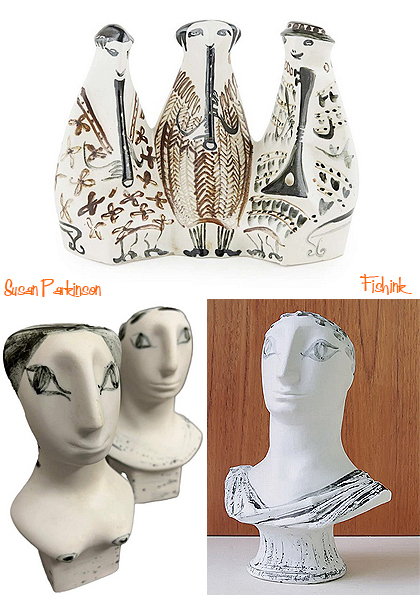
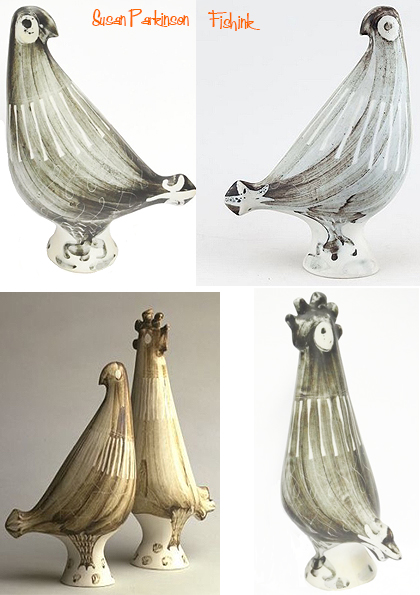
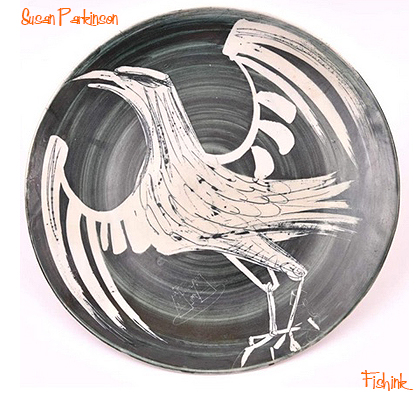
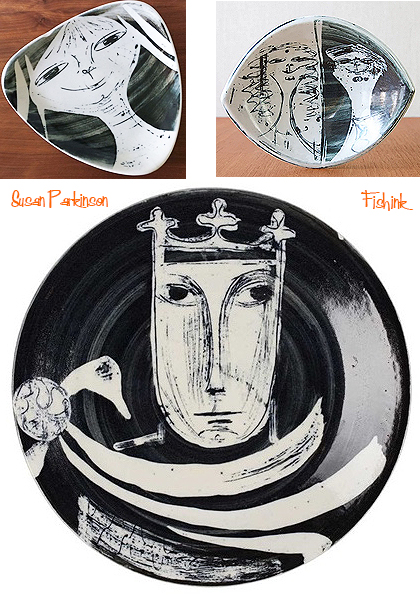
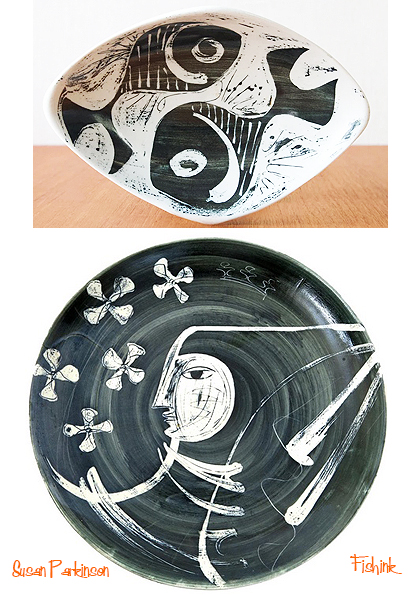
The next year, they launched a characterful porcelain cockerel and hen set, one example of which unsurprisingly found its way via Henry Rothschild’s Primavera gallery in Sloane Street into the V&A’s Ceramic Study Galleries. Some 40 years later, the decorative art dealer Tim Smith-Vincent fell in love with a second-hand set that he saw in a shop window and became an avid collector of Parkinson pieces. In 2004 he co-wrote with Carol Cashmore an overview of their work, Susan Parkinson and the Richard Parkinson Pottery.
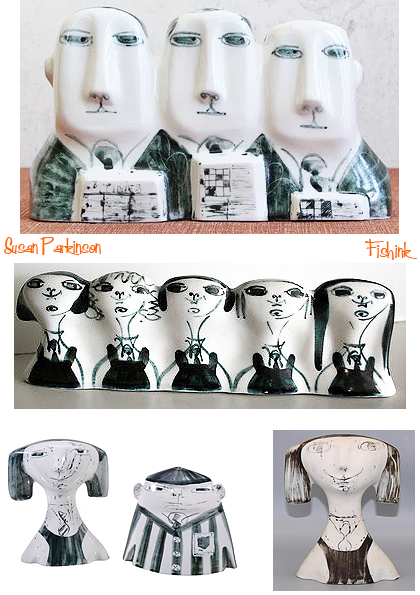
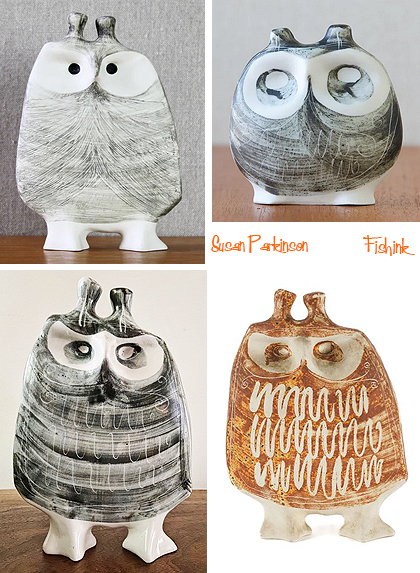
The pottery’s output was never huge, mostly as a result of the difficulties, and expense, of working with the Parkinsons’ material of choice, porcelain — the firing of which requires particularly high temperatures. Too few of their pieces survived the double trial of unglazed and glazed firing, or the difficulties of slipcasting, for the pottery to be viable long term; the expense that such problems entailed was not always something that they appreciated.
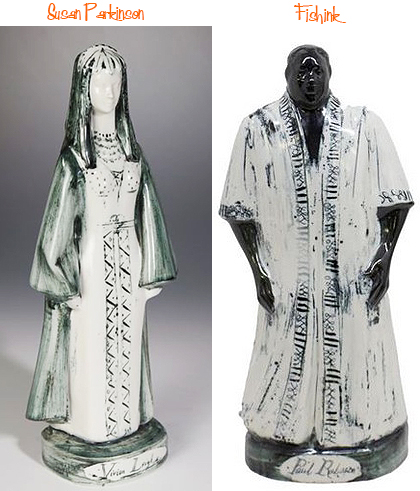
One unfortunate consequence was that they had to discontinue production of their 1958 set of theatrical figurines — the charming 12in-tall figures of Fonteyn, Gielgud, Leigh, Olivier and Robeson, commissioned from them by another pottery that had found its own earthenware unequal to the task. It was agreed that they would be paid £2 a figurine produced, but when the slipcasting proved especially difficult, with the moulds having to be made in several pieces, the Parkinsons realised the project was unsustainable, and production ceased. An idea of the amount by which they had been underselling their talent can be gained from the sums charged by the commissioning pottery when those figurines that were made were sold at the Design Centre in London in 1959: 10 guineas each, 40 guineas a set.
The couple were divorced in 1962. Without Richard’s energetic input the pottery was soon in significant financial difficulty. It closed, leaving Susan with little option but to take up teaching life drawing and sculpture. In 1963, however, she seized the chance of teaching art at Brickwall House, a specialist school for dyslexic pupils in Northiam, East Sussex. Parkinson swiftly became fascinated by her pupils’ artwork. “Compared to the work produced in art colleges where I had been teaching, their creative imagination was simply outstanding and the results amazing,” she wrote. She had the knack of knowing how to encourage and inspire young people, and they responded to her enthusiasm for her subject. Her work on behalf of her fellow dyslexics, both at Brickwall and later with the Arts Dyslexia Trust, was to have a profound impact.
“In those days there was little information available about how to teach dyslexics — no ‘code of good practice’, in fact, little about dyslexia at all,” she wrote. “All of us had to learn from the boys we were ‘teaching’. We listened to them and looked at their way of making things, building, and solving problems, and discovered what worked for them and what didn’t. This is still, I believe, the best training for a teacher.”
The A-level art results and entries to art college were soon proving that her approach worked, and it was not long before the art department expanded beyond the “not very waterproof cowshed with no light or equipment”, as she described the “studio” facilities on her arrival. Other outbuildings were commandeered, and a pottery, a forge and a computer graphics area were created. “The evidence continued to mount, steadily. It was not signs of disability we were seeing, but of exceptional ability in these subjects,” she wrote.
By the time she retired in 1985, she was convinced that there must be some reason why a lack of ability with words so often brought with it a higher than average ability in subjects requiring visual-spatial skills. With the help of an Open University degree course in research methods and statistics, she devoted her early retirement to discovering what that reason might be. Her conclusion was that, “Traditional academic education depends on the use of words and numbers that can only be understood sequentially. The visual thinkers, including many of the talented dyslexics, think three-dimensionally. The differences between these two ways of thinking are profound.”
In 1992, with two others who had taught at Brickwall, she founded the Arts Dyslexia Trust, whose main aims include moving the popular focus away from “correcting” what are perceived as the weaknesses of dyslexics (their problems with reading, writing, learning by rote and organisational skills), concentrating instead on encouraging the high creative potential of visually dominant dyslexic minds.
As the charity’s secretary and chief executive officer, she was heavily involved in organising high-profile exhibitions and seminars to increase awareness of the talents of creative dyslexics, not only in art but also in science and other fields. She also initiated a study into the proportion of dyslexic students among freshers at a major London art school, finding this to be an astonishing 75 per cent, and spent long hours manning the trust’s helpline for dyslexics and their parents with her customary good humour and sensitivity.
Many thanks to The Times for the information used in today’s post.


 fishinkblog.com
absolutely fascinating to read about the Parkinsons, and especially Susan, it sounds and though she was a lovely empathetic person, and seeing all those works too, I’ve seen a couple in the past , but never investigated further more’s the pity, thank you so much for introducing her/their work to me.
Thanks Liz