These Shoes were meant for sharing !
Hi everyone, I hope this find’s you well and easing into the week ahead. About a fortnight ago I had a few days away from the grindstone and hopped over to Northampton, largely to visit friends there, but also to take in the city and it’s wealth of surrounding parks.
I discovered that the town hall was rather lavishly decorated with stunning details.

There were beautiful stone carvings, depicting scenes from nature and many of the local professions of the area.

The top one being a shoemaker, which led us to visiting Northampton’s Museum and Art Gallery where there is a fabulous collection of shoes from throughout the ages.
The exhibition starts with the notion that there are perhaps only 11 types of shoe. The Bar Shoe, Boot, Clog, Court Shoe, Derby, Moccasin, Monk, Mule, Oxford, Sandal and Trainer. Northampton Museum and Art Gallery is home to one of the largest collections of shoes and shoe heritage in the world. Arts Council England designates the collection as being of local, national and international importance.

The first thing that struck me about shoes from the 1600’s is how thin and tiny people’s feet used to be. There is such a variety of styles, I just picked out some of the fancier ones. Spot the Chitty Chitty Bang Bang ‘child-catcher’ early Winkle-Pickers below and those famous flapper girls!!

As a county, Northamptonshire is built on the shoemaking industry with many towns and villages at one time or another being home to shoemakers, leather merchants, designers, tanneries and other related businesses. Northampton, has a proud heritage dating back almost 900 years. This photo dated around the 1920’s.

The county is still world renowned for the shoes it creates. Today over 25 manufacturers produce a huge range of quality footwear. Famous names such as Dr Martens and Church & Co still continue to thrive. Who recalls a trip to Clarks shoe shop and having their feet measured ?

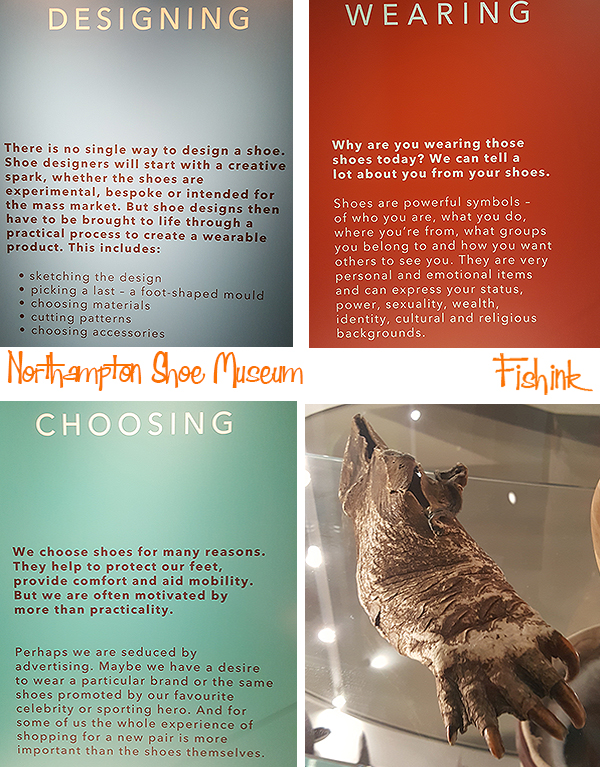
Some of the information and a rather scary looking reptile boot !
Examples from Trainers…
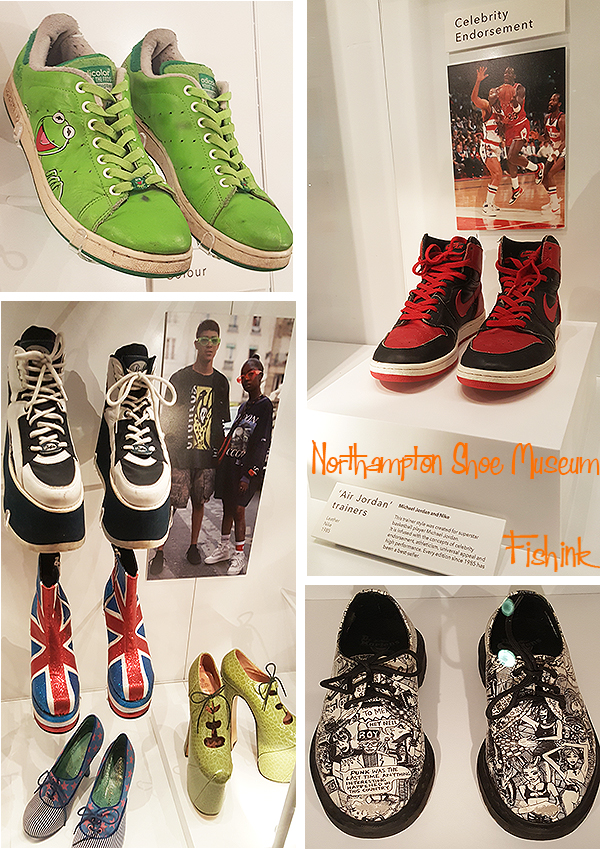
To something a little more specific !! The red shoes derive from the film “Kinky Boots” and parts of it was filmed locally too.

From desirable and almost sci-fi footwear…

.. to those from further afield.
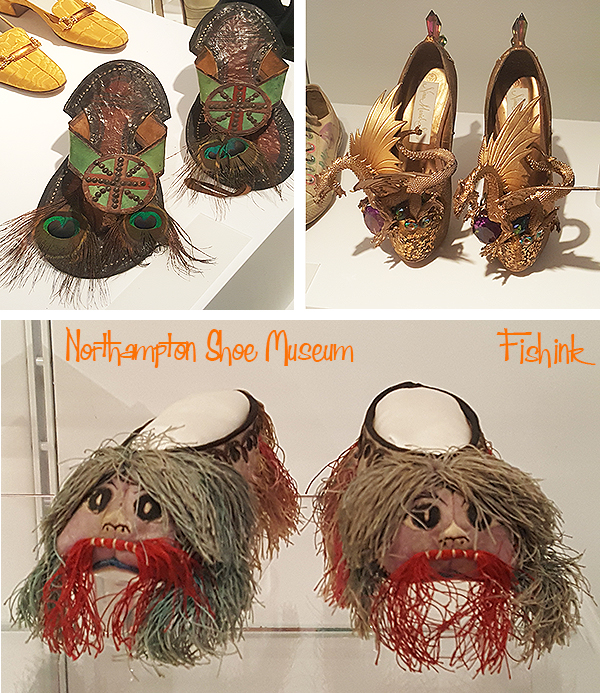
Spanning many eras.

Possibly my favourite idea was this “decorate your own pair” of Adidas trainers, complete with paints and brushes, all neatly packaged in an artists box. Clever designing !
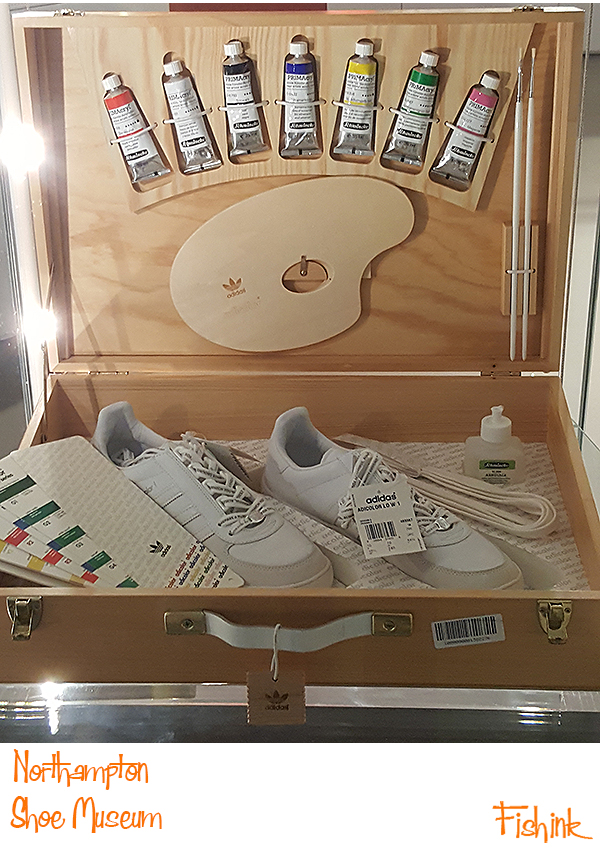
Something for all and well worth popping in for a browse as the educational videos were as entertaining as the shoes. What shoe stories do you have to share ?
Russell George Wilson Mixed Media Artist
I have been a keen admirer of the stunning work by artist Russell George Wilson for quite some time now.
He is a maker who is confident working across many different areas, including painting, illustration, needle felting and ceramics to name but a few. His work is always considered, precise and beautifully constructed and it is because of this attention to detail that it has taken a while for Russell to find the time to answer my questions and join the creatives here on Fishink blog. I’m so glad that he did, as I’m certain you will love his work as much as I do.
Let’s start off with some hand-made paper moths to whet your appetite !
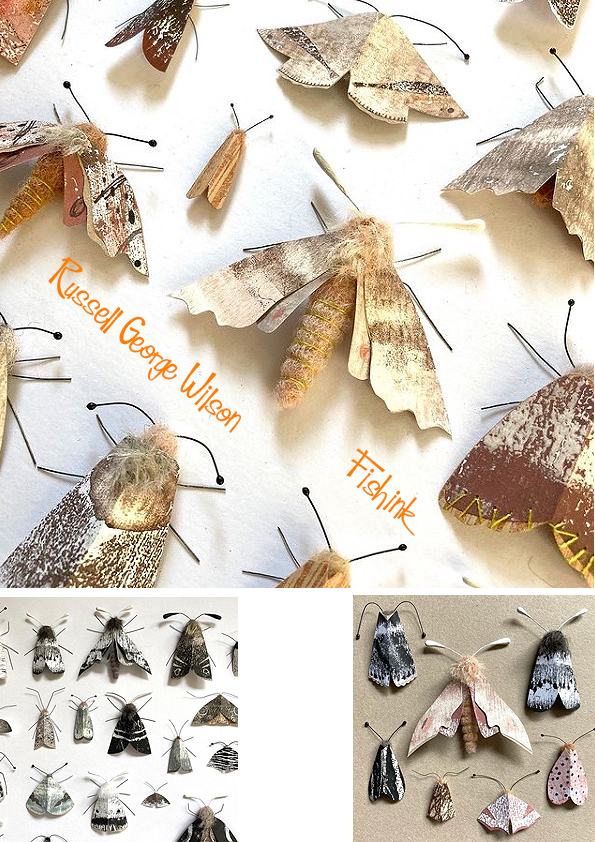
Hi Russell, Please can you tell us a little about your artistic journey prior to today?
I’ve always loved being creative and I was forever drawing or making something as a child, I used to make lots of models and always had some sort of project on the go that I’d get completely obsessed by ( I probably drove my parents mad!) Later on, I studied Graphic design at Derby University to degree level. I’m not sure why I chose graphic design as a course as I came to realise in my final year that this was somewhat misguided and not at all what I wanted to do as a career. I think if I had my time again I would have done a ceramics or craft based degree. Luckily, I did get the opportunity to do illustration and 3D work as part of my degree which was more my sort of thing.
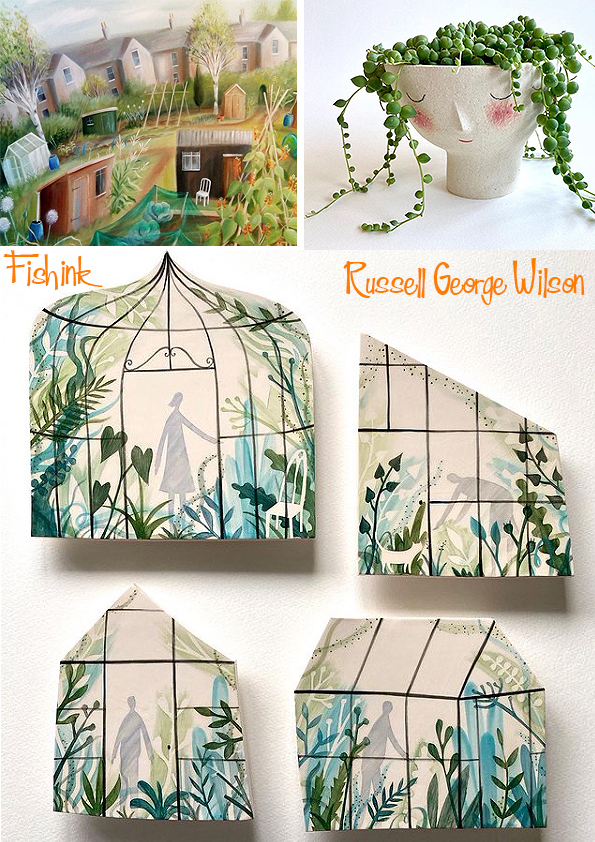
After leaving university I worked in a local theatre painting stage sets and eventually became an Assistant Scenic Artist whilst I also did some freelance illustration work for various card companies. I was eventually offered a job at one of the card companies as an illustrator where I worked for 21 years before deciding to go it alone and pursue a career making my own work; something I’d always wanted to do but never felt sure until the pandemic happened. I had been making ceramics and other craft work whilst I was employed and selling to galleries etc but I never felt that I was giving it 100% but hopefully now I can. I would describe myself today as a mixed media artist, I work across several different disciplines including ceramics, illustration, needle felting, painting and paper.
How did you first get involved with ceramics and model making?
Like I said previously, I was always making something as a child, paper mâché, air drying clay…..you name it! I suppose I just tend to have a brain that can think in 3D.
I remember vividly being introduced to ceramics in the first year of senior school, everybody did pottery class back then….I’m not sure if that happens today (which is a great shame if not). Whilst a lot of our class weren’t remotely interested and spent most of the lesson throwing clay at each other, I was fascinated and hooked from the first lesson. I was amazed how clay magically became solid after firing. I made some really lovely small pinch pots that the teacher glazed in the most beautiful glazes, I have no idea what happened to them but they were in our house for years. Later on, years later in fact whilst I was employed illustrating greetings cards, I enrolled on an evening class to do A level ceramics. I hadn’t touched clay for years up to this point but it bought back the memory of the enjoyment of making things from clay years before. I loved doing the evening class every Wednesday night and made some great friends! It wasn’t very long before I purchased my own kiln and began making ceramics at home.
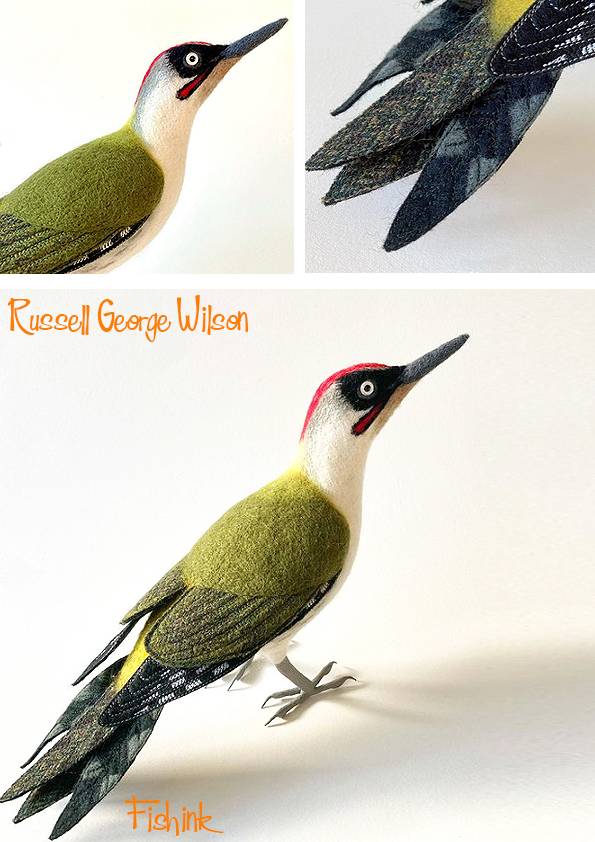
My needle felting work developed from my time again working for the greetings card company. I stumbled across the work of an American lady (I can’t remember her name now) who made characters out of needle felt, I found them quite amazing and had no idea how they’d been made etc. I basically found out all about the technique and through trial and error taught myself, my first attempts were probably quite awful looking back but eventually I became the go-to person at work for 3D character briefs.
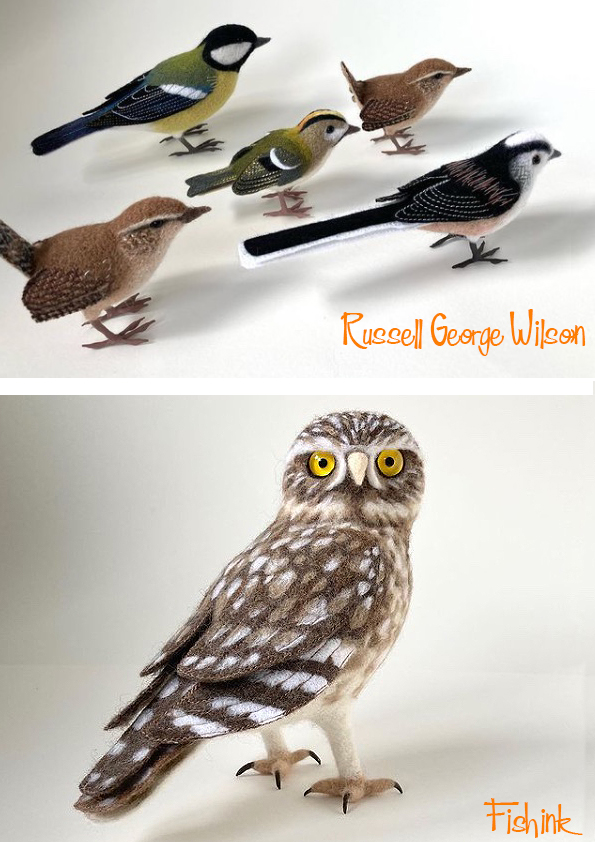
My characters were photographed to go on greetings cards, they were all mainly cute animal type things! My birds sort of just emerged from a desire to make needle felting a bit more of an art form, something more worthy – I think needle felting has a very crafty and quite twee image and isn’t particularly well regarded as a media, I’ve found some galleries don’t really like the idea until they have seen photos of my work so hopefully I have gone some way to change perceptions.
Where does the inspiration for your lovely characters derive from?
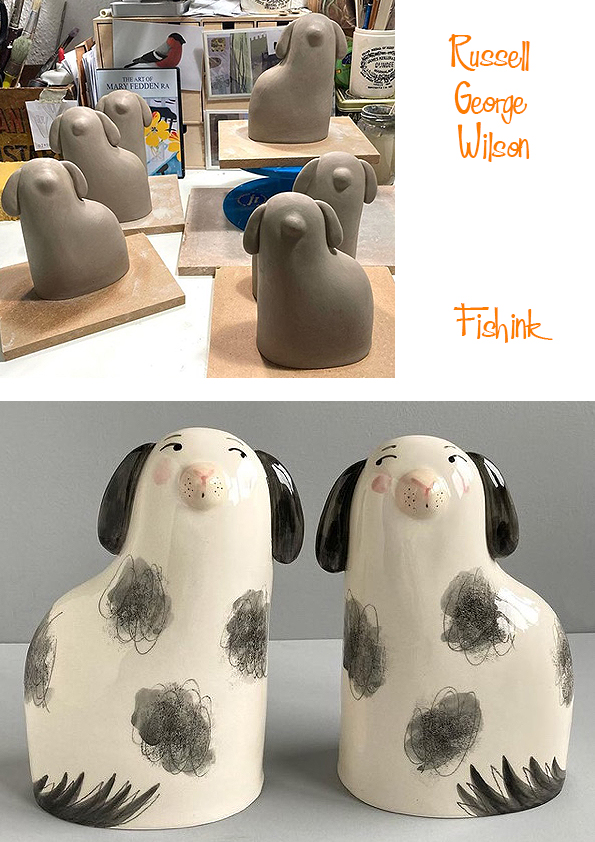
My approach to making my ceramic animals is very much my own really, I work instinctively – sometimes I will use reference for a particular animal as a starting point but often I will just use my imagination and create something from my head. I’m particularly interested in stylisation, the animals are not meant to look real or anatomically correct, they are more about form and simplicity of shape. It’s interesting to see how far I can push the shape of something and it still be recognisable as type of animal that someone will recognise. This can probably be best illustrated by my ceramic lions, their faces are so un-lion like but they are still undoubtably a lion, I’m not really sure where the face for my lions came from, it just sort of happened!
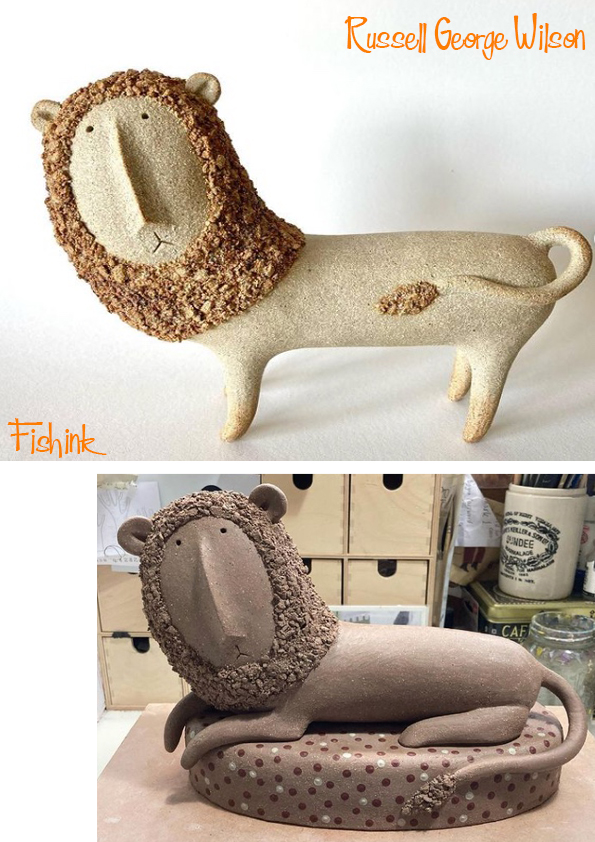
I suppose the best way to describe my animals would be naive but controlled. As for inspiration, I am strongly influenced by the simplistic animal forms found in prehistoric cave paintings, primitive sculpture from early history, my love of folk art and Staffordshire pottery figures/ animals. I also love the naivety of 19th Century carved Noah’s Ark animals, traditional wooden religious toys that were bought out on a Sunday for children to play with (and educate them about the bible). The animals were all carved often by people who had never seen or experienced the animal being depicted, so they were often rather odd or quirky looking, something which I find really appealing. I hope someway I can capture a little of that feeling in my animals.
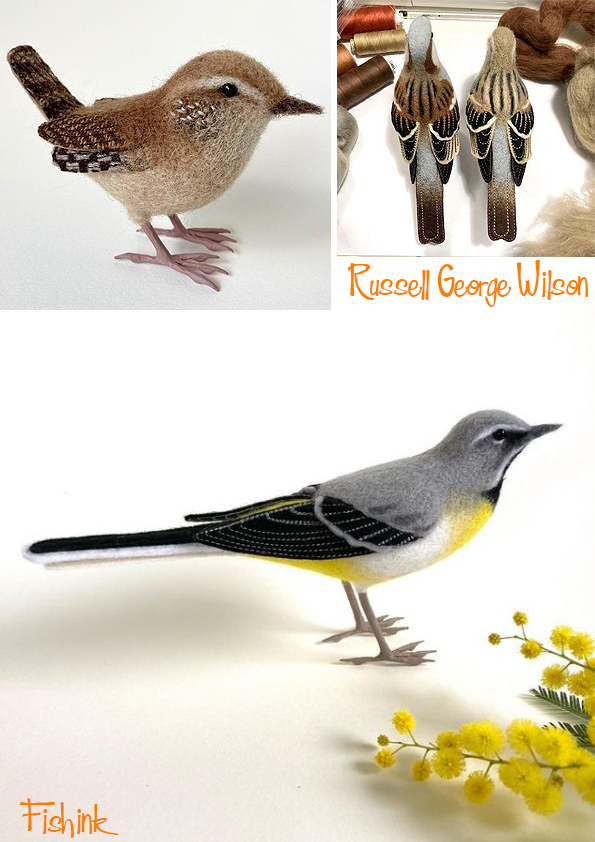
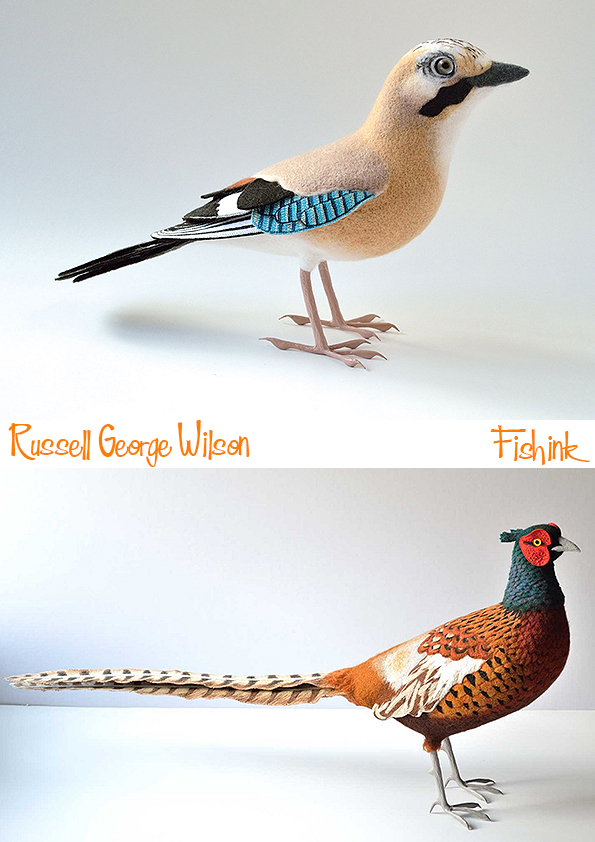
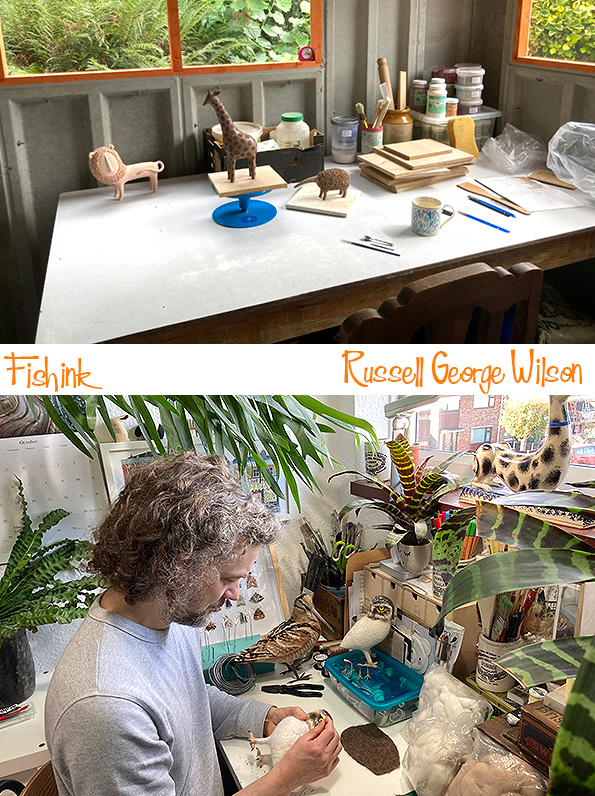
As for my felted birds, I think these are all about detail and being as real as possible, anyone that knows me will know that I love detail and can become quite obsessive about it, so the birds sort of reflect that side of my character, weirdly contrasting with my approach to my ceramics?! The birds were initially inspired by traditional taxidermy, my aim was to make a sort of alternative version that didn’t involve killing anything, but still give a similar effect, something that I think works best with the larger birds I’ve created. I had a phase of putting smaller birds inside glass domes but had limited success with this idea, maybe the idea was a little too Victorian!
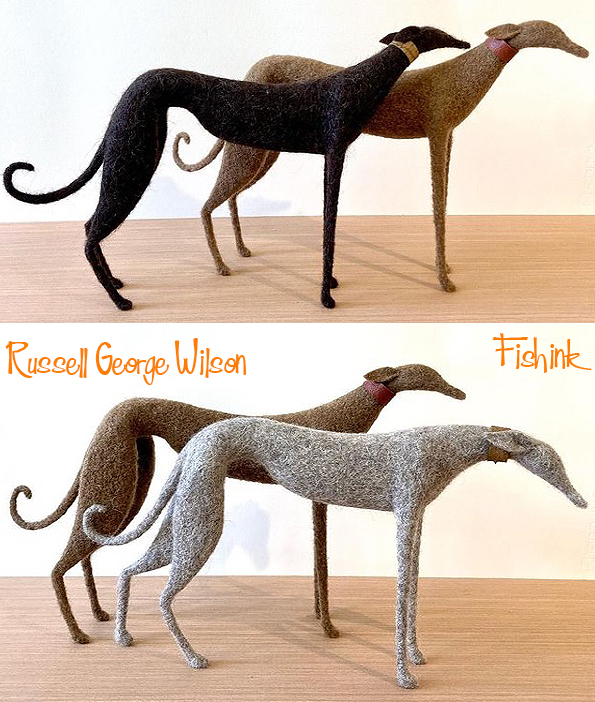
Look at these stunning sighthounds too, another reason I was drawn to Russell’s work !
Do you have a website where people can view and purchase your work?
Yes, I do have a website but unfortunately it needs updating as currently it only shows my felted birds. My website is russellwilson-felt.com I need to update it as it’s not really showing the rest of my work and its a few years old too now. I don’t currently have an online shop either, again this is something I’ve been meaning to get set up. I tend to sell my work mainly through galleries and occasionally I will sell pieces, particularly paintings on Instagram (@russellgeorgewilson). I’m fairly new to social media, I resisted for a very long time as it just isn’t my thing but I now see the benefits as it’s great for getting my work seen by a wider audience and it’s encouraging to get feedback etc.
What part of the making process do you enjoy the most/ not enjoy at all and why?
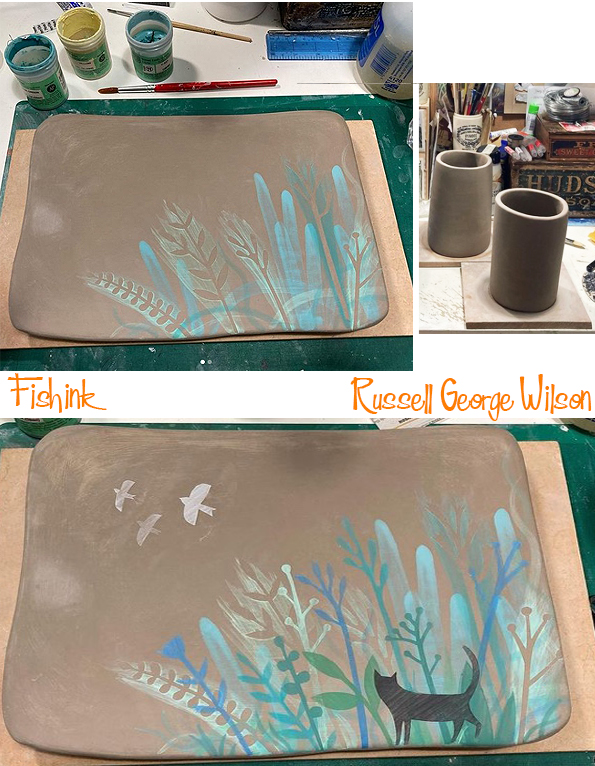
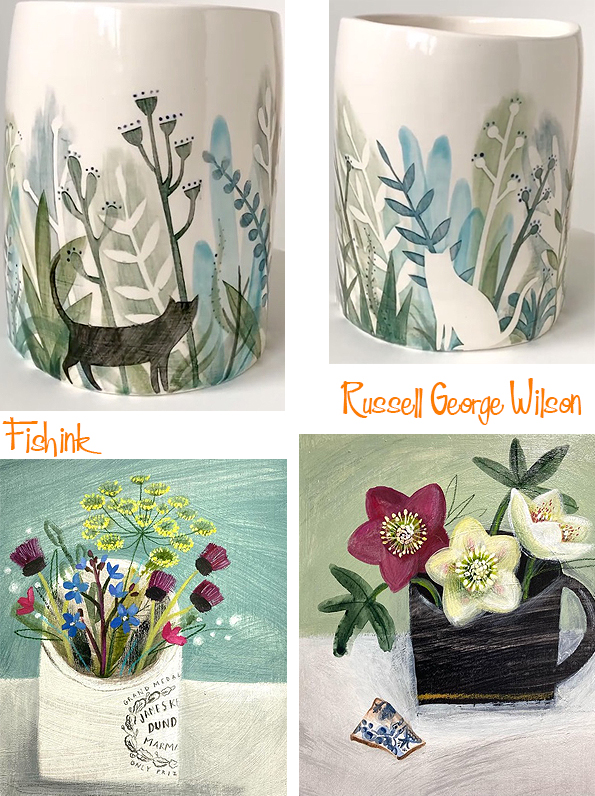
With ceramics, I really enjoy the making process , actually handling and using the clay. I make most of my animals using the technique of pinching combined with random coiling (probably better described as adding small pieces of clay in a haphazard way to build the shape). I’m careful to try and make the inside as smooth as the exterior of the piece, keeping the walls of clay quite thin. When I first started making ceramics my pieces were really hefty and thick but over the years I have refined this!I always think I’m more of a maker than a decorator with ceramics, I often find the glazing/finishing stage quite difficult and often get stuck and really have to think how to proceed so I don’t ruin the piece. I have lately developed a method of using just three different stoneware clays that I make my pieces with and also use the same clays as slips to decorate the animals, avoiding the need to use glazes. Having said that, I do have a couple of fairly reliable matt glazes I sometimes use.
Regarding my felted birds, I actually find the making process quite laborious, it’s basically hours of stabbing wool with a felting needle, very time consuming….anyone who has had experience of needle felting will understand how long it can take, I suppose I take it to ridiculous levels though for the standard of finish I aim for. I must admit that the finished result is what tends to keep me going, particularly when making a larger bird the actual making process can be very long-winded! It’s always great adding the eyes to a bird, I sometimes use glass taxidermy eyes and it’s great when I know I’ve really captured the look of whatever bird I happen to be making. I find pricing my felted birds very difficult as I can never get back all the hours they take monetary, I sometimes think people find them a little expensive, usually the uninitiated who don’t appreciate the amount of work involved.
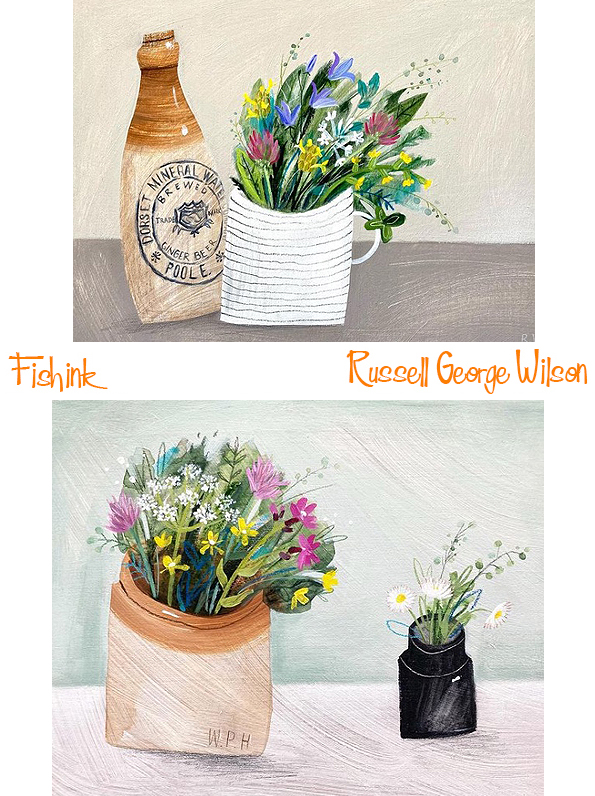
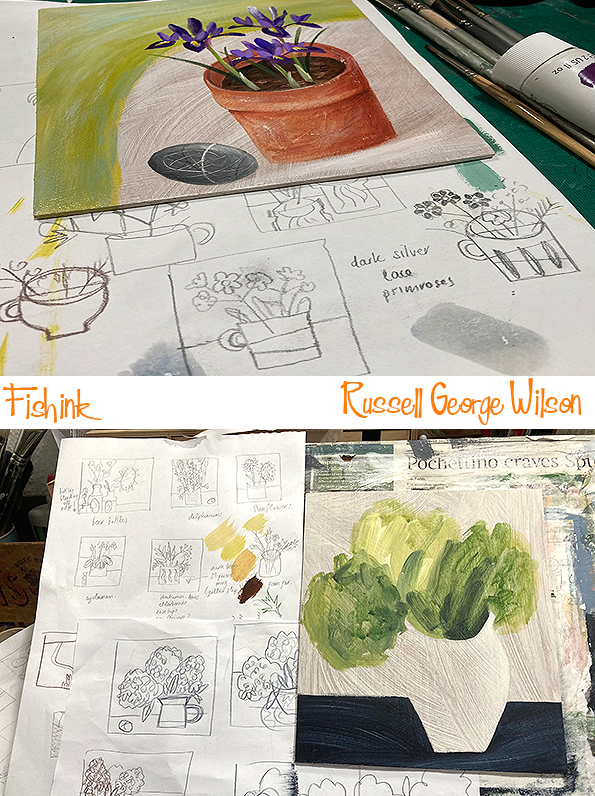
I haven’t really mentioned my paintings yet…..but I enjoy all aspects of painting. I tend to paint still life subjects and landscapes. I love plants and gardening so most of my still life paintings feature seasonal flowers or plants combined with old/vintage pottery, often old advertising ceramics such as Dundee Marmalade pots etc.
My landscapes are more about playing with space and composition.
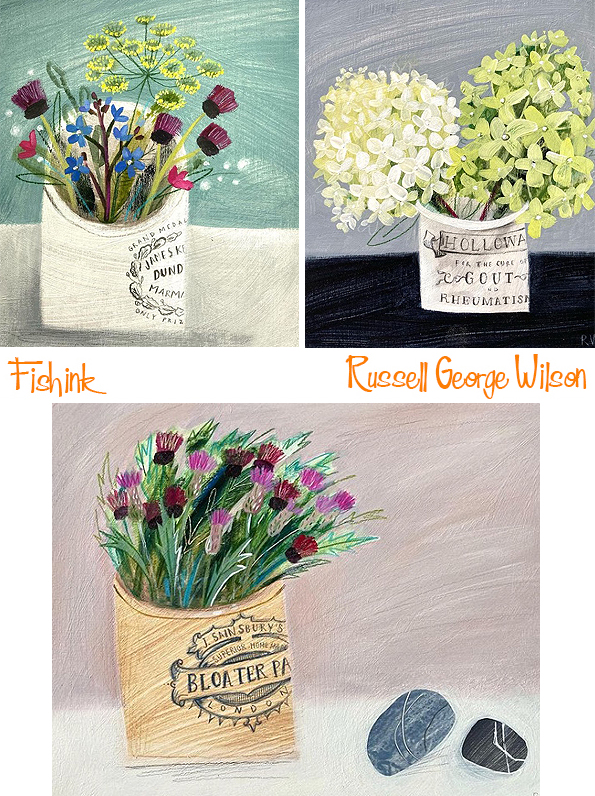
I find that painting can have its frustrations especially on days where nothing goes well and I tighten up and get too detailed. I’m constantly trying to keep a looseness to my paintings but I have to be on my guard not to start adding too much.
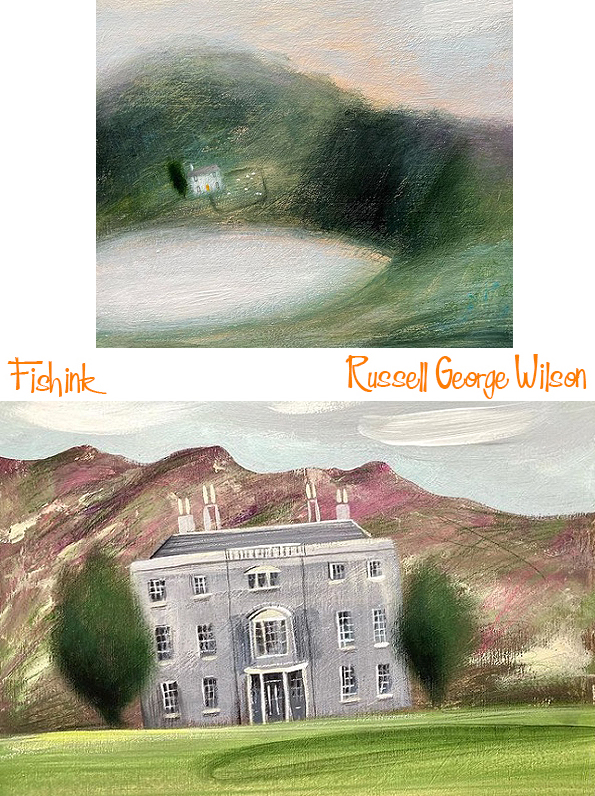
I don’t tend to use sketchbooks for my ideas, I just tend to do rough scribbles or thunbnails on scraps of paper, or just write ideas down. I sometimes wish I could keep a beautiful sketchbook like other artists do but it just doesn’t seem to come naturally. I find I get most of my ideas whilst out walking when my mind can just wander.

And those ‘rough scribbles’ turn into these beautiful creatures.
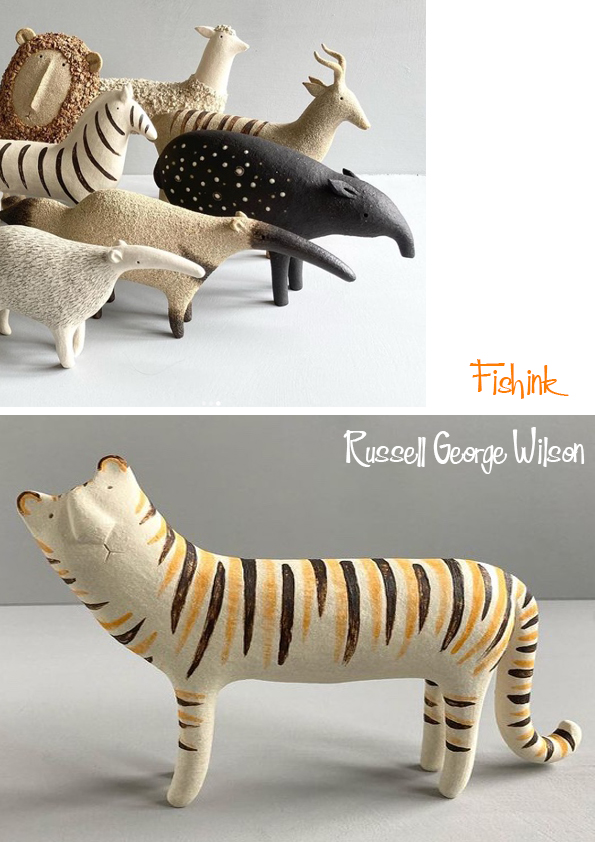
I would so love a Lion or a Tiger from Russell’s animal range. Their curious faces are just perfect !
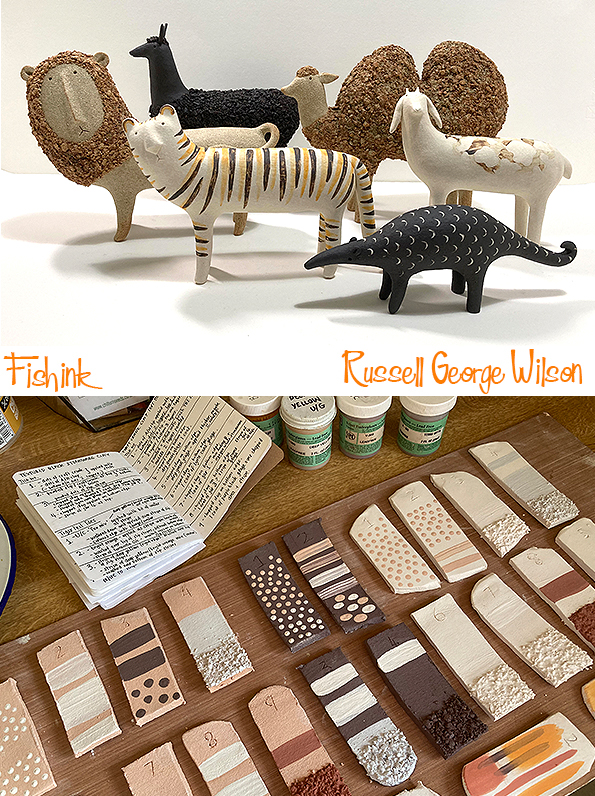
Who’s work do you find inspirational and which artists do you follow regularly?
I love lots of artists work, I’m constantly inspired by what I see in exhibitions, books and on Instagram etc.I love the ceramic work of contemporary artists such as Jane Muir who makes wonderful simplified sculptural figures with amazing colour/ decoration. I also love the ceramic animals and birds by Susan O’Byrne, theses are pieced together from intricately patterned fragments of clay, I have a couple of her birds here at home. I’m inspired by the painter Mary Newcomb, her work is just incredible. I first saw her work years ago when I bought a book about her, but recently I saw her paintings for real at the recent exhibition at Compton Verney. I think she has to be my favourite artist.
Other painters I like include Mary Fedden, Elizabeth Blackadder and contemporary painters Elaine Pamphilon, Barbara Peirson and Vanessa Bowman. I also love the work of illustrator Laura Carlin, she has such a sophisticated but child-like, playful style, she also makes ceramic pieces too which are just wonderful. I follow lots of artists on Instagram, too numerous to mention really….. I think its the best reason to be on there really to see peoples amazing creations. Of course, my greatest source of inspiration for my work has to be nature and the natural world itself.
Where do you see your work going in the future? Either in terms of materials you use, the places it featured or the items you create?
It’s not really something I’ve really thought about, I guess I just hope to continue developing and making good pieces of work that people covert and want! My head is full of ideas, many of them never come to fruition but hopefully there are lots of ways I can continue to develop further. I had wondered whether I should concentrate more on one media, but so far it’s only been just a thought. It would be very nice one day to be able to do a two person or solo exhibition of my work at a gallery when I’ve had a bit more time to expand my work. I’ve actually always fancied having a go at woodcarving…..but maybe that would confuse matters further!
If you could make one thing for the rest of your life, what would it be?
I would like to have the time to concentrate more on my ceramic work as I feel it has potential. It seems to have taken a bit of a backseat lately as galleries have mainly been interested in my paintings and birds. I have had my ceramics in a really great gallery in Derbyshire this year, they sold really well which was good. So far my ceramic animals have been fairly small in scale so it would be lovely to work on some much larger, sculptural pieces maybe. I still feel I have so much to learn about ceramics, the more I learn, the more questions there seems to be.
You have a natural brilliance when working with many different materials, your work is beautifully precise and a joy to behold. What would you say spurs you on to make things and what is important to you when creating new pieces?
Thank you for saying that! Yes, I must admit I’ve struggled with the fact that my work ranges across different media and is difficult to pigeonhole into one thing. I feel like the expectation is to concentrate on one medium as working across many is difficult for galleries particularly to categorise, but working in this way seems quite natural to me. I’ve always just used whatever media feels appropriate, I think I’d feel restricted doing just one. The jobs I’ve done too, particularly being a greetings card illustrator were very varied and so I suppose I just like variety!
I think I’m just spurred on by an inbuilt need to create things and by the urge to keep improving and developing my work.
Well Russell I can honestly say that I think you should continue to work with whatever mediums you feel excite and interest you. As long as you can sell and show all the different work through different galleries, shops and your website / Instagram account, then there is no reason to be restricted.
What do you think readers ?
Krystyna Turska Children’s Book Author / Illustrator
Krystyna Zofia Turska was born in 1933 and spent her childhood in Poland until World War II.
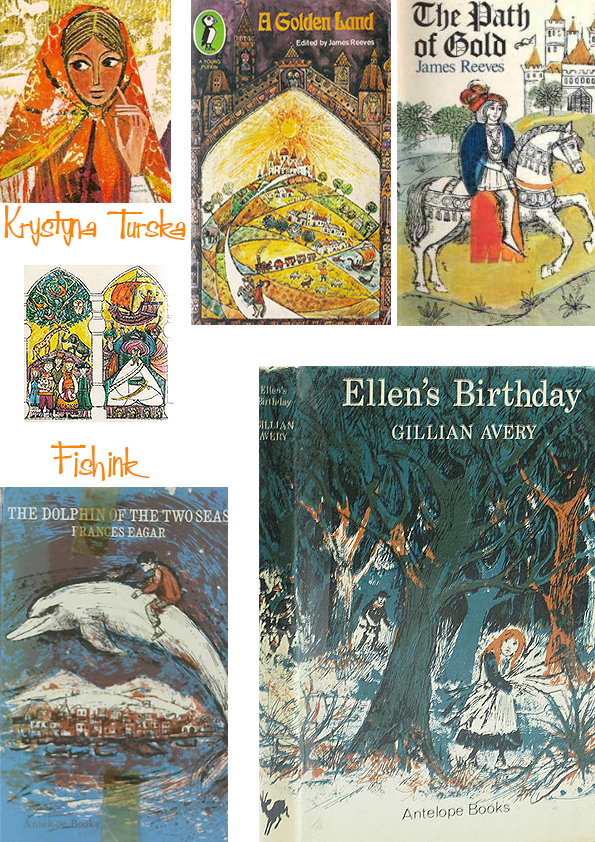
In 1940, Krystyna was arrested with her family and taken to a concentration camp in Russia. She escaped to Persia and finally reached England in 1948.
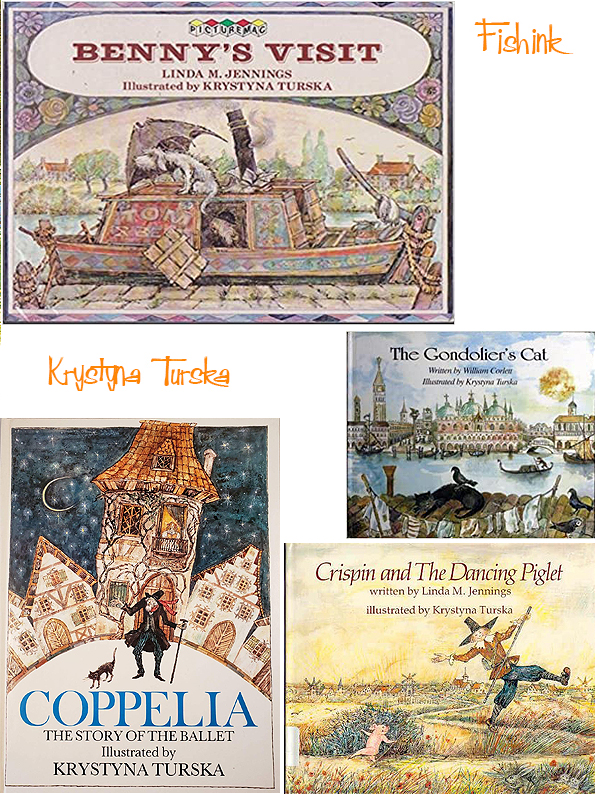
Krystyna studied at the Hammersmith School of Art and became an illustrator and author of children’s books.
Here are a few of her many titles.
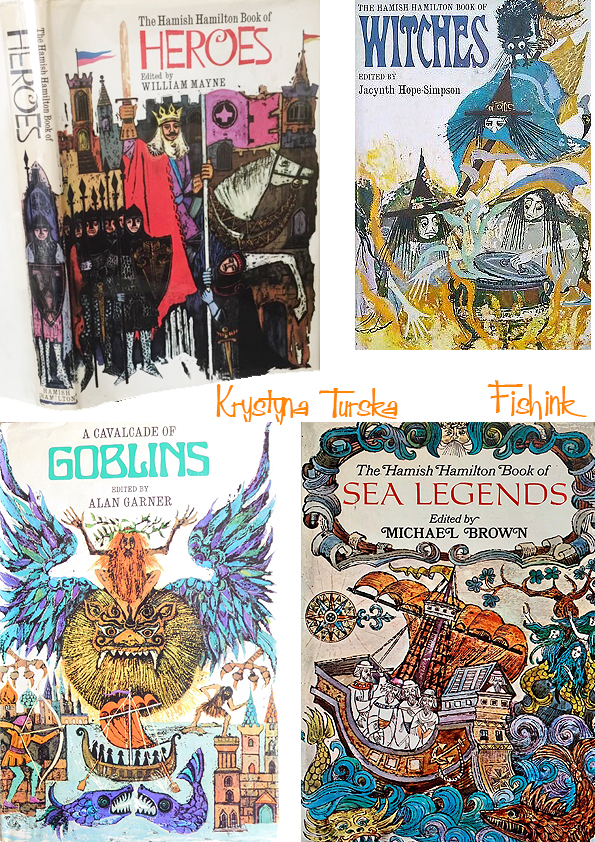
She had a long and prolific career in illustration and worked as an author too.

Like many other illustrators working at this time, she has a variety of bold and ornate styles to suit each different publication.
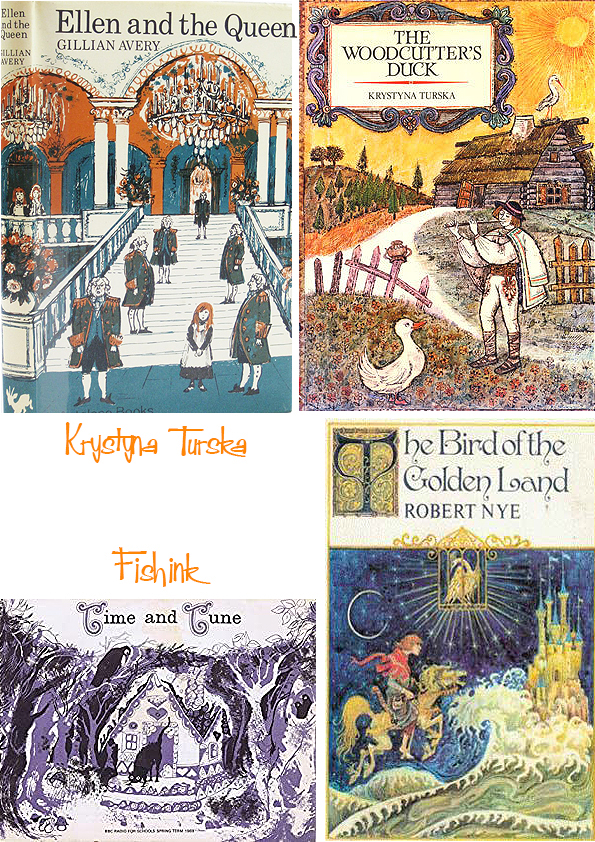

Krystyna received a Kate Greenaway Medal for The Woodcutter’s Duck.
Some of Krystyna Turska’s books include:
Coppelia the Story of the Ballet (1985)
How the Camel Got His Hump: And How the Whale Got His Throat
The Elephant’s Child
The Woodcutter’s Duck (1972)
A Cavalcade of Sea Legends (1971)
A Cavalcade of Goblins (1969), A Cavalcade of Witches (1966)
A Cavalcade of Dragons (1970)
Marra’s World (1975)
The Mouse and the Egg (1980)
The King of the Golden River (1978)
Tales From Central Russia (1978)
The Trojan’s Horse (1968)
Here’s a few black and whites.
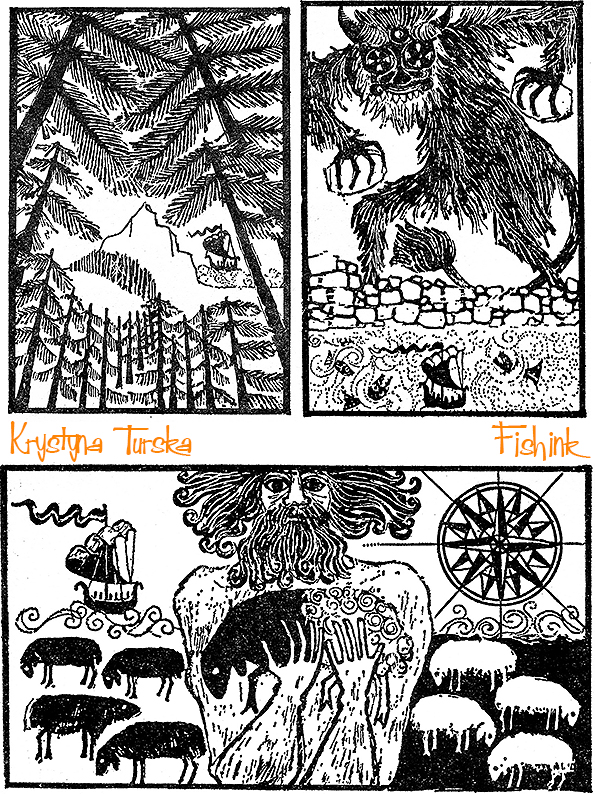
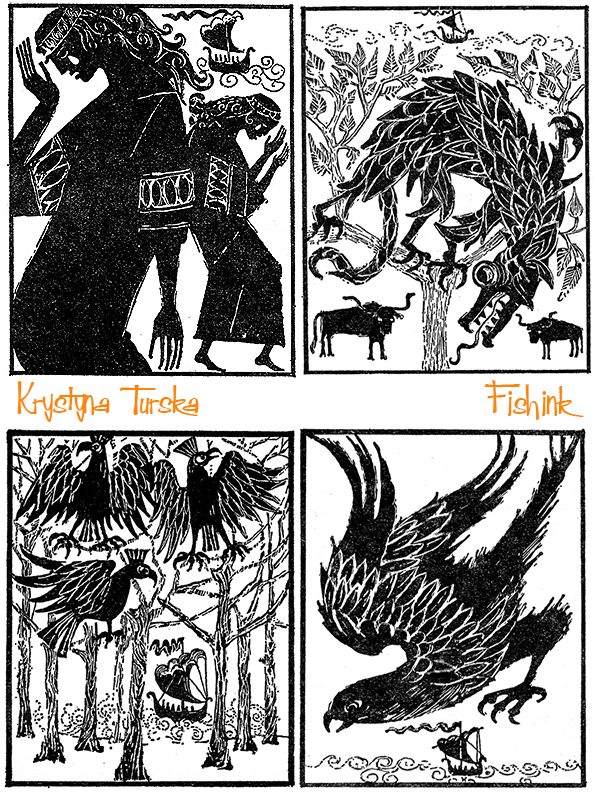
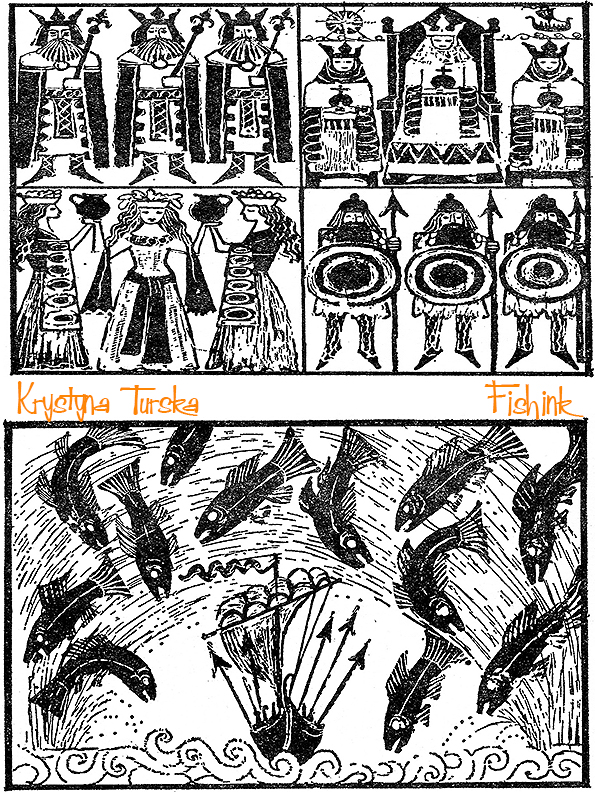
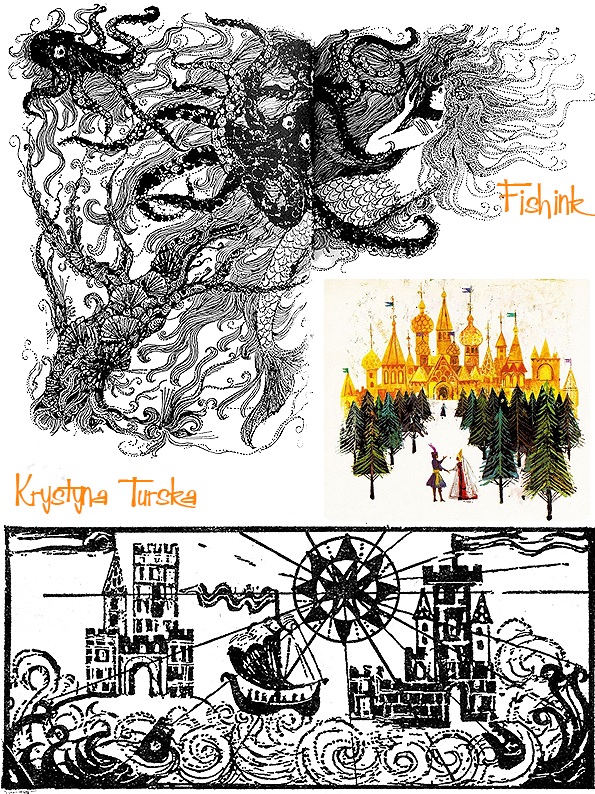
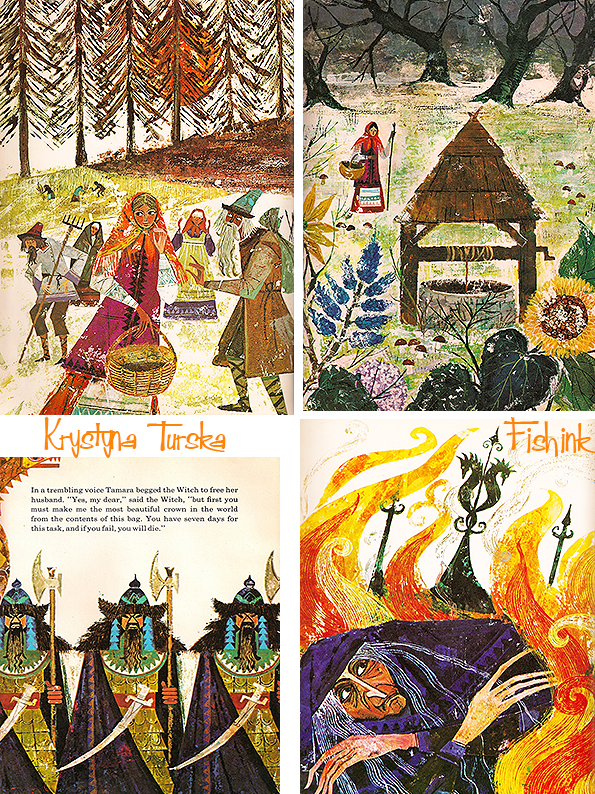
Some wonderful painterly textures here.
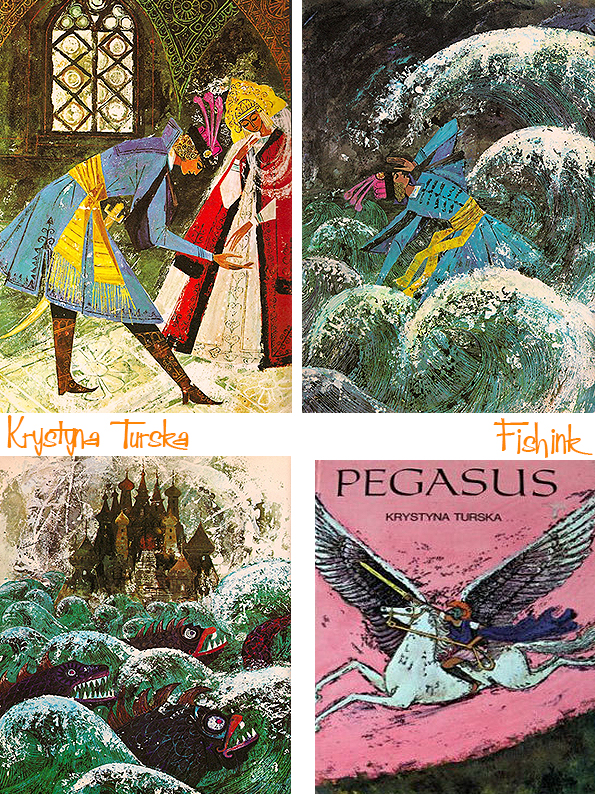
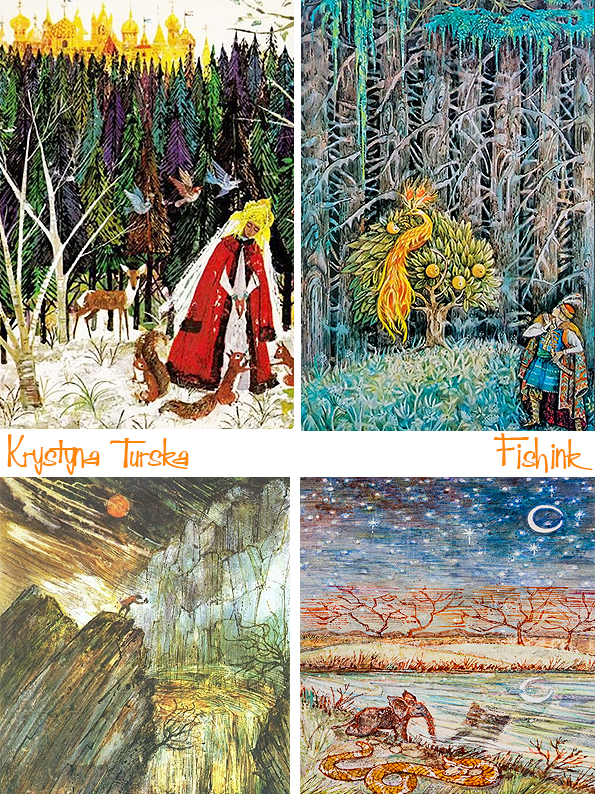
I couldn’t find anymore information online, so if anyone else knows more about Krystyna and her work, do get in touch. Thank you.
Jenny Southam Creative Ceramist
Jenny Southam gained a Fine art degree and a Post-Graduate Diploma at Bristol Polytechnic (now UWE), specializing in work in bronze. She now lives in Exeter and creates her terracotta, individually hand-built figurative sculptures from her home studio. I fell for her fabulous work last year and have wanted to introduce her here to my readers ever since. I’m very happy to say that we recently managed to make it happen.
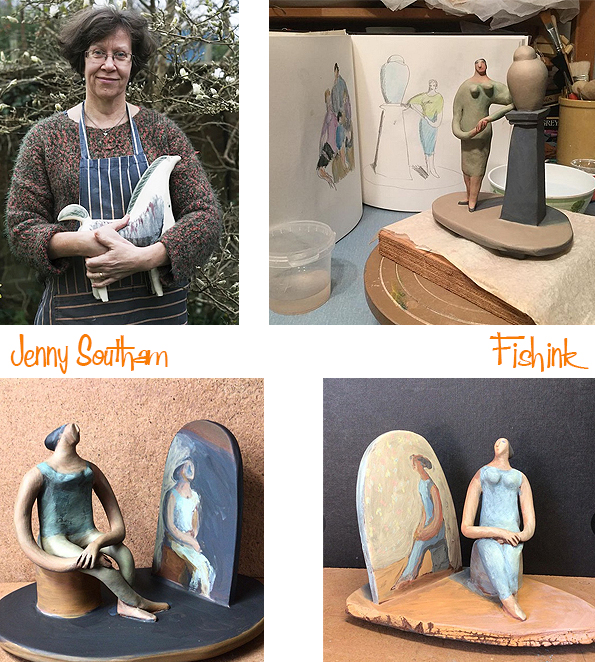
What are your first memories of making art ?
I remember that my mum kept scrap bits of paper in a brass coal scuttle box on a hearth, which was my go-to place for raiding and drawing on in my very early years. When I was five we moved to a house which had an area that we called the ‘clay patch’. My brother and I played here for hours and would dig up this white clay to make things out of. Once we made a large collection of Egyptian-like artefacts out of the clay and grass there, and organised them into an exhibition. I loved all manner of crafts as a kid, in many materials. Every time I went to the local library on the Saturday I would always bring back a book on some craft activity.
Let’s talk knitting patterns.. where did this lovely idea first originate ? We’re you or your relatives a knitter previously ? I love the idea of the film company possibly using them too !
I’ve collected vintage knitting patterns for a few decades now, just for their quirky imagery. But it was only a couple of years ago that it came to me that I could use this imagery as a starting point for my own figurative ceramic work. They are a very individual and unusual historical phenomena in that they show models, obviously showing off the knitwear, but also set often within a scene or environment, either indoors or outdoors. This might be a garden or park, an art gallery, cafe or a living room.
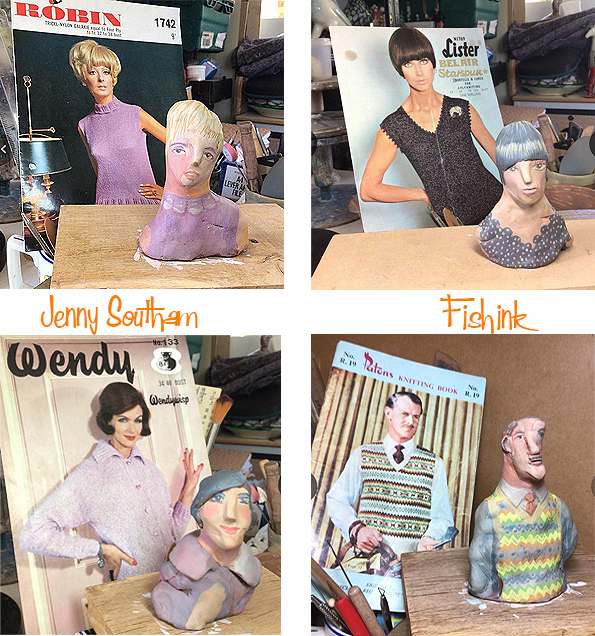
They sometimes have props; for example an umbrella, a drink, balloons, a horse, a bunch of flowers, and also the inevitable pipe for smoking. They create fascinating tableaux within which a possible narrative unfolds. I previously created narrative ceramics anyway, but these wonderful pamphlets provide rich source material for further exploration.
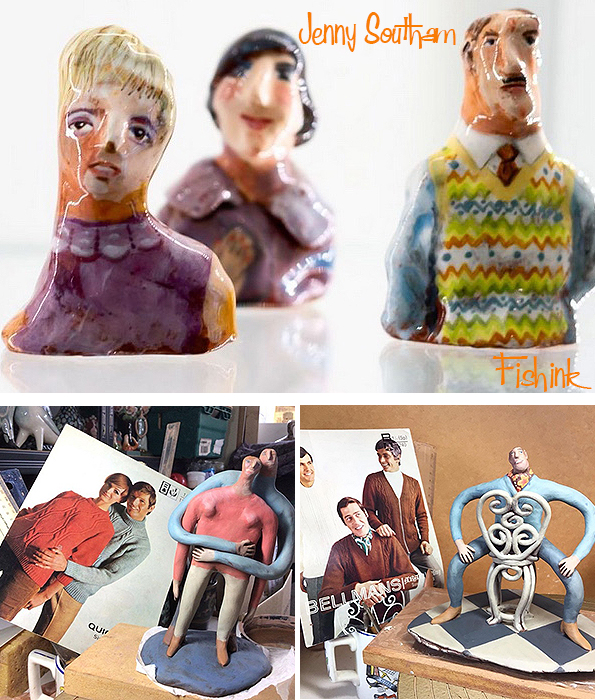
My mum would knit us all jumpers and cardigans, although there were six of us kids and so she never had the time or resources to be very experimental with her knitting. They were functional and hardwearing. I would have given my eye teeth for a nice synthetic shop- bought school cardi rather than a rather chunky home-knit! One day recently I was made aware that an American film company had bought a small series of my ceramic busts (head and shoulders), based upon knitting pattern models, and that they wish to possibly use them in a forthcoming film based on the ‘Wool’ trilogy by Hugh Howey. Very exciting news, although having read the first book I’m not exactly sure where these little people would fit into this dystopian setting. There is very little directly to do with actual wool. Watch this space!


I see you use sketchbooks to draught out your ideas first. Do you always work in this way and does it help you ‘see’ your sculpture in a 3D form by working intially in 2D ? Do you ever work straight from an image in your mind or do you always prefer to sketch the ideas first ?
In fact I usually dive straight in to making the clay sculptures directly either from my imagination or more latterly straight from the knitting patterns themselves. I might make a series of small maquettes first, before more ambitious pieces. I am too impatient often to makes sketches, collages or paintings first, although when I do give myself permission to play two-dimensionally I enjoy doing them hugely. I feel that I should be working in clay all the time, which is ridiculous really, as in fact I feel that my clay work benefits from the process of initial two-dimensional interpretation first. What I would love is a dedicated painting/ drawing/ collage studio that I can go and immerse myself in at any time and not have to tidy things away in between times. But I guess that’s the same for many of us.
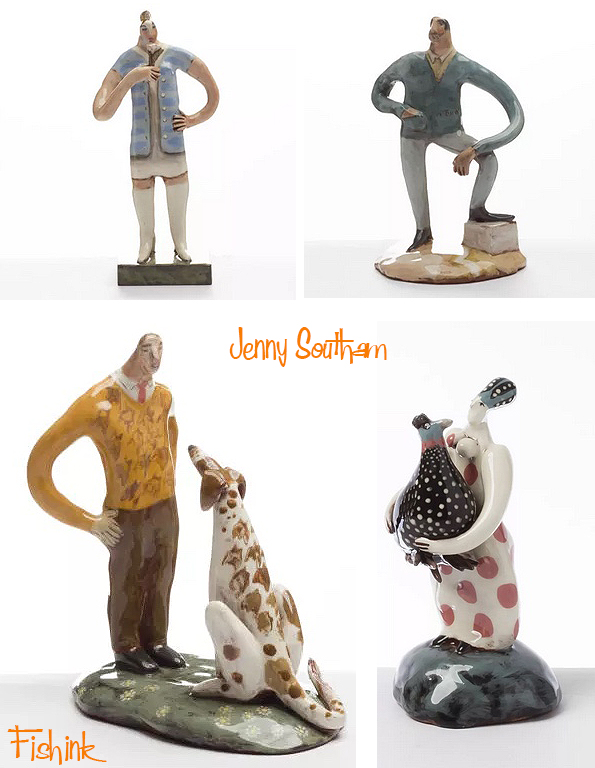

What are your favourite pieces to presently make and why ?
I must admit that I’m a bit of a butterfly and like to have a period of making, say, large cats, and then have some time making small narrative pieces, and then my Knitting Pattern Folk, and then maybe making some stock for galleries. In truth I would want to be making all of these things all of the time, as I love making them all; but that’s not feasible. I am extremely invested in the Knitting Pattern Folk however. I feel that I have only scratched the surface of all the many possibilities that they offer. I love their ‘staginess’. The theatricality and nonsensicality of the tableaux produced. Each figure I make seems to have their own personality which moves me somehow.
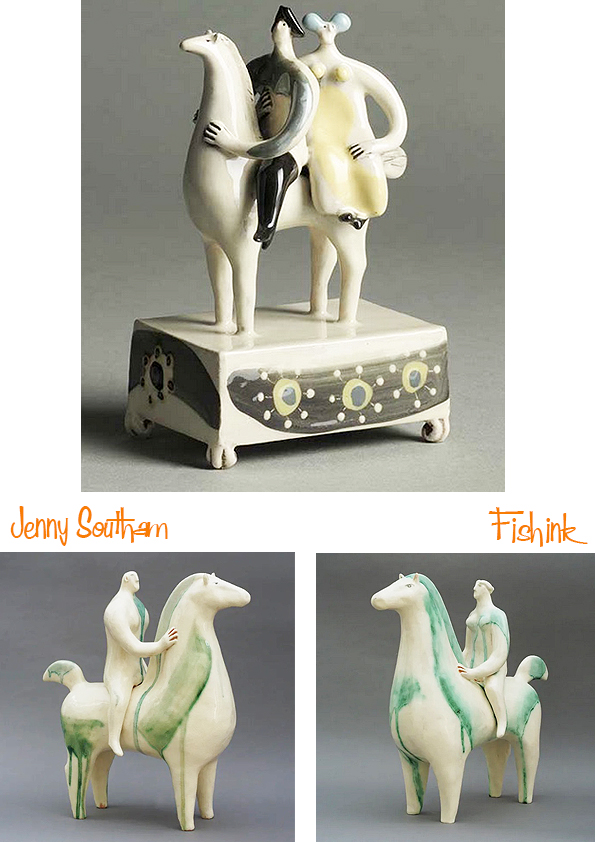
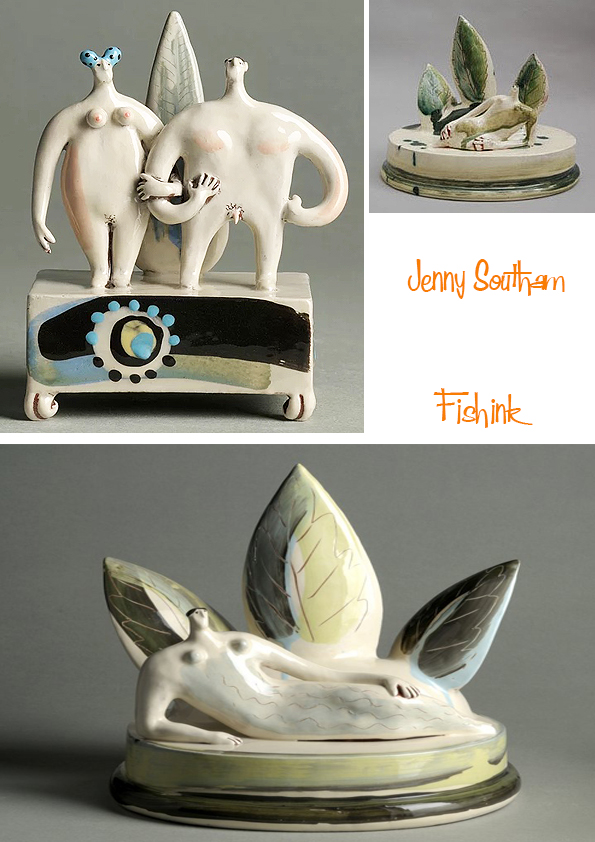
What would be your fav and least fav part of the making process and why ?
My favourite part of the process is the handbuilding. Constructing something out of a lump of clay is both an easy and a very challenging thing to do. I’m always amazed when I go to ceramic fairs and see the most astonishing variety of creations that once started as muddy stuff dug out of the ground. It has such a history to it as well, and I love to see artefacts that were made and used, or given some purpose tens of thousands of years ago.
So I like to make my figures and animate them with some personality or inflection which I feel gives them an emotional resonance. As to the least favourite, I sometimes find applying colour to them difficult, and I can dither around a lot before I know how I am going to approach it. I used to work in bronze before I turned to clay, and the monochrome qualities of this medium proved much more straight forward. But actually in answer to your question glazing has to be one of the most exacting, yet boring processes to carry out.
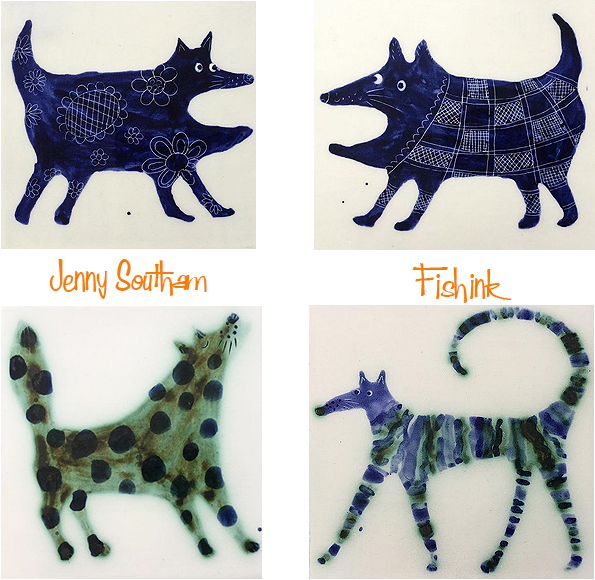

Are your figures all hollow inside and if so what ‘tricks of the trade’ to you use to help ensure they remain upright ?
The small figures are usually solid. A rule of thumb is never to make work that is thicker than an inch or else they might blow up in the kiln due to thermal differentiation. I sometimes go a bit thicker than this but make sure
that I take the temperature of the kiln up and down slowly to accommodate this. Bigger work I make hollow, and tend to roll out slabs of clay and piece them together. I use good old fashioned scrunched up newspaper to fill in the forms to stop them caving in, and the odd wooden block to prop elements up until they are dry enough to take their own weight.

I’ve read that some of the inspiration for your work comes when you are gardening. Are there other times when ideas pop into your head for suitable new pieces to make and do you have to jot them down there and then, to
keep them from slipping away ?
Many of my earlier works were concerned with the domestic rituals that we carry out. For example; giving a haircut or planting seeds, making a bed or talking to a friend. This early era coincided with renting an allotment; the potential of which excited me hugely and so the idea of growing things became important within my work. As I work on one piece, I always get ideas during the making process for more possibilities and variations. So ideas evolve and I will jot/ draw the ideas as I go, or else, like dreams they might easily evaporate!


Are there any future creative lines that you are thinking about and can share with us today ?
I had a run a few years ago of depicting narratives based on some personal family stories. I would like to return to this area and explore some family history in a visual way.

Who or what would you say are your modern day influences ?
It depends how modern we are talking about here. I am a huge fan of Mid-Century European Modern. In fact I want some time to read through the posts you have written here on Fishink Blog about artists from that era. But I particularly enjoy English, Italian and Northern European art and design. If you are wanting more recent influences, there are a large amount of extremely talented ceramicists producing incredibly exciting work that I very much admire. But I’m a bit of an old fashioned gal and tend to be more influenced by seventeenth century English flatbacks and slipware, and Greek and Roman sculptures than contemporary work.

Where do you see your work going in the future ?
Hmmm. Interesting question. I feel extremely privileged to be able to make ceramic work in the first place. All I really have on my horizon is to continue making and creating; either in clay, or in other media. And also to keep
pushing to make it go forward; to keep it fresh and developing. I’m not much good at talking about my work, but feel that if the work speaks to people, and enriches their life in some way, as it does with mine, and continues to do so, then I’ll be happy. The other thing that I would like to do is collaborate with other makers. Working in a studio can be a solitary business, and there are several people that I would love to work alongside to explore various ideas.
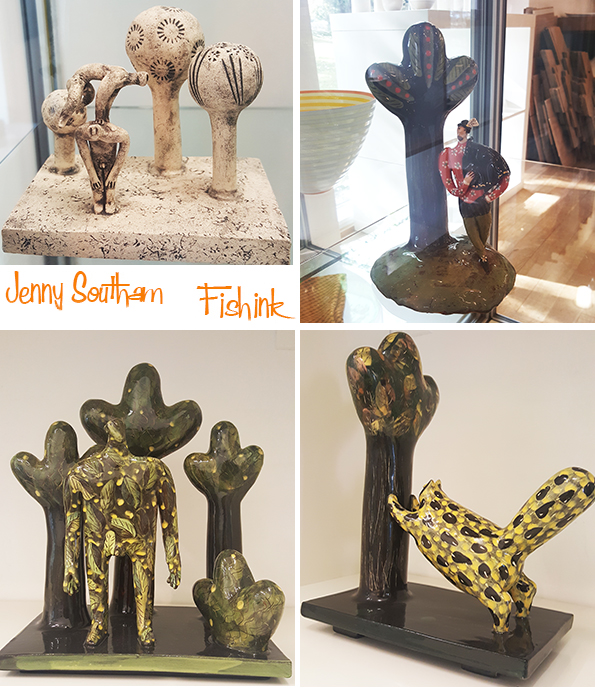
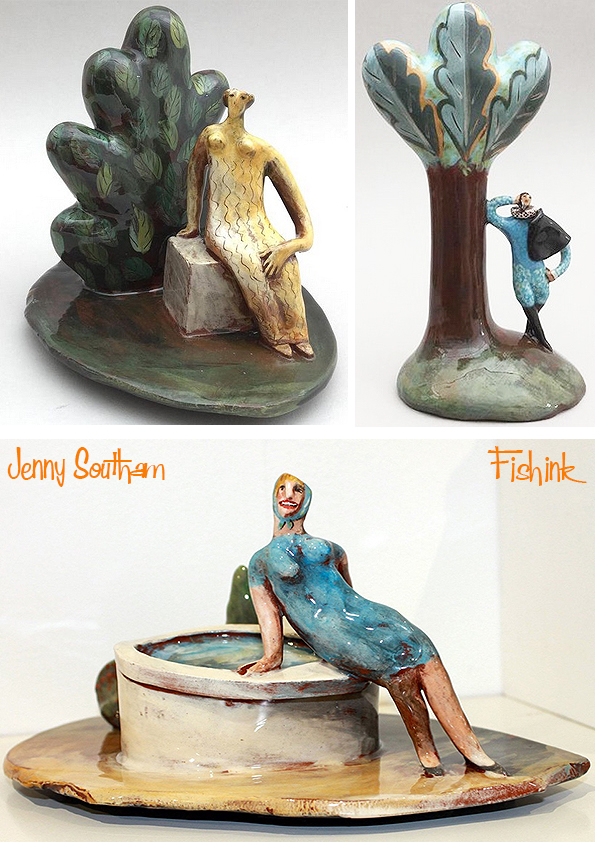
I recently visited the Ruthin Craft Centre in Wales amd saw these pieces of Jenny’s work up close. Such a great experience ! Many thanks Jenny for making the time to contribute to Fishink Blog. I’m sure many more new followers will be as excited about your work as I am, don’t forget to follow Jenny over on Instagram @jennysoutham I for one, look forward to seeing what new folk emerge from your creative thoughts and knitting patterns.
Sylvia Leuchovius Mid century Ceramist
Sylvia Leuchovius (1915–2003) was one of Sweden’s leading ceramic artists in the 20th century.
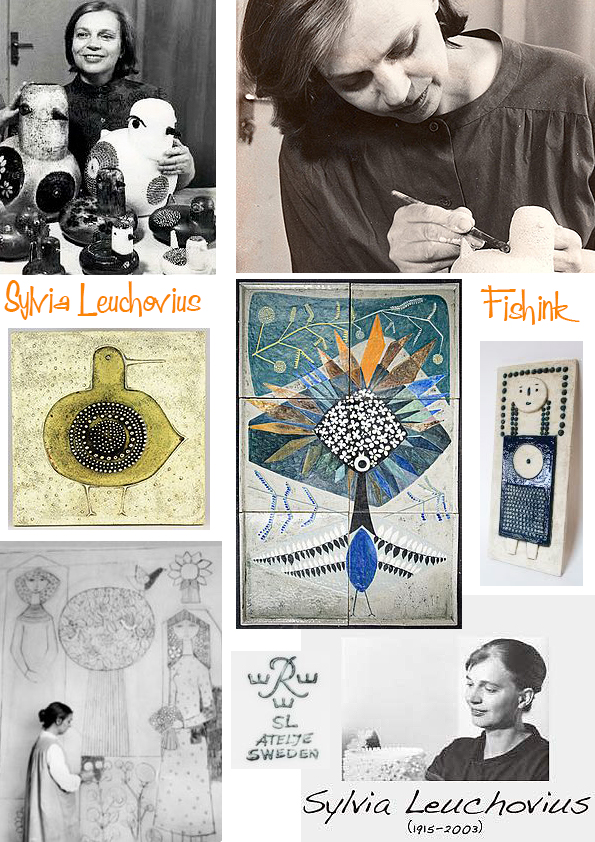
She was part of the Nordic design tradition aiming for warm-hearted, humorous, and sometimes subtly ironic design.
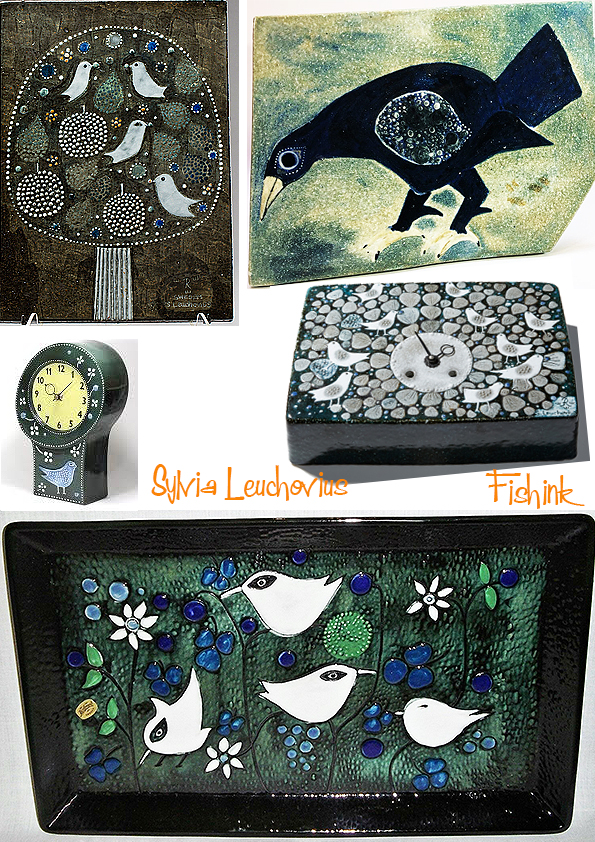
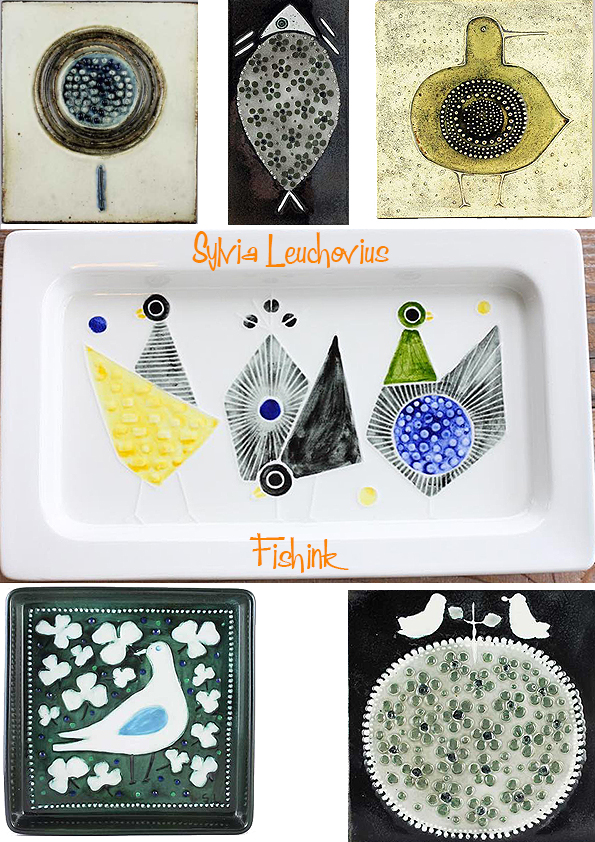
After her studies at ”School of Design and Crafts” in Gothenburg, Sylvia worked for the Rörstrand factory for more than 20 years.
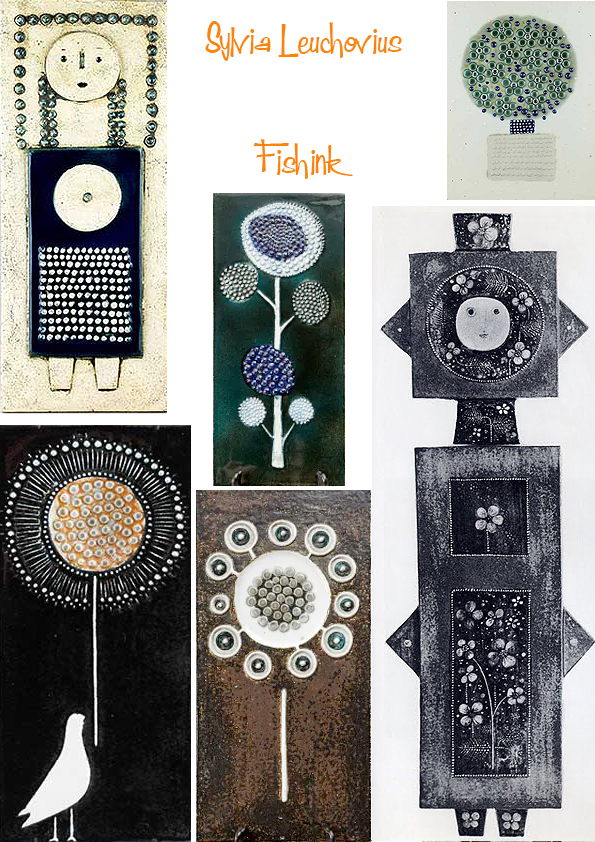
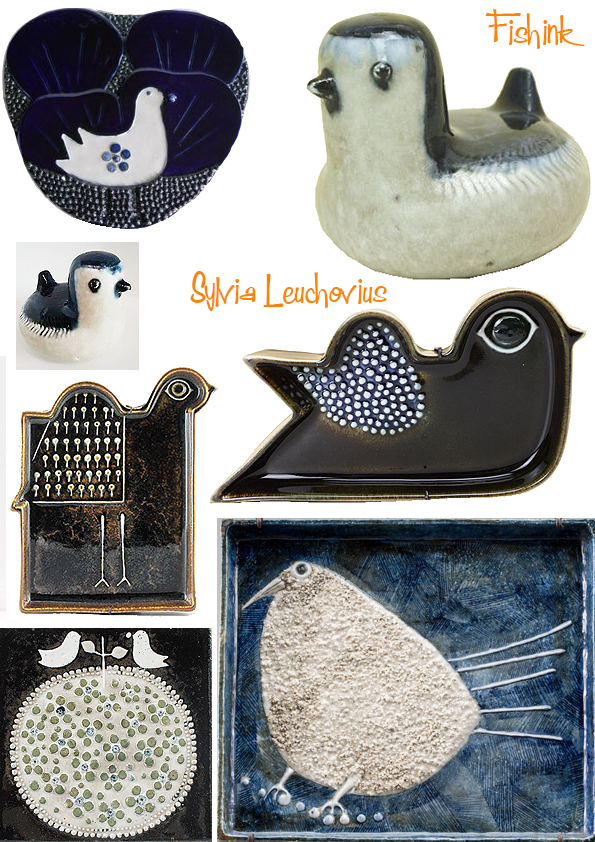
She became a prominent designer of figurines, wall plaques, and tableware – often with stylistic animal or plant motifs.
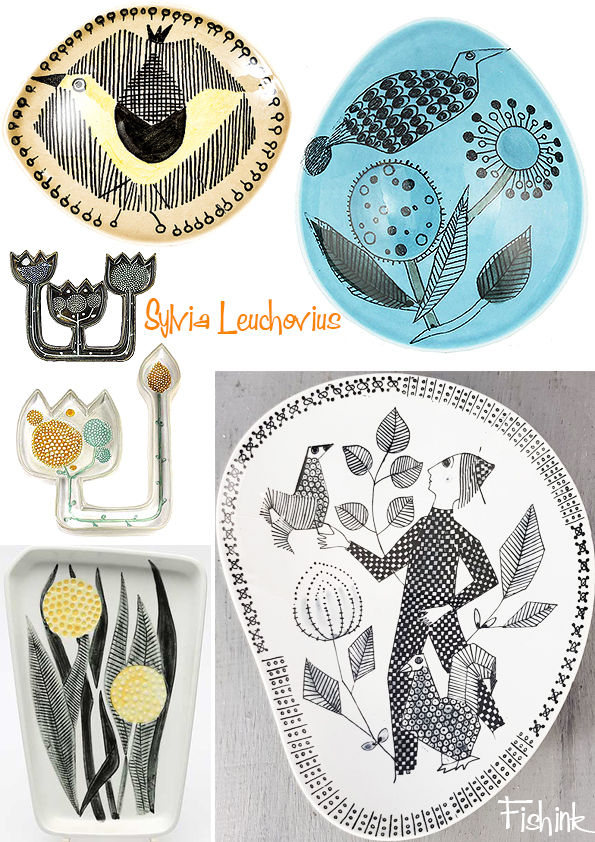
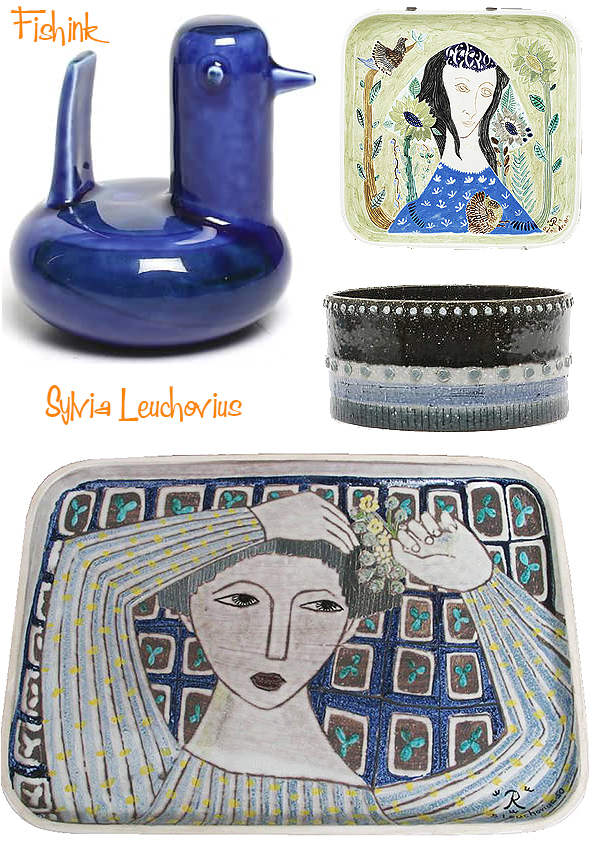
Sylvia’s artistry is represented at the Swedish National Museum of Art and Design.
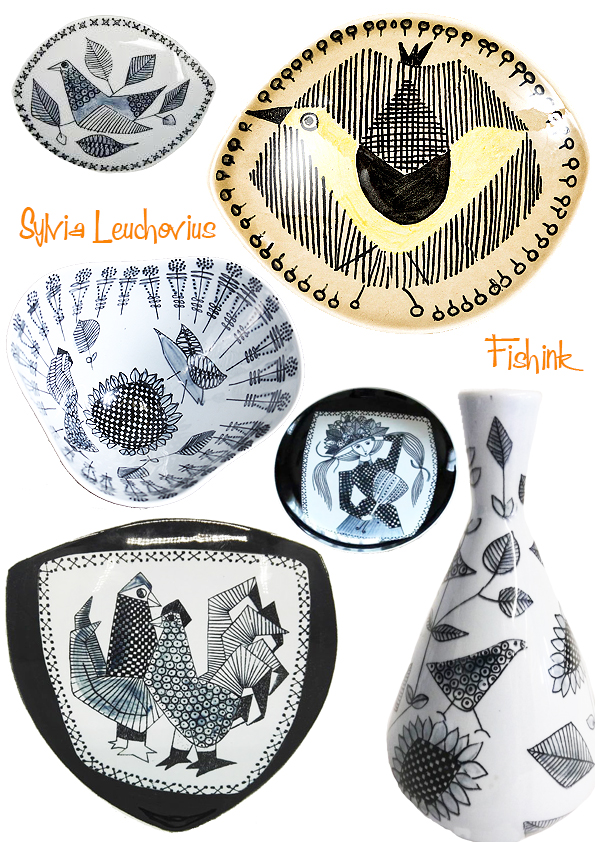
Such a fun and quirky style.
Gareth Floyd Author and Illustrator
Gareth Dennis Floyd, was born at Whiston, Prescot, Lancashire in 1940. I first came across his work through a copy of Finch’s London. The book is an oddity as guide books go, presenting London as a varied selection of pubs with some interesting sights in between ! His illustrations draw you in and offer an artist’s view to accompany the guide’s descriptions.
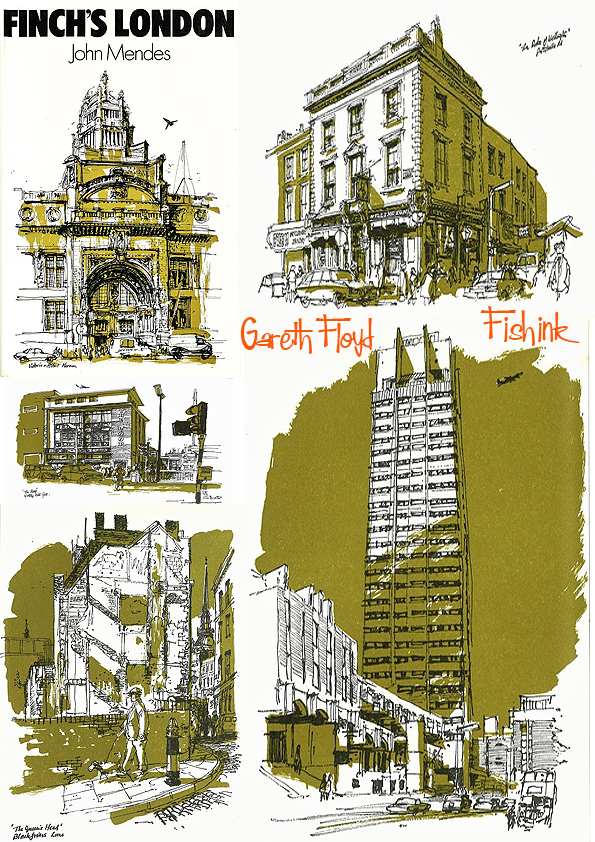
Gareth spent his childhood at Halesworth, Suffolk and studied at Lowestoft school of Art under Eleanor Doris Varley.

Gareth Floyd is a published author and an illustrator of children’s books and young adult books and illustrated a series for Penguin Books during the 70’s and ’80’s.

The credits of Gareth Floyd include ‘The Whispering Knights’, ‘The Midnight Fox’ (Puffin Modern Classics), ‘The Real Live Dinosaur and Other Stories’, and ‘The Night-Watchmen’ (Lythway Large Print Series) .
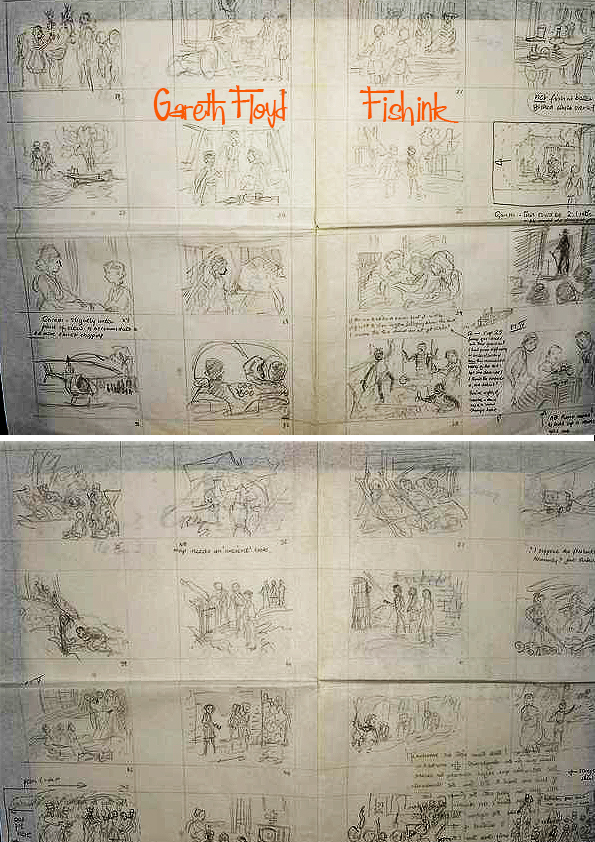
He is probably best known for working on Jackanory, (a BBC TV children’s story show), as an illustrator.

Often someone would narrate a story whilst Gareth illustrated a scene from it. Gareth worked on the series for nearly 15 years. Here are some of the ones used on the programme.
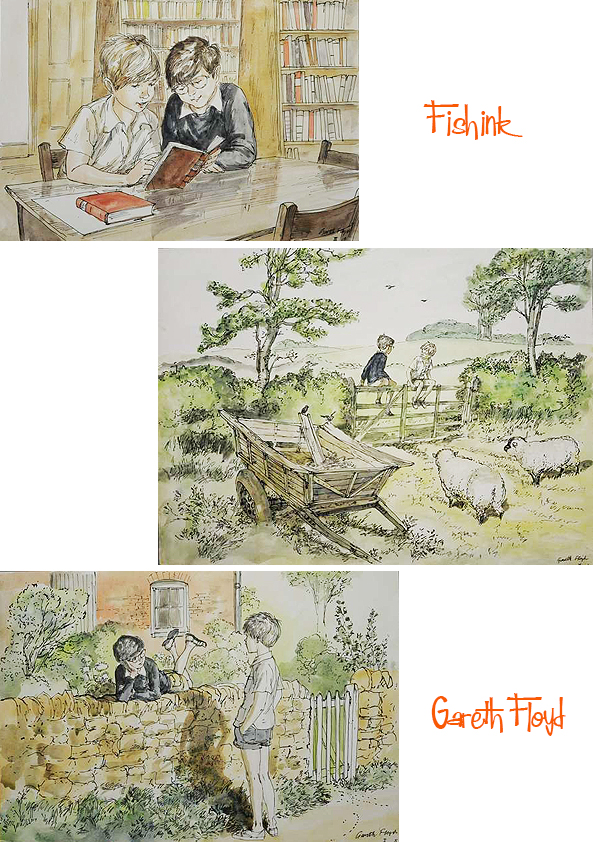
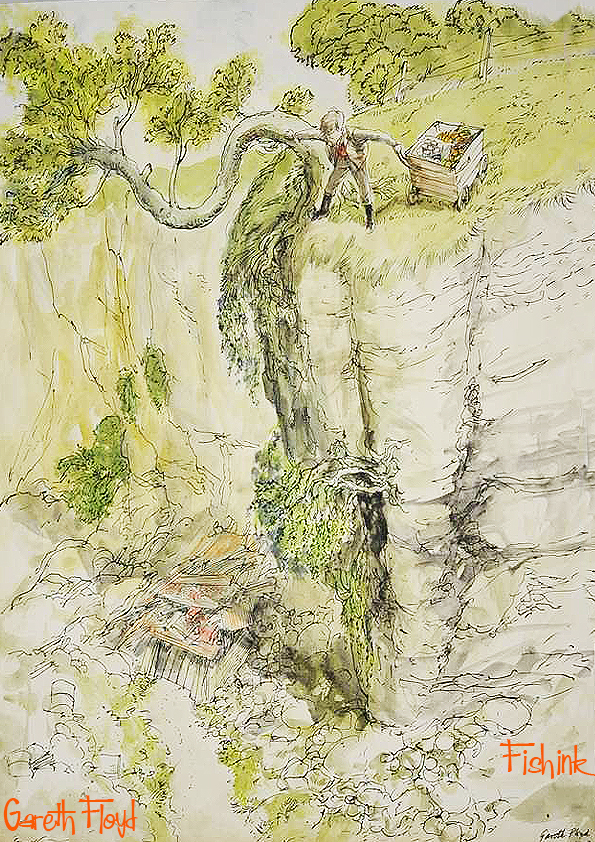

Some viewers recall the effect that the drawings had for them at the time, so with books like ‘Stig of the Dump’ by Clive King, they said they could clearly visualise the characters mainly because Gareth’s drawings made them come to life.

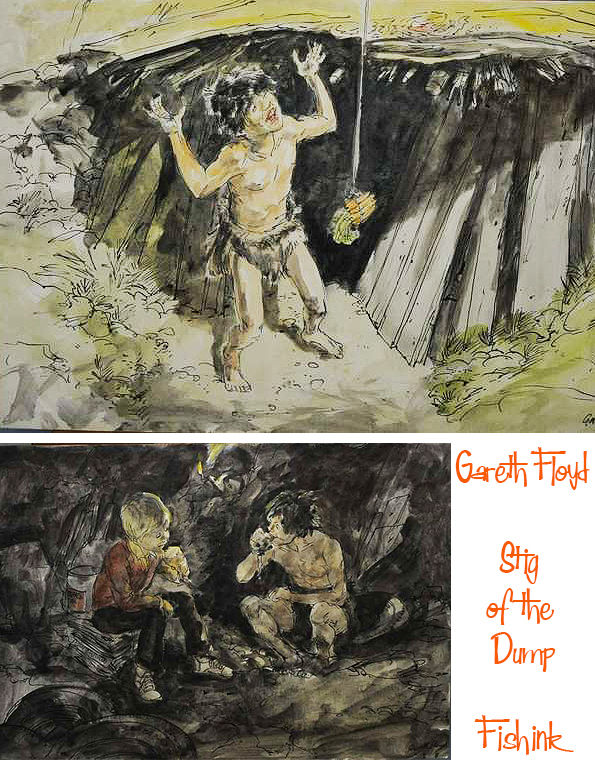
His iconic Jackanory illustrations (about 1,200 of them) were sold by auctioneers Ewbanks only last week and some of you bought a piece of their childhood history ! Gareth was also a popular choice with the publishers to capture a child’s or perhaps a parent’s imagination with a great cover illustration. Here are just a few.


It seems that some publishers at the time, thought the title of the book had more impact, if it began with the word ‘The’ !


He also has an interest in railways and modelling. He married at Guildford, Surrey in 1965 with Penelope Dean and is still living in Guildford now.


Another talented artist from my childhood days. How many of these covers do you remember ?
Bernard Cheese From Fisherman to the Fields
Bernard Cheese (1925-2013) was born in Sydenham, Kent and went on to train at the Beckenham School of Art. In 1947, he enrolled at the Royal College of Art. There, Cheese’s enthusiasm for lithography was fired by Edwin La Dell, who had set up a lithographic workshop modelled on Parisian ateliers. La Dell encouraged Cheese to go out into the streets to record London life in the markets, pubs and parks and to mingle with the crowd, sketchbook in hand, and observe. Over eight decades, Cheese became an enthusiastic observer of British society.

At the Royal College, Cheese met a fellow student, Sheila Robinson, the Nottinghamshire-born printmaker and illustrator. They married in 1951 and set up home in Beaufort Street, Chelsea. Both artists worked on Festival of Britain murals alongside their art-school tutor and close friend Edward Bawden. Bernard’s mural was in the Shot Tower (demolished to make way for the Queen Elizabeth Hall), it was called Kaleidoscope and circled the tower. The boards they were painted on have been lost and are presummed to be destoryed. It was at this time Cheese was getting work as a commersial artist with a set of posters and decorations for London Transport and printed by the Baynard Press.
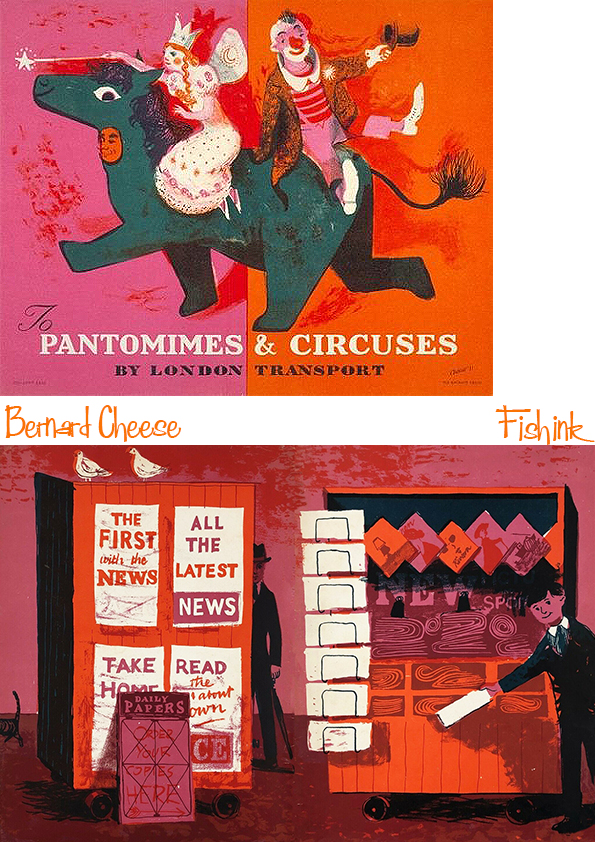
Their first child, Chloe, now a celebrated artist in her own right, was born in 1952. Bawden introduced the couple to Great Bardfield, a village in Essex. In 1953, they moved to Bardfield End Green at Thaxted, where their son, Benjamin, was born the following year. Cheese established his studio at a former fish and chip shop in Great Bardfield. Both he and his wife taught printmaking at London art schools: Cheese at St Martin’s School of Art (1950-68) and Robinson at the Royal College.


Great Bardfield was a quintessentially English village – a thriving community with butcher, ironmonger, grocer and, remarkably, a close gathering of artists who, by design or happy coincidence, lived and worked in or around the village. The Cheeses would soon enjoy their friendship and support, contributing to regular “open house” exhibitions. Among their artist neighbours were Edward and Charlotte Bawden, John Aldridge, George and Kate Chapman, Michael and Duffy Rothenstein, and the textile designer Marianne Straub.


In 1957, Bernard and Sheila separated. The following year they were divorced and Bernard married his former student Brenda Latham Brown. They moved to nearby Stisted, where their daughters, Joanna and Sarah, were born. For a studio, Cheese rented a Sunday school room. The 1950s and 60s saw great innovation nd diversity in British printmaking. Lithography had become the favoured medium of the younger generation and there were more opportunities to publish and exhibit prints. Cheese was now showing as far afield as Beijing (1956), Stockholm (1960), Washington DC (1962) and New York (1968).


A regular exhibitor of fine art prints, he also worked on commissions for poster designs and illustration. In 1951, London Transport commissioned the first of several posters, Pantomimes and Circuses. La Dell asked him to contribute to Coronation Lithographs, a portfolio of 40 prints by staff and former students of the Royal College for a celebratory exhibition at the Redfern Gallery in 1953. The brewers Guinness – seeking to establish a market for unsigned lithographs for display in pubs – commissioned A Fisherman’s Story in 1956.

Choosing his subject from the Guinness Book of Records, Cheese shows a contented fisherman on a bar stool, arms outstretched, a half-empty glass of ale in one hand, pipe in the other, boasting of his day’s catch to the barman and all in earshot. Other clients ranged from the BBC and A&C Black to P&O Cruises.
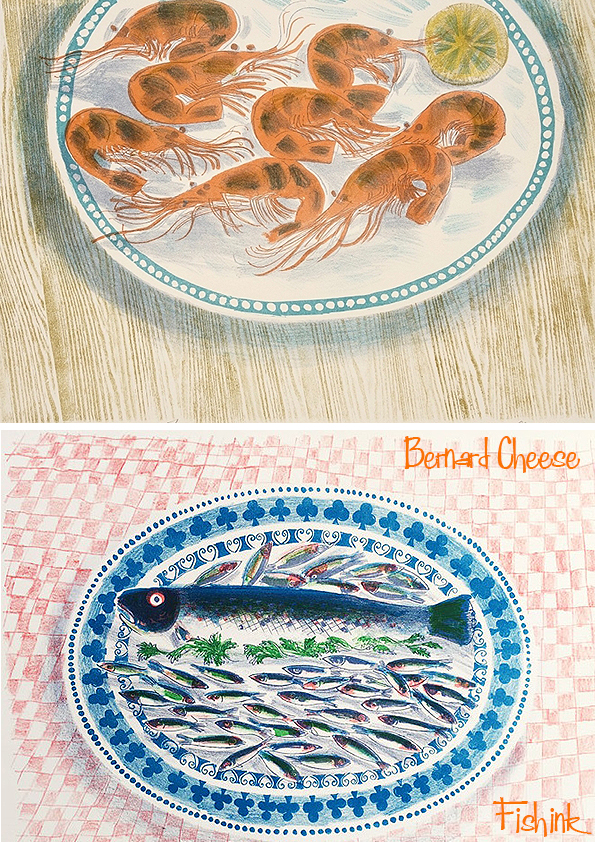
After leaving St Martin’s, Cheese was appointed senior lecturer at Goldsmiths College (1970-78) and taught part-time at Central School of Art and Design, London (1980-89). He and Brenda separated in 1988 and divorced in 1992. Cheese then settled in Nayland, north of Colchester. While he continued to travel in search of new subjects for watercolours that he subsequently reworked as lithographs, he turned increasingly to delightfully idiosyncratic still-life arrangements such as Trout on a Plate and Victoria Plums and English Coxs. Though Cheese’s work often comes across as whimsical, his seemingly light-hearted touch is rooted in sound draughtsmanship and a well-structured composition.

Here are a few beautiful illustrations from his time in the French countryside.

He captures this scene at differet times of the year, exploring how the seasons change the colours and the appearance of the land.
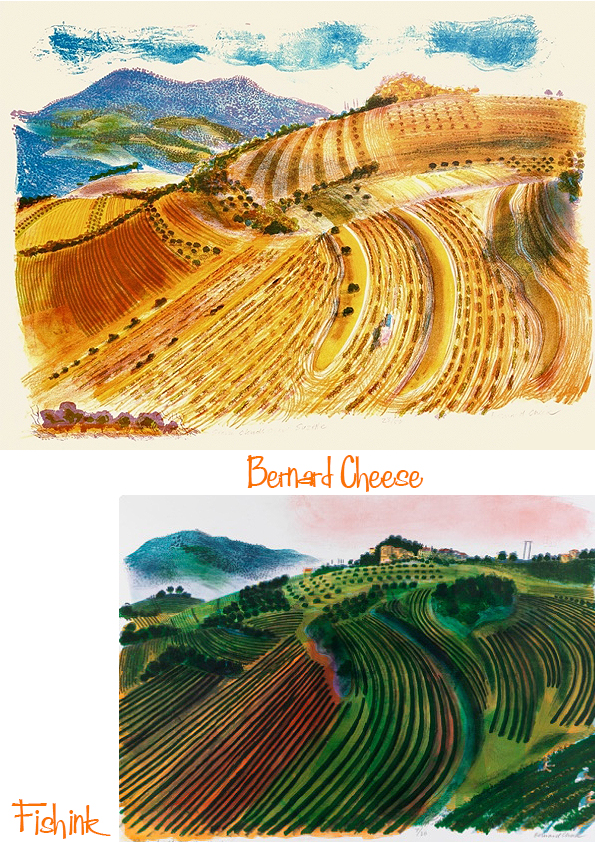


In later years there were numerous invitations to stage solo exhibitions. His works were acquired by many important collections, from the Victoria and Albert Museum and the Royal Collection to the Museum of Modern Art in New York and New York Public Library. With more than 100 lithographs and watercolours, Aberystwyth University holds the largest public collection of his works. However, accolades were long overdue. Cheese was not elected a fellow of the Royal Society of Painter-Printmakers until 1988, more than 40 years after he made his first print.
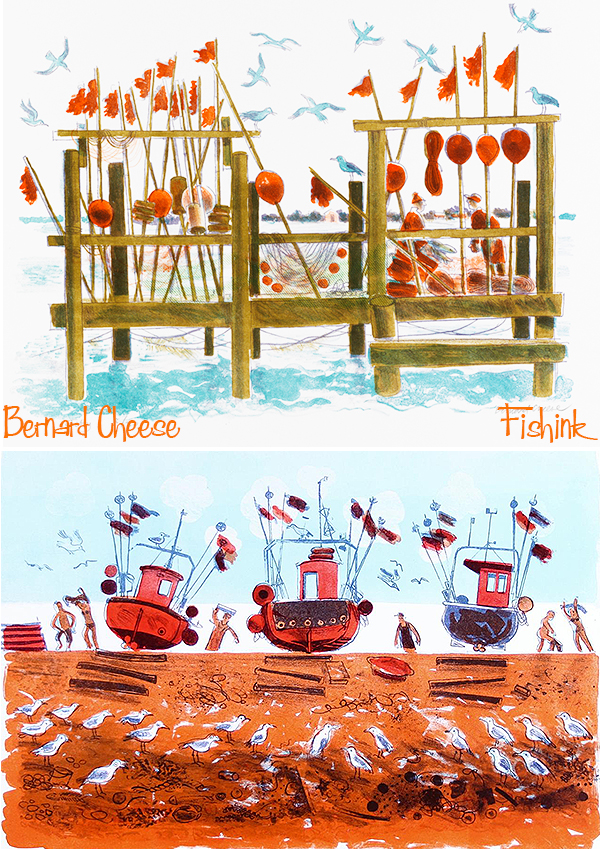
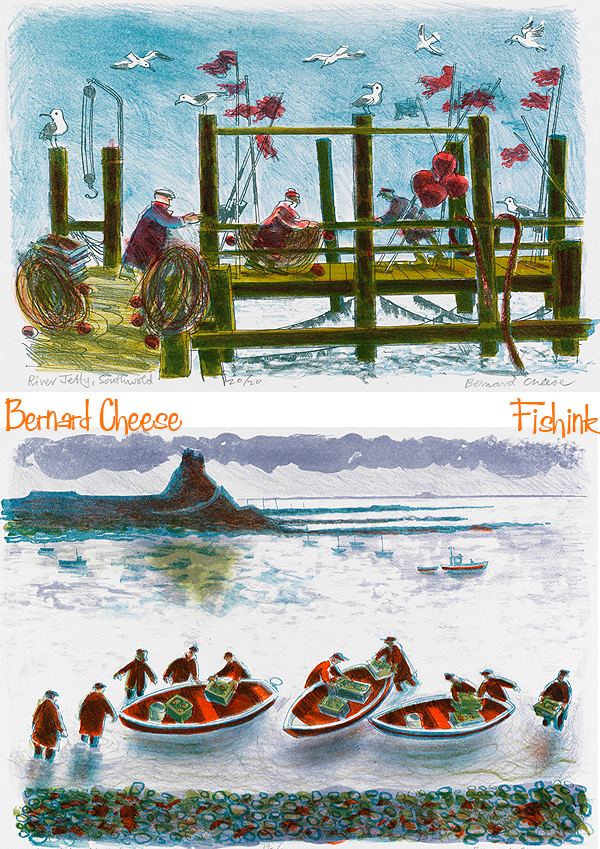
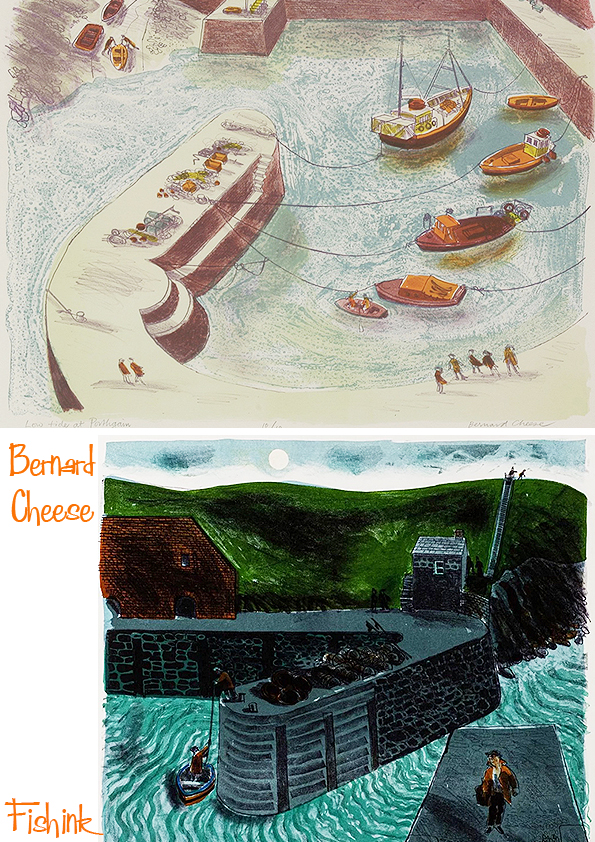
I love his work observing fisherman on the coast, taking in their routines, the way that they work and again how the textures of the fishing nets and the changing colours of the sea and sky, help to form a scene.
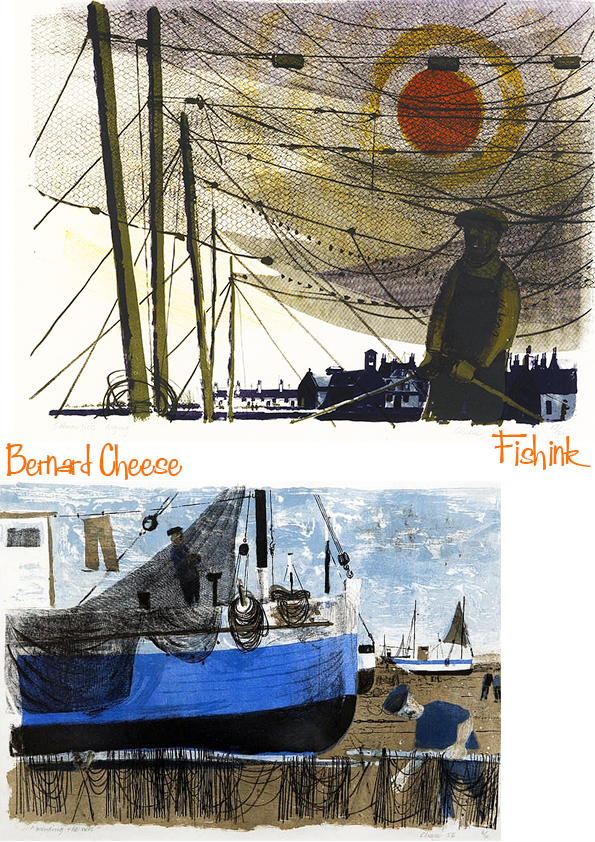

Through viewing Bernard’s work all together, I notice just how he has spent observing and capturing the world of these fisherman. Watching their everyday activities and illustrating their lives. He has created an illustrative journal of their time with the sea.
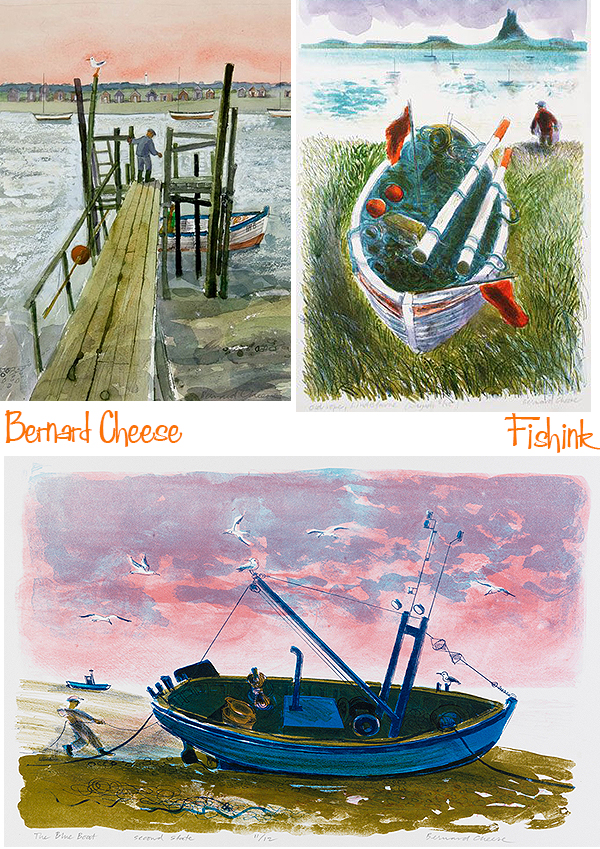


Not to forget his sense of humour, seen clearly here in this last image, where all the seagulls are eyeing up the couple and waiting patiently for their leftover scraps.

Wonderful work, I’m sure you’ll agree.
Victor Reinganum
Edward Victor Reinganum, painter and illustrator was born in London in 1907.
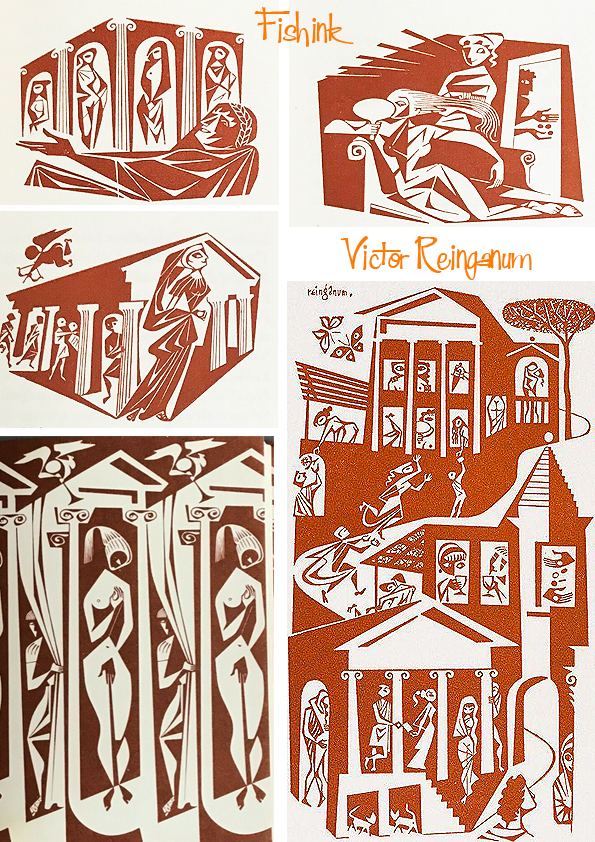
He was educated at London’s oldest art school, Heatherley School of Fine Art, located during the 1920s just off Oxford Street. He also attended the Academie Julian in Paris, where he was one of Leger’s six private students in his studio in Montmartre.
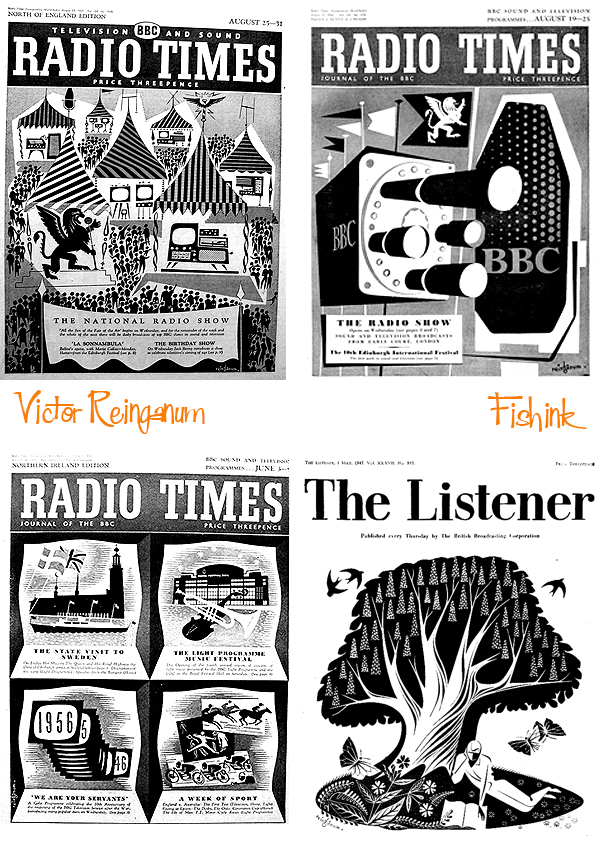
On his return to London in 1926, Reinganum took his portfolio to Maurice Gorham, the art editor of the Radio Times, who bought one of his drawings on the spot and started Reinganum on his freelance career as illustrator. During the 1930s and 1940s, together with Eric Fraser, Reinganum became responsible for the style of the Radio Times. His association with the Radio Times was to continue for 40 years.

The discipline that this work demanded, the speed and accuracy with which he had to absorb information and interpret it, informed his painting and graphic design.

In 1926, with Nicolas Bentley, Reinganum formed the Pandemonium Group, a loosely knit group of “bright young things” that held regular exhibitions at the Beaux Arts Gallery, where they began their tentative experiments with abstraction. In his freelance work as designer and illustrator, he worked for Shell and London Transport, the two main patrons of progressive artists in the 1920s and 1930s, as well as BBC Television, the Ministry of Works, the Post Office, British Rail and the Science Museum.

Victor Reinganum was an intellectual and a wit. He was reticent about himself, impatient with the world, and a moralist with a sense of humour. As a conscientious objector during the Second World War, he was trained in first aid with St John’s Ambulance Brigade in 1939 and drafted into the Rescue Service at the time of the London blitz.


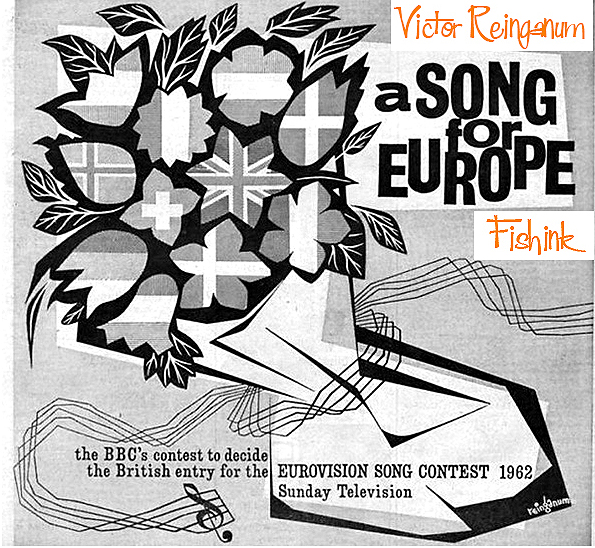
After the war, he continued his freelance career as graphic designer and painter, in London until 1953, then in Hartfield, Sussex, and after 1980 in Tunbridge Wells in Kent. From 1962 to 1966 he taught part-time in the department of Graphic Design in Croydon College of Art. He also designed the first Radio Times cover celebrating the Eurovision Song Contest in 1962. with this illustration.
During the sixties he became known for his graphic style book covers, and primarily the first editions of Muriel Spark’s The Ballad of Peckham Rye (1960) and The Prime of Miss Jean Brodie (1961).
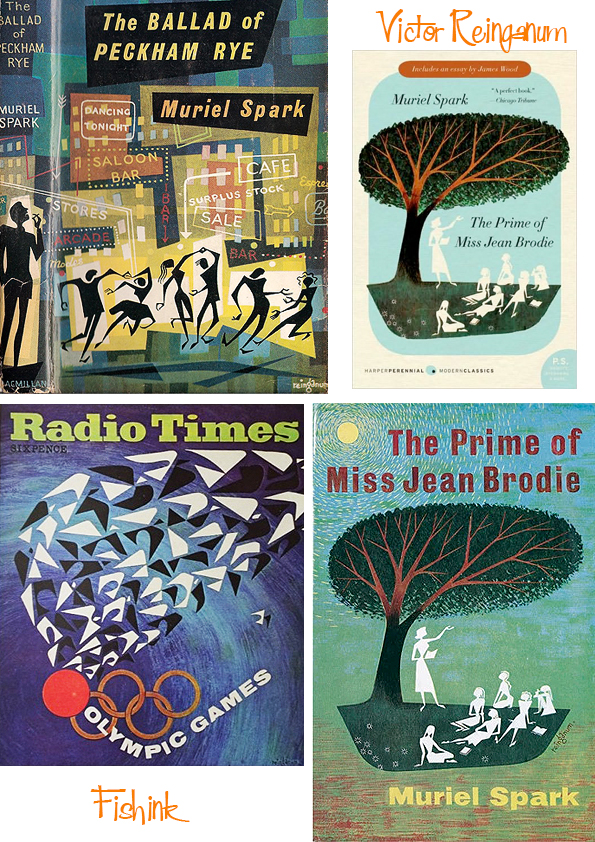
Here’s a small selection of the many dust jackets he went on to illustrate.


Victor Reinganum was an intellectual and a wit. He was reticent about himself, impatient with the world, and a moralist with a sense of humour. As a conscientious objector during the Second World War, he was trained in first aid with St John’s Ambulance Brigade in 1939 and drafted into the Rescue Service at the time of the London blitz.
After the war, he continued his freelance career as graphic designer and painter, in London until 1953, then in Hartfield, Sussex, and after 1980 in Tunbridge Wells in Kent. From 1962 to 1966 he taught part-time in the department of Graphic Design in Croydon College of Art.

Reinganum disliked categories, both of medium and style, and did his best to avoid them. His paintings were exhibited under the banner “abstraction” but, gradually, the world at large dubbed him a Surrealist and he was swept up in the wave of British Surrealism exhibitions in the 1970s. His paintings have been shown in 20 exhibitions with “Surrealism” in their title, together with other members associated with the movement that included: Edward Burra, Eileen Agar, Merlyn Evans, Conroy Maddox, Tristram Hillier, John Piper and Roland Penrose.


Reinganum’s paintings are imaginative explorations of form with references to the real world of objects, figures and nature. However abstracted, the images are usually identifiable, characteristically biomorphic and often menacing. He used the conventional media of gouache, oil and collage, but he also invented his own techniques that enabled him, for instance, to achieve marbling effects by floating waterproof ink on water in the kitchen sink and then lifting it off on sheets of paper.
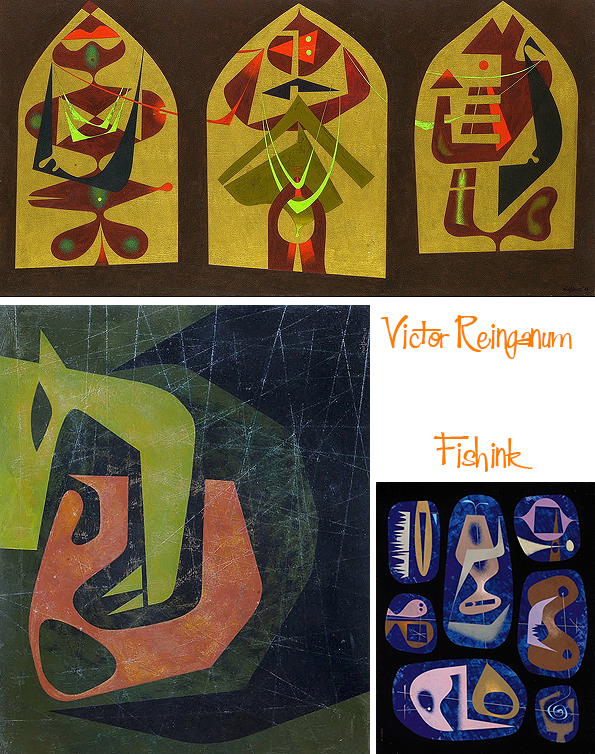
Reinganum called the most abstract of his paintings Diagrams. They are not diagrams of or for anything, but equally they are not abstractions from or of anything, “except,” as he said, “from my imagination”. Even so, all these highly crafted formal arrangements have relationships that are full of incident as the shapes touch and interact, interpenetrate, and then go on to devour each other with calm and measured formality.
His last retrospective exhibition, “60 Years of Painting”, was held at Oriel Gallery, Theatr Clwyd in Mold, 2009. He sadly passed away in 2011. Edward Ardizzone said of Victor Reinganum, “He is to art what Roy Plomley is to biography.” Reinganum described himself as an “illustrator/ painter” and occasionally as a “pen man”, because the pen determined the precision of his forms and black e mergedas the richest and the most persistent of his colours.

I love the style and graphic edge to his work. What are your thoughts readers ?
Many thanks to The Independent for the information for this post.
Ben Shahn
Hi Everyone, before I start with this week’s post, I would just like to say that I have a Ceramics Sale this Saturday on Instagram at Fishinkblog . It starts at 10 AM UK time and I would really appreciate it if you could spread the word for me. I make original, creative ceramics and can ship worldwide, so do pop over and see for yourself in my stories and on my feed. Or message me craig @ fishink .co.uk if there is anything you would like to buy if you are not on instagram and I will return your message asap. Thank you.

and here’s today’s post… enjoy !

Ben Shahn (1898–1969) is one of the most admired and collected artists of his generation, he was a painter, photographer, printmaker and political activist, who is best known for his poignant narrative paintings of American life.

Shahn was born in Kovno, Lithuanian and his father, a socialist and fervent anti-czarist, was exiled in 1902 for participating in revolutionary activities. His father eventually immigrated to the United States, and in 1906, a young Ben Shahn and his siblings joined him in New York City. At fourteen, Shahn apprenticed with a Manhattan lithographer (1913-16). His lucrative career as a journeyman lithographer made it possible for him to finance his academic and artistic education, and he attended the Art Students League (1916-17), New York University (1919), City College of New York (1920-21), and the National Academy of Design (1921).


In 1925 and 1928, he took extended trips to Europe, studying old master paintings and the work of European modernists. Shahn did not subscribe to the avant-garde philosophy that art existed in a realm above the concerns of everyday life. On the contrary, he believed that artists had a moral obligation to express their social and political views through art. He stated: “It is not just the artist’s experience, but his values, his judgments… that live in the work of art and make it significant to the public.”
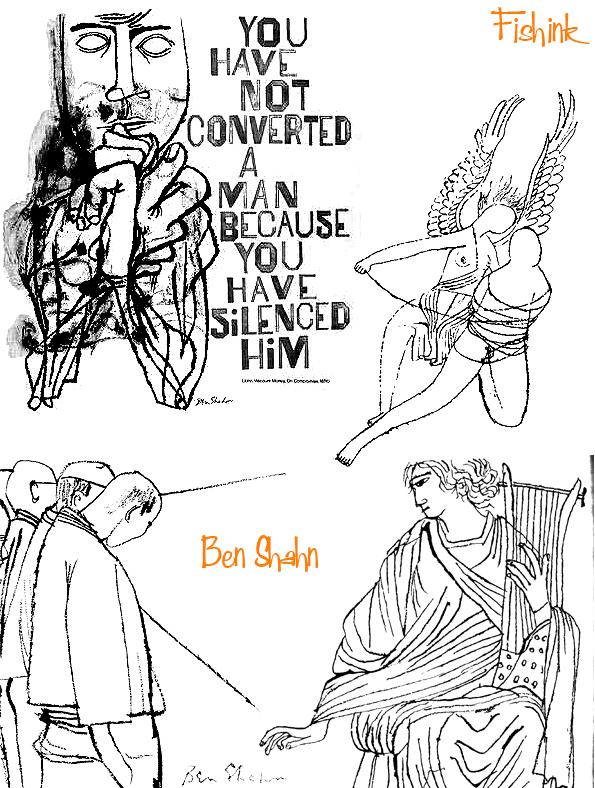

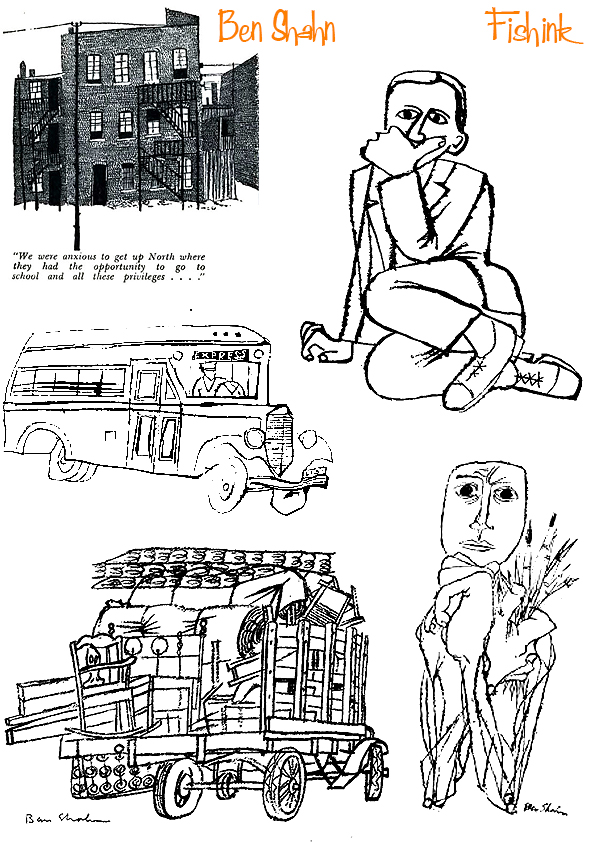
In 1929, Shahn shared a Manhattan studio with photographer Walker Evans. With Evans’s encouragement, Shahn began taking photographs of New York City, and during the Great Depression, Shahn joined the staff of the Special Skills Division of the Resettlement Administration/ Farm Security Administration (RA/FSA) (1935). In addition to his work with the RA/FSA, Shahn executed murals for the Federal Art Project and the Public Art Section of the Treasury Department and continued to work on his own easel paintings.
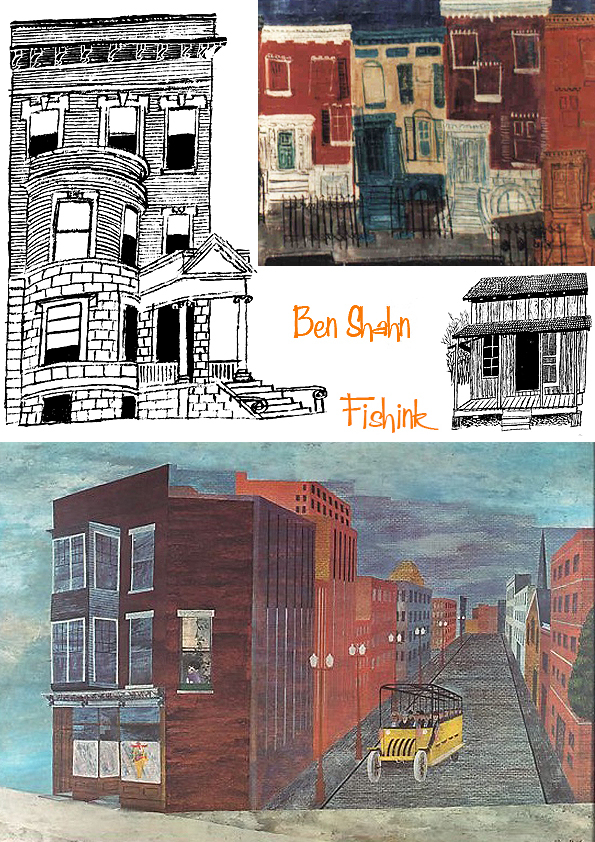
In 1932, Shahn had his first critical and commercial success when his series The Passion of Sacco and Vanzetti was exhibited at Edith Halpert’s Downtown Gallery in New York City. a painting which condemned the controversial conviction of two Italian-American immigrants who were sentenced to death in 1927.


In 1942, Shahn began working for the Office of War Information (OWI), creating posters for the government’s anti-fascist propaganda campaign. However, OWI officials rejected most of his designs because they were considered too violent; he resigned in 1943. From 1944 to 1947, Shahn worked for the graphics division of the Congress of Industrial Organization’s Political Action Committee (CIO-PAC), and in 1948 he was a member of the graphic arts division on Henry Wallace’s Presidential campaign.
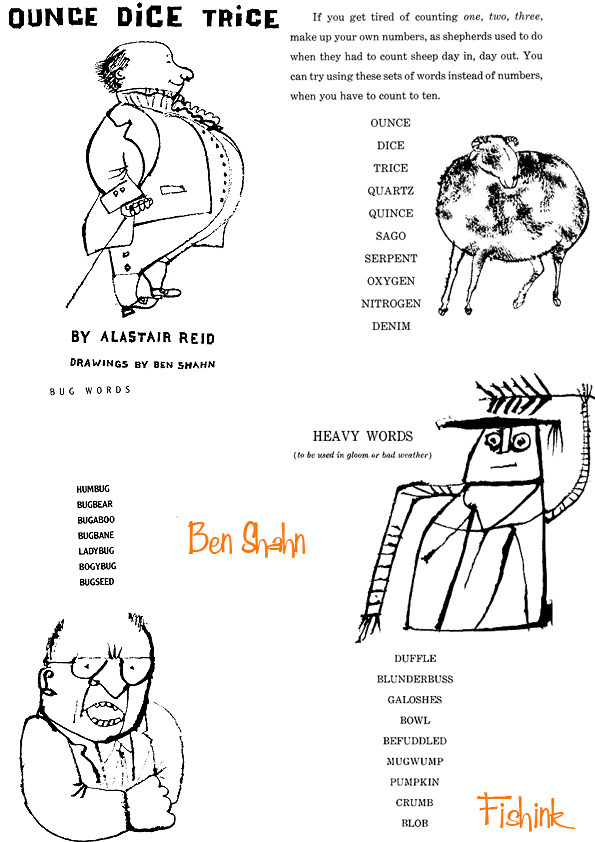
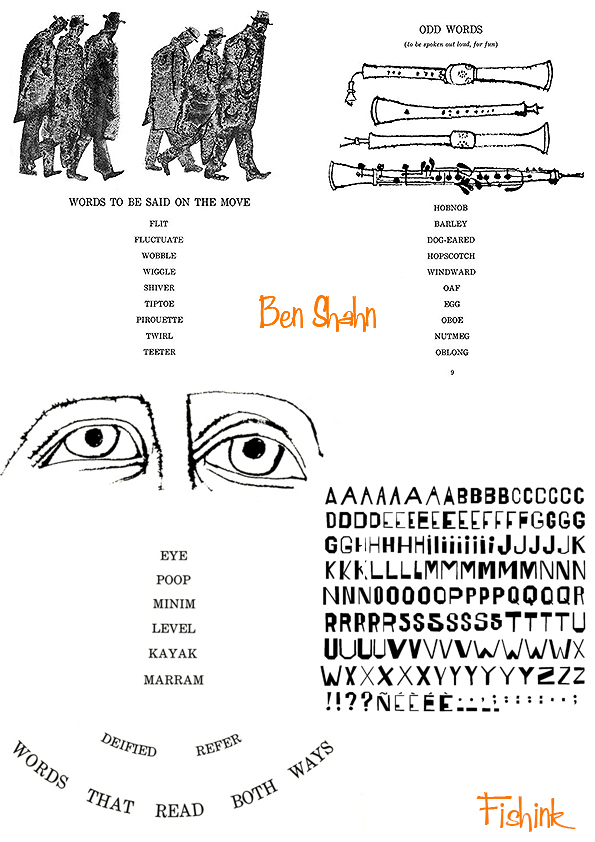

During the Cold War, Shahn’s work became increasingly symbolic and allegorical, yet he continued to assert that art should be a means of political expression.
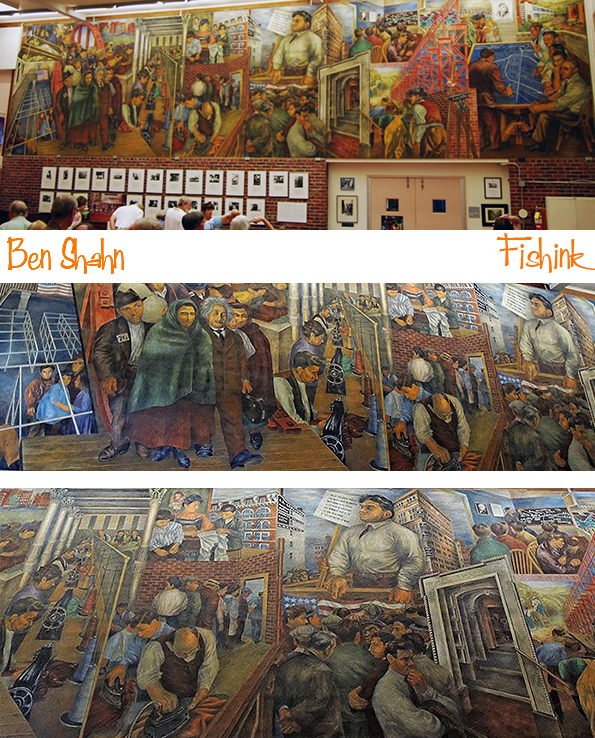
Even though right-wing politicians attacked his work as communistic, by the late 1940s Shahn was one of the few American artists who could earn a living solely from painting.


Despite his celebrity, he continued working as a graphic artist and serving the social and political causes he believed in. In 1947, Shahn had his first major retrospective at the Museum of Modern Art, and in 1954, MoMA organized a second exhibition for the American Pavillion at the 27th Venice Biennial.


Shahn continued to paint, illustrate, teach and remain politically active until his death in 1969, at the age of 71.

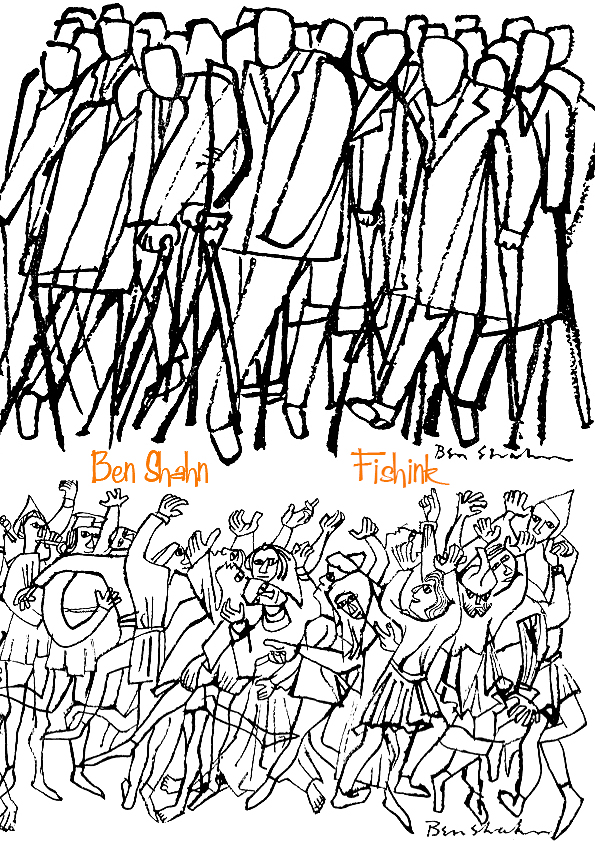

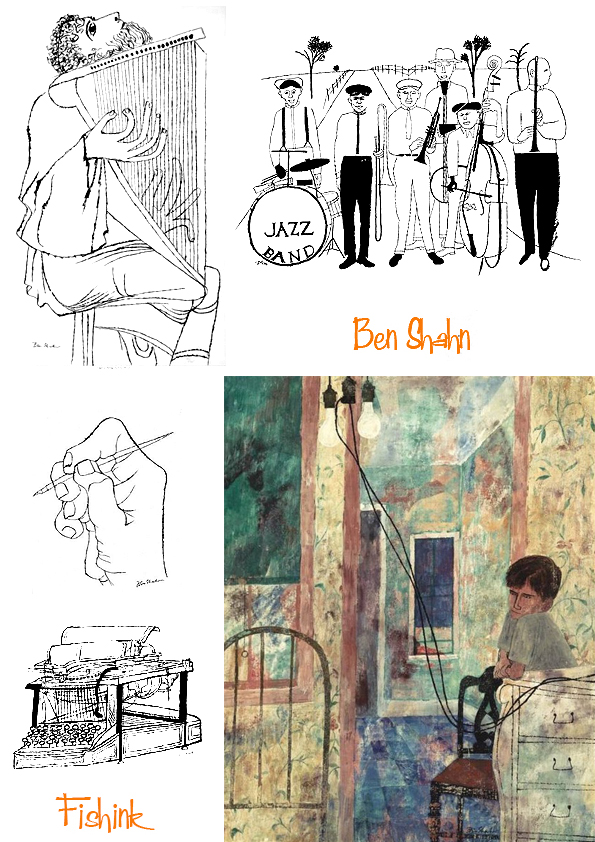
Today, Shahn’s works are held in the collections of the Art Institute of Chicago, the Whitney Museum of American Art in New York, the Tate Gallery in London, and the National Gallery of Art in Washington, D.C., among others.
Many thanks to the Michael Rosenfeld site for the information about Ben. There’s a great essay and another lenghthier piece with much more info here and here.
Robert Littleford Illustrator

I came across the work of Robert Littleford about a year ago on Instagram @robertlittleford. I find his work very strong, bold and captivating, with a direct and honest approach. I got in touch with Robert to find out more.
What are your earliest memories of creating art, does it run in the family at all and is it something you remember being encouraged to explore in your younger years ?
I always drew a lot as a child, I was a junior twitcher and would happily wander off with my trusty Observer book of birds to draw every bird that I spotted. I also read voraciously, being a bit of a loner, loved exploring, making maps of my travels. Two Little Savages by Ernest Thompson Seton was the first big influence with its lovely black and white illustrations.
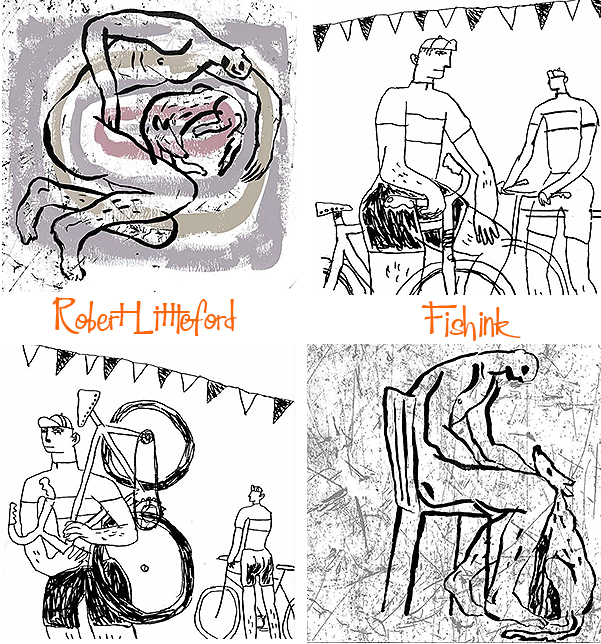
I think this bird and horse is one of my favourites.
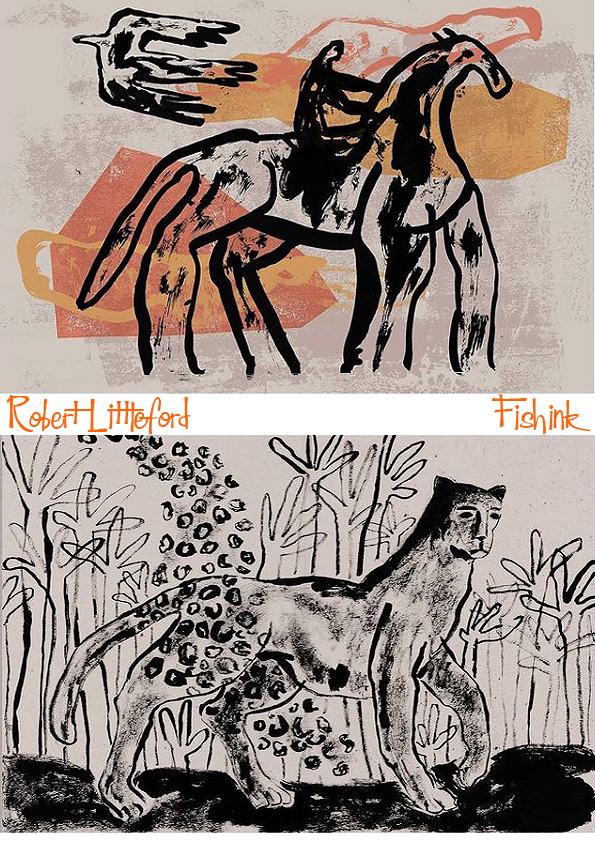
I love the fact that your style is defined and yet you can adapt it to paintings, maps, books, posters etc. How did you start to draw in such a bold and defined way or is it just an extension of your outgoing personality lol ?
Thanks, oddly I never felt like I had a style, it might sound a little zen but I just try to be true to me, it just took years of practise to even recognise who that ‘me’ was. I like the visceral quality of drawing and try to avoid editing or any kind of photoshoppery. It’s a warts and all approach to my work.

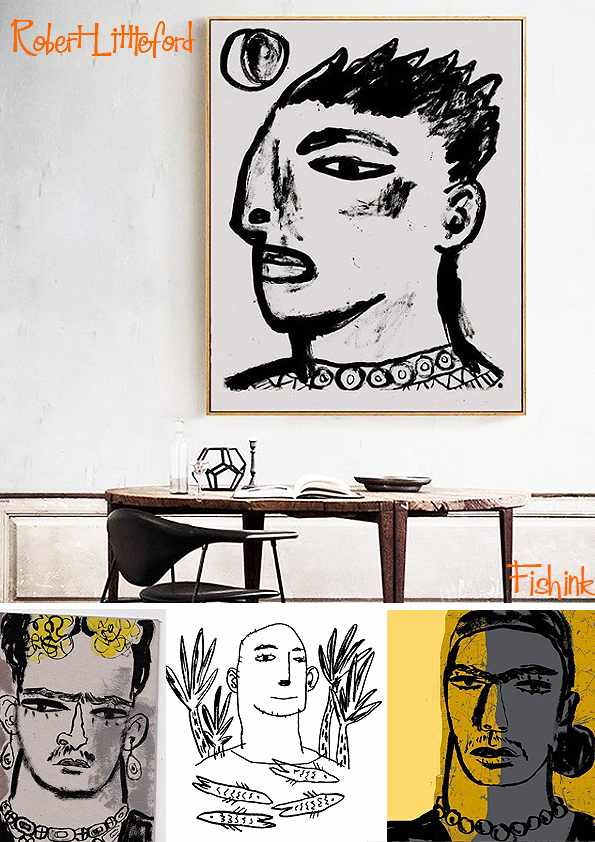
Which artists work do you follow and who would you say inspires your work (if anyone) ?
I follow @HuntleyMuir on IG who always inspire me with their fresh, edgy, authentic work.

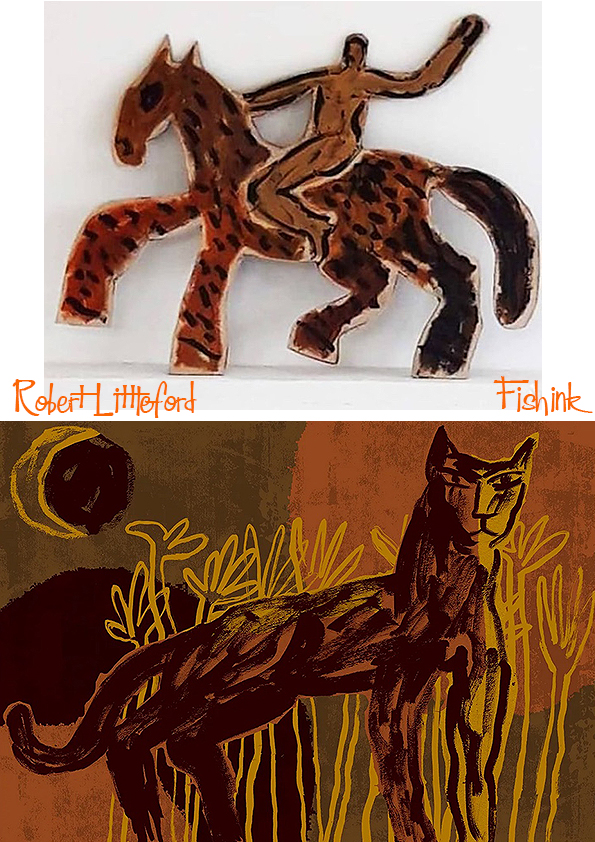
You have the style of artwork that is very loose and sketchy. I know from experience that it’s a style that an illustrator can do over and over again until they get each element just right. Do you work very spontaneously, mostly from your imagination, or sketchbooks or might you plan out a new piece, before even putting a brush to paper ?
You are so right about the over and over again. Often I don’t know even what I am looking for, a good drawing just has a special something. I just do it over and over until I find that elusive something. I work a lot in sketchbooks, II often do plan but try not to get in my own way. I always take my sketchbook when travelling and enjoy recording my trips.
Robert’s work has illustrated books and articles too.


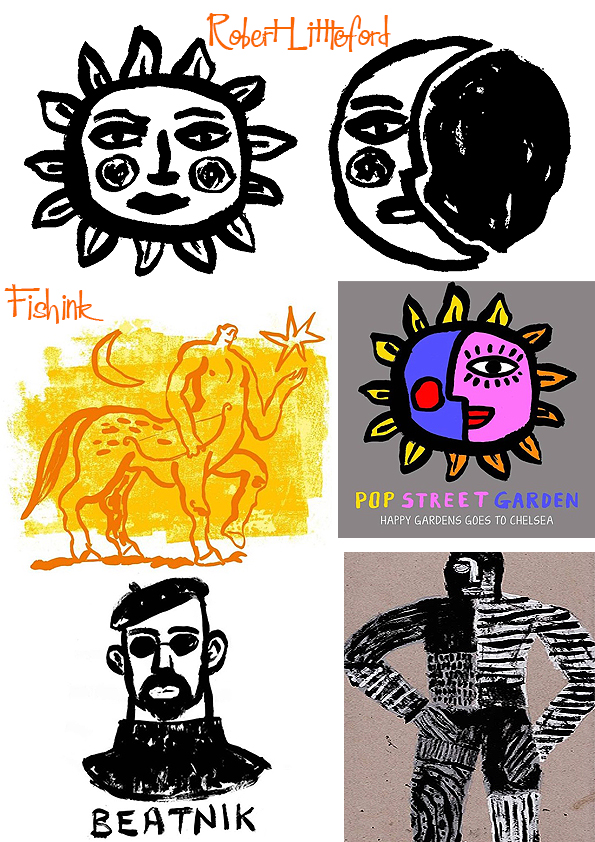
What is your idea of an ideal commission ?
To quote Ru-Paul… one that recognises my Charisma, uniqueness, nerve and talent.


What materials do you most like to use and why ?
I like the rush of drawing with brush and Indian ink, its very unforgiving, there’s no correcting the mistakes.

How big a part of your work are researching a topic and sketchbooking ideas ?
I draw everyday, in sketchbooks, on scraps of paper, leftover cardboard packaging, ideas come out of the process of drawing. Most often projects require a lot of research, and that research is essential to keep the work authentic and true to the project.

I feel there is a ‘dark side’ to your work, in both it’s ideas and in the execution. Is this something you nurture deliberately or just the range of topics that naturally interest you ?
I wouldn’t say I nurtured it deliberately, but I think of illustration as being like Rock and Roll, and I naturally aspire to be more Nick Cave than Kylie Minogue.
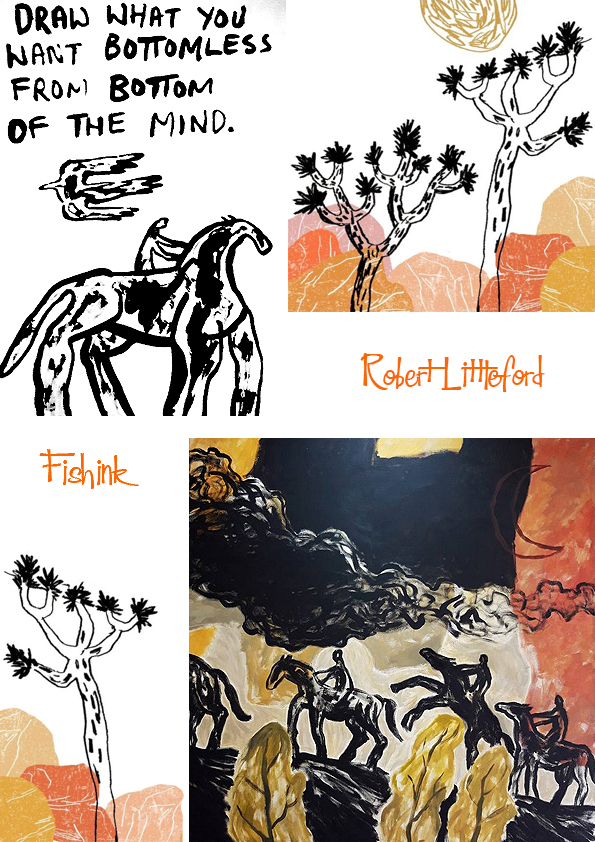
Have you ever turned down a project because it didn’t inspire you ?
Wracking my brains, I don’t think so, this is what I do for a living so often I don’t have a choice. Because of the way I work I usually get offered the more interesting jobs. I used to get all the serious subjects when I worked a lot in editorial.
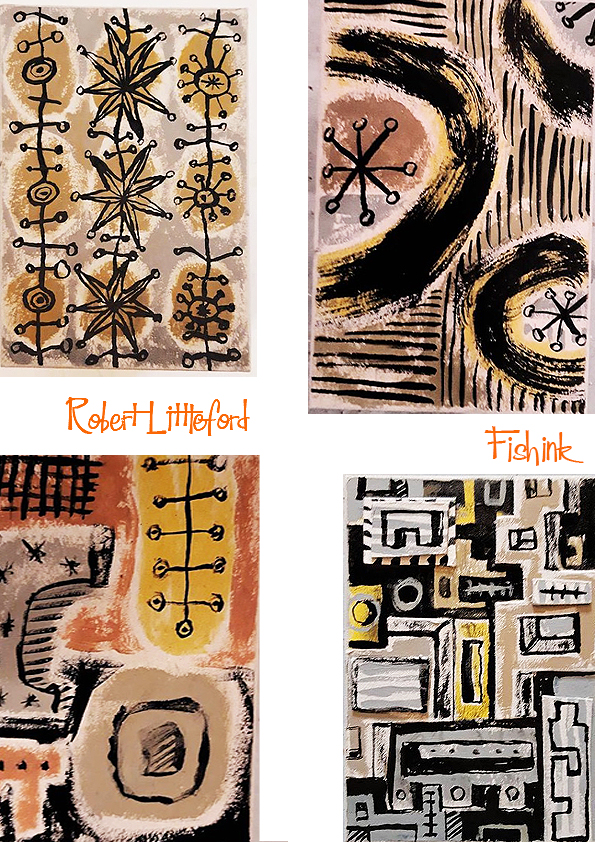
Where do you see your work going in the future, are there avenues you still wish to explore and if so what might they be ?
I am working on a Chelsea Flower Show garden at the moment, making figurative sculptures and designing a wall mural inspired by Pop art. I am really excited by the bold and vivid colours of this project. I hope that this will open up some new work avenues to explore.
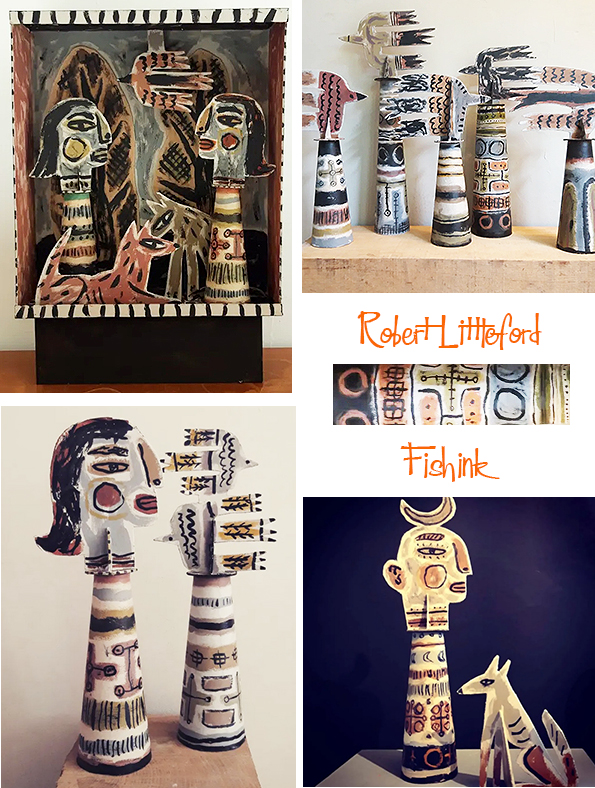
Many thanks Robert for taking the time to answer my questions and allowing me to use your images. I’m very much looking forward to seeing what happens next with your path and illustration. I think your models above would make amazing ceramic pieces if you chose to take them in that direction !
If you like this style of illustration, you may also appreciate this post on Christopher Corr.

 fishinkblog.com