Abram Games
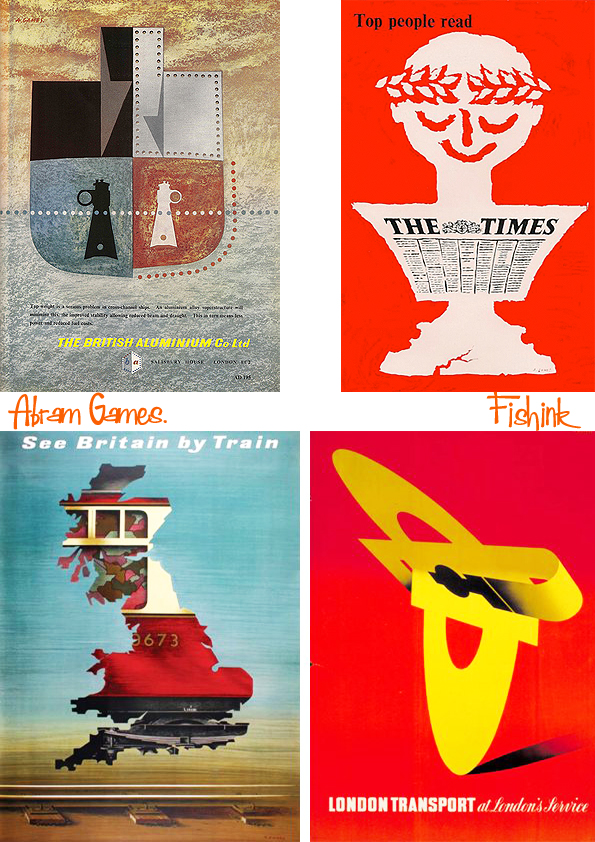
Abram Games (29 July 1914 – 27 August 1996) was a British graphic designer. The style of his work – refined but vigorous compared to the work of contemporaries – has earned him a place in the pantheon of the best of 20th-century graphic designers. In acknowledging his power as a propagandist, he claimed, “I wind the spring and the public, in looking at the poster, will have that spring released in its mind.” Because of the length of his career – over six decades – his work is essentially a record of the era’s social history. Some of Britain’s most iconic images include those by Games.
Abraham Gamse was born in Whitechapel, London on 29 July, the day after World War I began in 1914, he was the son of Joseph Gamse, a Latvian photographer, and Sarah, nee Rosenberg, a seamstress born on the border of Russia and Poland. His father, who had emigrated to Britain in 1904, anglicised the family name to Games when Abram was 12. Games left Hackney Downs School at the age of 16 and, in 1930, went to Saint Martin’s School of Art in London.

Disillusioned by the teaching at Saint Martin’s and worried about the expense of studying there, Games left after two terms. However, Games was determined to establish himself as a poster artist so while working as a “studio boy” for the commercial design firm Askew-Young in London between 1932 and 1936, he attended night classes in life drawing. He was fired from this position due to his jumping over four chairs as a prank. In 1934, his entry was second in the Health Council Competition and, in 1935, won a poster competition for the London County Council. From 1936 to 1940, he worked on his own as a freelance poster artist. An article on him in the influential journal Art and Industry in 1937 led to several high-profile commissions for Games, from the General Post Office, London Transport, Royal Dutch Shell and others.

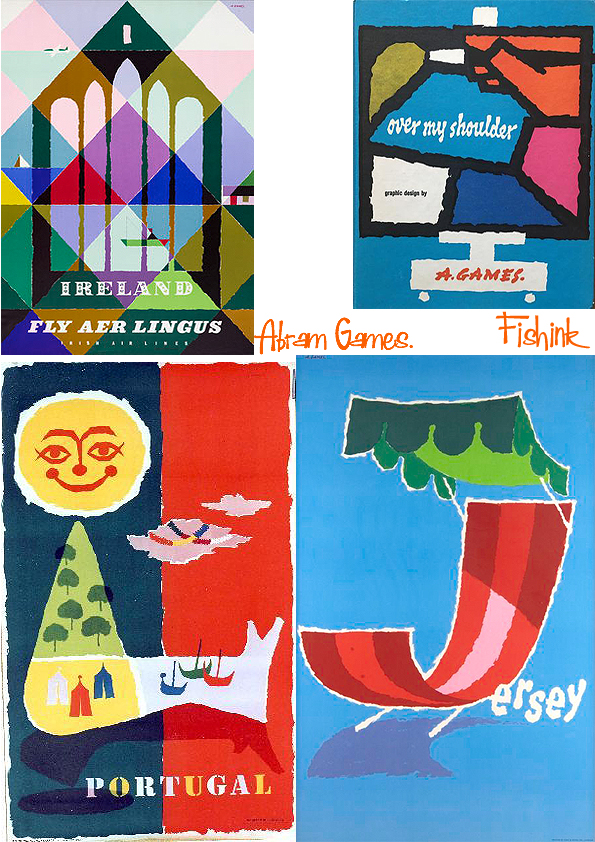
At the start of World War Two, Games was conscripted into the British Army. He served until 1941 when he was approached by the Public Relations Department of the War Office who were looking for a graphic designer to produce a recruitment poster for the Royal Armoured Corps. From 1942 Games’s service as the Official War Artist for posters resulted in 100 or so posters. Games was allowed a great deal of artistic freedom which enabled him to produce many striking images, often with surrealist elements. Among his first designs was the Auxiliary Territorial Service recruitment poster that became known as the blonde bombshell, (below top left).

Games had wanted to challenge the rather drab image of the ATS but the authorities feared that the glamorous image he had produced would encourage young women to join the ATS for the “wrong reasons” and the poster was quickly withdrawn. The design Games replaced it with was criticised by Winston Churchill as being too “Soviet”.
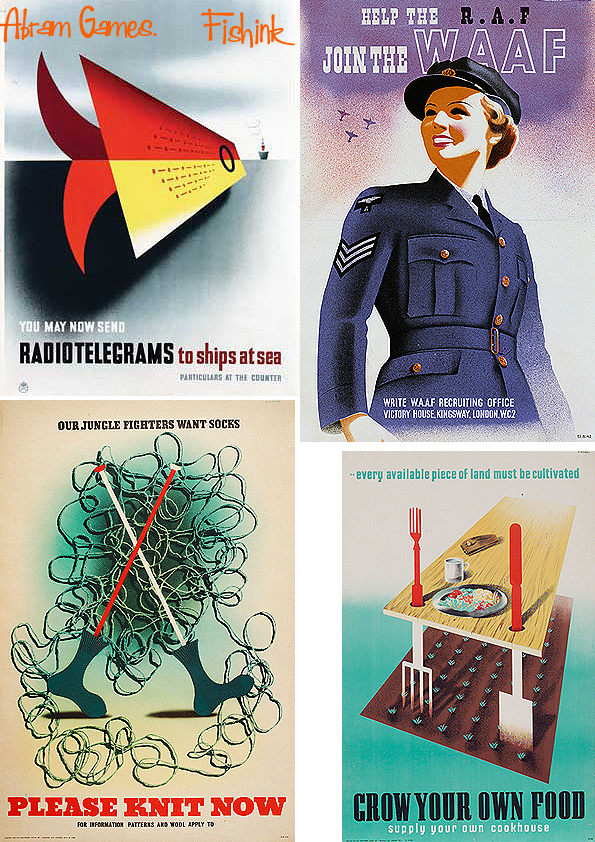
Other notable posters included Your Talk May Kill Your Comrades (1942) in which a spiral symbolising gossip originates from a soldiers mouth to become a bayonet attacking three of his comrades. Games used the photographic techniques he had learnt from his father in that and other posters such as He Talked…They Died (1943) part of the Careless Talk campaign. In addition to his poster work, Games completed a number of commissions for the War Artists’ Advisory Committee.


Later in the War, Churchill ordered a poster Games had produced to be taken off the wall of the Poster Design in Wartime Britain exhibition at Harrods in 1943. The Army Bureau of Current Affairs, ABCA, had commissioned Games and Frank Newbould to produce posters for a series entitled Your Britain – Fight for It Now.

While Newbould produced rural images similar to the pre-war travel posters he had created for several railway companies, Games presented a set of three Modernist buildings that had been built to address poverty, disease and deprivation. The poster that annoyed Churchill most featured the Berthold Lubetkin designed Finsbury Health Centre superseding a ruined building with a child suffering from rickets. Churchill considered this nothing short of a libel on the conditions in British cities and ordered the poster to be removed. Ernest Bevin, the war-time Minister of Labour, had another poster in the series removed from the Poster Design in Wartime Britain exhibition organised by the Association of International Artists.

In 1946, Games resumed his freelance practice and worked for clients such Royal Dutch Shell, the Financial Times, Guinness, British Airways, London Transport and El Al. He designed stamps for Britain, Ireland, Israel, Jersey and Portugal. Also, he designed the logo for the JFS school. There were also book jackets for Penguin Books and logos for the 1951 Festival of Britain (winning the 1948 competition) and for the 1965 Queen’s Award to Industry.


Among his pioneering contributions was, in 1954, the first moving on-screen symbol of BBC Television. He also produced murals. Between 1946 and 1953, Games was a visiting lecturer in graphic design at London’s Royal College of Art and in 1958, was awarded the OBE for services to graphic design. In 1959, he was appointed a Royal Designer for Industry (RDI). He also designed the tile motif of a swan on the Victoria line platforms at Stockwell tube station in the late 1960s.


Games had been among the first in Britain to see evidence of the atrocities committed at the Bergen-Belsen concentration camp, when photographs taken there by British troops arrived at the War Office in 1945. The same year he produced a poster, Give Clothing for Liberated Jewry, and would often work to support Jewish and Israeli organisations. Games, who was Jewish, spent some time in Israel in the 1950s where, among other activities, he designed stamps for the Israeli Post Office, including for the 1953 Conquest of the Desert exhibition and taught a course in postage-stamp design. He also designed covers for The Jewish Chronicle and prayer book prints for the Reform Synagogues of Great Britain. In 1960 Games designed the poster known as Freedom from Hunger for the Food and Agriculture Organisation of the United Nations.
Games was also an industrial designer of sorts. Activities in this discipline included the design of the 1947 Cona vacuum coffee maker (produced from 1949, reworked in 1959 and still in production) and inventions such as a circular vacuum cleaner and an early 1960s portable handheld duplicating machine by Gestetner, which was not put into production due to the demise of mimeography.

In arriving at a poster design, Games would render up to 30 small preliminary sketches and then combine two or three into the final one. He would also call on a large number of photographic images as source material. Abram quickly and methodically filled a layout pad with two to three dozen ideas for a poster. Invariably two elements would be combined to produce a third image. Once he had selected a design from the thumbnails, he circled it with a pencil. He wasted no time covering large areas and avoided detail. ‘I never work large because posters seen from a distance are small. If ideas don’t work an inch high, they will never work.’ he said.
Showing his rough ideas to his wife, children and friends, he would ask ‘What does this mean to you?’ If they looked blank, he threw his efforts into a large dustbin and started again. When the final artwork for the poster was finished, he painted ‘A. Games’ in a corner. It hung on his studio wall for one week, inviting criticism from colleagues, family and friends. Only when satisfied, he would add a full stop after his signature. Purportedly, if a client rejected a proposed design (which seldom occurred), Games would resign and suggest that the client commission someone else.


In 2013, the National Army Museum, London, acquired a collection of his posters, each signed by Games and in mint condition. Many thanks to Wikipedia for the information for this post.
Parkgatefest 2018
Hello everyone on this sunny Monday morning. I’m just freshly returned from a weekend at Parkgatefest, which was a fabulous event, although sadly not in terms of sales. My friend Sarah who I was exhibiting with and who runs Sllipblog, had designed and created such an amazing stand for us to display our ceramics on, she’s got a real eye for design and detail, it looked like this.
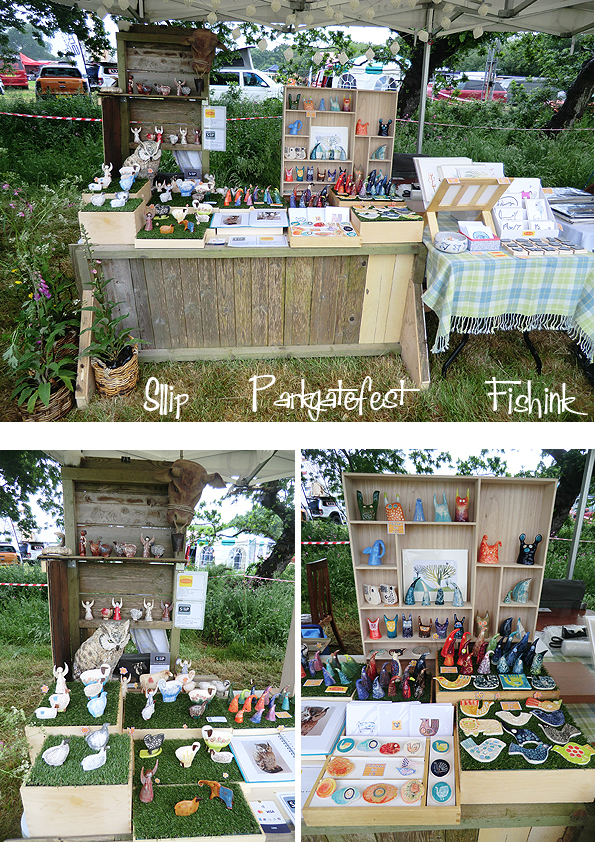
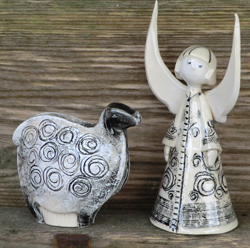
Her work is beautiful and a mix of sheep, guardian angels and shepherdesses. If something catches your eye, she sells direct through her Instagram site here. I’d imagine she’ll soon be taking orders for Christmas angels as well as the guardian angels she makes all year round.

They are stunning, don’t you think.

Such expression in her lovely characters too.

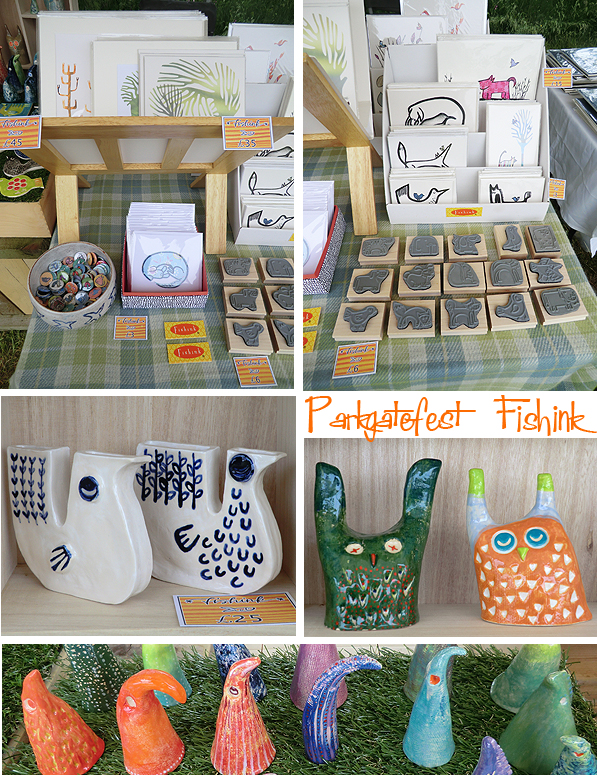
My half of the stall looked like this. I’m also selling some pieces through Etsy and Instagram, please ask for prices if you see anything you like.

I had a range of original artwork too and the cat, dog and bird cards which did prove a popular choice.
There was a range of other craft stalls like these great bags created in Burma for design company Mowgs.

Pretty, functional and recycled plastic… great values.

The tribute bands were really great, including among others Queen, Take That, Tom Jones and the amazing Temptations. Steam, football tricks, rides for the kids and a wealth of choice of great food and drink and all for a day ticket of £10.. (kids get in free) I’ll definitely be going again.

Sunday was the best weather and was glorious all day. Hope you enjoyed your weekend. Do let me know your thoughts on the ceramics too.

Monday Mix 7
Happy Bank Holiday to everyone this affects, apprently it’s going to be a hot and thundery one… hold onto your hats !
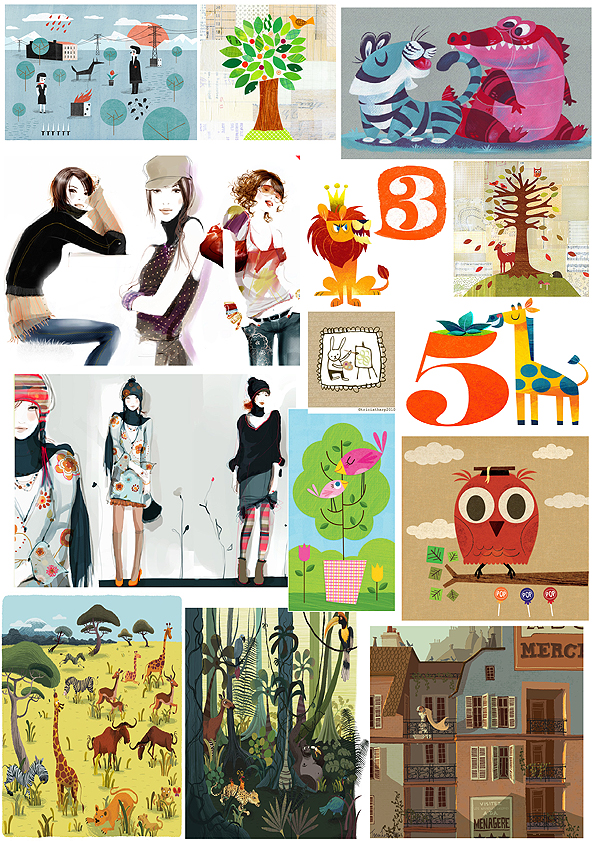
Since about 2008, I’ve been collecting images from the internet that have caught my eye. Way back then, I wasn’t so diligent in keeping records as to where images came from, or who had painted, photographed, illustrated or indeed created the artwork in the image. So I apologise in advance for their lack of referencing, but to be honest, it was purely about seeing groups of imagery together, that for whatever reason, I enjoyed.
As I have managed to amass quite a few of these ‘collaged sheets’, I thought I would share them with you, in the hope that they may also provide some inspiration to you the readers, from their shape, colour, texture or out and out randomness : )


Do let me know your thoughts and which images catch your eye for whatever reason. Also I’d like to mention my Instagram page for Fishink Blog. The link is (https://instagram.com/fishinkblog) or you can click on the button on the right of my site. I am building up the collection every week, so if you lovely folk would like to follow me, or leave a comment or see more of my illustration artwork, then please pop on over and check it out today. I’ll look forward to sharing more of my own drawings with you.

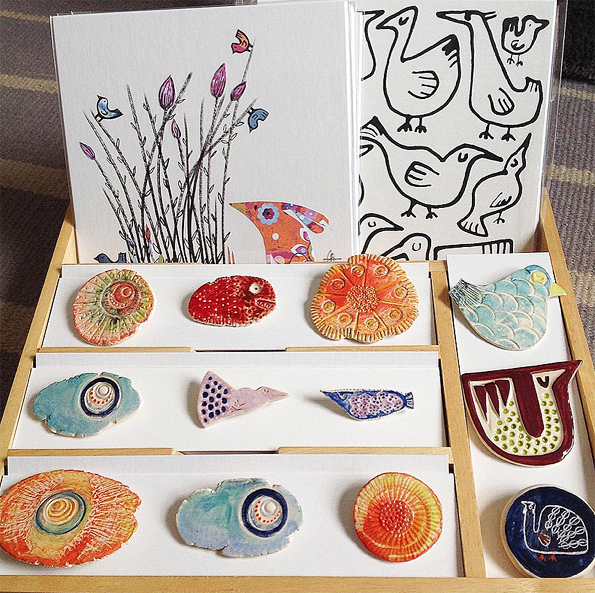
Don’t forget I’ll be exhibiting at Parkgate Fest next weekend so do pop over to the Wirral and say hi. Here’s a selection of the brooches and wall plaques I’ll have on display for sale.
Have a great Monday and please feel free to comment and pass my blog onto your friends. It all helps : ) Thank you
Parkgatefest 2018
With two sets of ceramics now passed under the watchful eye of the kiln fire-godesses (and survived intact), I can now start to think about where and how to sell my growing ceramic menagerie. I’ve teamed up with a good school friend Sarah, who is also a ceramist and works under the name of Sllipblog and we are taking a stall at the fairly new Parkgatefest on the 2nd and 3rd of June over at Parkgate on the Wirral.
Getting here using sat nav, the postcode for you to enter is CH64 6RD, ParkgateFest is situated off Boathouse Lane, in Parkgate, this is easily accessed from the A540. The site is on the land adjacent to Marsh Nurseries.
I’ll be taking a mixture of flat wall hanging ceramics like these birds…

As well as some birds that are a little more 3D lol
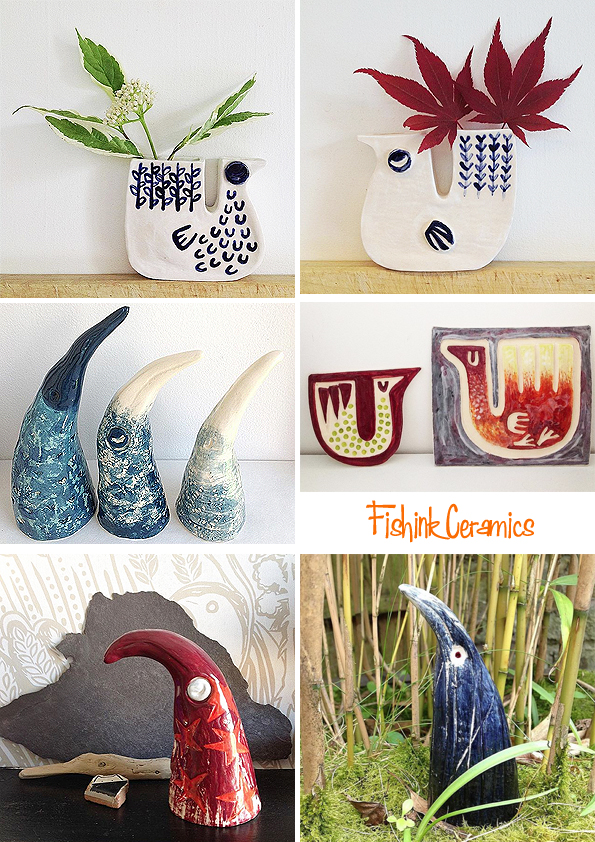
My friend Sarah over at Sllipblog, creates a beautiful range of sheep, shepherdesses and guardian angels, like these…

wonderful textures, designs and no two the same.
If the weather stays as amazing as it has been it should be a fantastic weekend. Last year was Parkgatefests first year and they had over 5000 people through their gates ! Let’s hope it’s as busy this year too ! Do pop the dates in your diary, spread the word and say hello to us on the stand if you get there too. If you’re interested in buying any of the items above, then drop me a line before they appear in the show. I’ve a few items already here on Etsy and more to join them soon. This little chap was one of the first to leave the ceramic creations and is now on it’s way to Northumberland.. Yay!

Hope you’re all enjoying this warm spell : )

Vintage Book Covers
It’s been a while since I shared some classic book covers.
I can’t tell you why but they always make me feel warm inside, I hope they have the same effect for you : )
Here’s a little science to get the visual party started.

A little food to go on the side table.

Throw in a little mystery and intrigue.
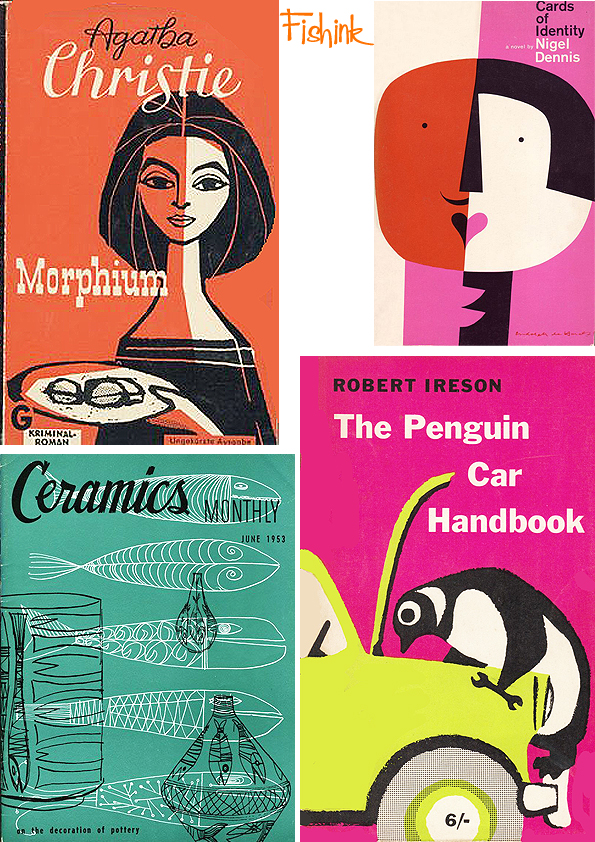
Making sure it’s well packaged.

Remember there’s a lot to learn out there.

Even if it’s from our children.

Before alas and all too soon… the party’s over.
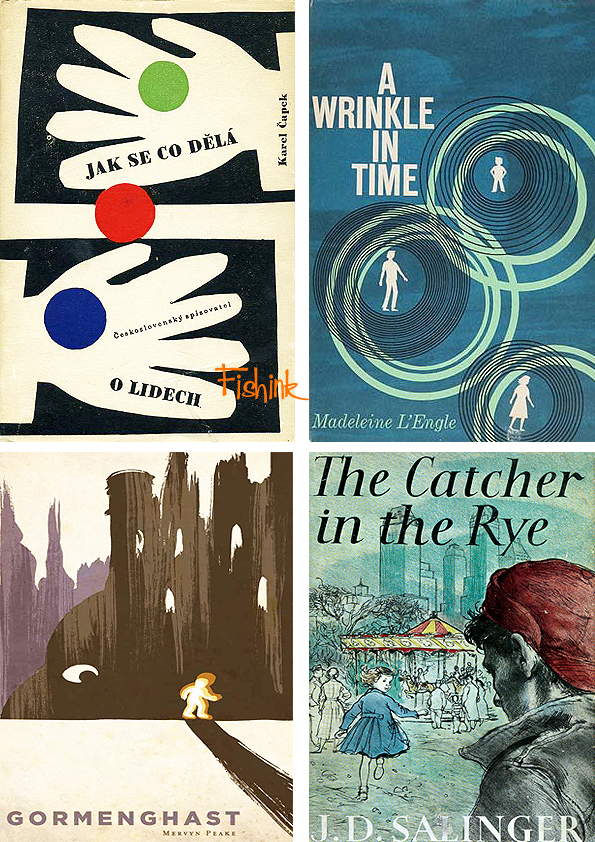
Do any of these covers prompt a memory for anyone ? Hope you enjoyed today’s visual feast !
Enid Marx A design pioneer

Enid Dorothy Crystal Marx was born in London on 20th October 1902. She first went to school in Hampstead, then at the age of 12 she boarded at Roedean in West Sussex where she benefited from an excellent art teacher. In 1921 she entered the Central School of Arts & Crafts to study drawing, pottery and printed textile design. After a year she went to the Royal College of Art (RCA), where she studied under Paul Nash, among others, with fellow students, and future RDIs (Royal Designer for Industry), Edward Bawden and Barnett Freedman. The assessor failed her diploma piece as being too abstract but sixty years later the RCA appointed Marx an Honorary Fellow in 1982 and Senior Fellow in 1987.


Gallimaufry, the College magazine, included Marx in its ‘Hall of Fame’ for 1925 because ‘among all the misses who flirt with Art, she alone woos it seriously’. Nash recognized her originality as a pattern maker and he encouraged her to become an early member of the Society of Wood Engravers and the Society of Artists.


Marx spent a year in the studio of Phyllis Barron and Dorothy Larcher as their apprentice. She learned how to mix dyes and the craft of hand-block printing on textiles. In 1926 she set up her own studio printing her usually abstract and geometric designs on various materials. These soon became extremely fashionable and sought-after. A reviewer of the 1928 Arts & Crafts Exhibition Society’s exhibition, for the RSA Journal, said that ‘Enid Marx is an able designer; her printed linen…might be taken as a good example of a good collection’. Two years later a review of her first one-women show at the Little Gallery elicited an appreciation of her designs, ‘somehow she manages to combine forms that are essentially in the modern spirit with large harmonies that have the most agreeable traditional suavity’.

Just a small selection of the repeat patterns that Enid created.

Marx showed her work at many exhibitions including Zwemmer’s ‘Room and Book’ and ‘Artists of Today’ shows, as well as the 1935 Paris Expo. Christian Barman RDI of London Transport commissioned Marx to design seating fabrics for their trains and buses (1935). They formed a mutual admiration society, Barman praised her work and Marx wrote his obituary for Design magazine (1980). Other commissions included lining fabrics for luggage designed by John Waterer RDI.
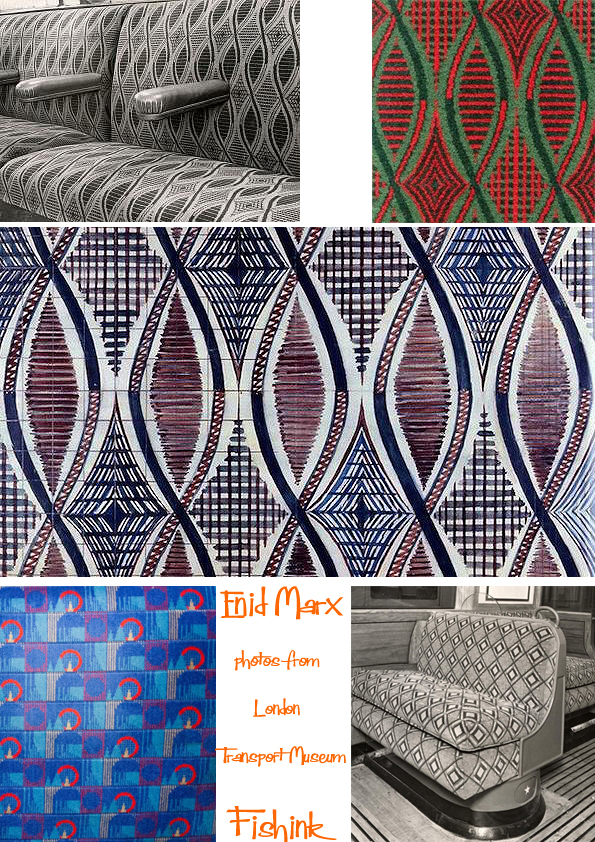

Curwen Press commissioned a number of her repeat patterns on paper to bind their publications. Book covers and wood engravings were commissioned by a number of publishers, including Chatto & Windus, Hogarth Press, Faber & Faber and Penguin, as well as being featured in various publications such as Artwork, The Studio and The Woodcut Annual. She also wrote and illustrated a number of children’s books and, with her lifelong companion, the historian Margaret Lambert, she published pioneering works on folk art – a subject close to her heart. English Popular and Traditional Art, published in 1946, was Marx believed ‘the first time there had been an overall survey, and the notion that there was indeed such a thing as English popular art’. Her bequest of the Marx-Lambert collection of 19th century ephemera, to join their holdings of British folk art has ensured that Compton Verney holds the largest collection of popular art in Britain.

With Paul Nash and Eric Ravilious, Marx taught wood engraving at the Ruskin School, Oxford (1931-33) and she spent a term, as cover for an absent tutor, at Gravesend School of Art. She took her students, including the future RDI Sir Peter Blake, to see a considerable collection of ships’ figureheads. Blake hints that this might have been the start of his own enthusiasm for popular art. At the age of 63 Marx took up full-time teaching at Croydon College of Arts as Head of the Department of Dress, Textiles and Ceramics (1965-70). ‘I was rotten at admin…but the students were poppets’, she wrote. ‘I think they only wanted me for my RDI!’ She continued to help and advise students until she was well into her nineties.

During the Second World War Marx was one of the artists invited by Sir Kenneth Clark to participate in his ‘Recording Britain’ scheme to record the country’s natural beauty and architectural heritage under threat from German bombing and other destructive forces. To her surprise her children’s book, Bulgy the Barrage Balloon, was an instant success. As well as writing and illustrating several more books Marx also produced little chapbooks, printed on off-cuts to amuse the young during air raids.

After the war Marx was invited to join one of the teams sent, by the British government, to Germany to report on how the Germans set about training designers. Margaret Lambert wrote up their findings in a report for the Board of Trade and its publication subsequently helped Robin Darwin form many of his ideas for reshaping the RCA when he became Principal. Marx went on a similar fact finding visit to the Scandinavian countries and reported that, in spite of the war, they had managed to achieve work of quality and innovation.
Towards the end of the war Sir Gordon Russell RDI invited Marx to join the Design Panel of the Utility Committee. Her textile designs were produced by Alastair Morton RDI at Morton Sundour and exhibited at Britain Can Make It (1946). Morton and Marx shared a close and creative relationship for the rest of their lives. These utility fabrics also featured in the RSA’s Design at Work exhibition (1948) and she wrote the section on ‘Furnishing Fabrics’ in the accompanying booklet. For the Festival of Britain (1951) Marx helped RDIs Milner Gray, Reco Capey and Keith Murray select the furniture, furnishings and equipment for the Festival’s Royal Pavilion.
The invitation to design commemorative stamps for the Queen’s Coronation in 1953 provided Marx with the opportunity to work in a different medium. ‘Our stamps’, she said, ‘are, or should be regarded as, our Queen and country’s visiting card’. Marx described working on the stamps as one of her greatest pleasures. She received a further commission from the Post Office to design the Christmas stamps for 1976, her designs for these were taken from the ‘Opus Anglicanum’ embroideries.

Appointed a Royal Designer for Industry (RDI) in 1944 in recognition of her excellence as a ‘pattern maker’, the only member of the Faculty to be given this attribute, Marx felt that she was now accepted as a professional, ‘before I was like most women artists, just considered an amateur’. She regularly attended Faculty meetings and took an active role as a jury member for the RSA’s Industrial Design Bursaries competitions. Marx urged the RSA to be more proactive and influential in design education, she regularly encouraged them to extend their archives and raise their profile and she used the correspondence section of the RSA Journal to express her concerns about the British manufacturing industry, design and craftmanship. In her appreciation of the life of the Finnish textile designer Dora Jung HonRDI, for the RSA Journal in 1981, Marx wrote that Jung’s ‘weaving forms a beautifully illuminated page in the record of Finnish art and design’.
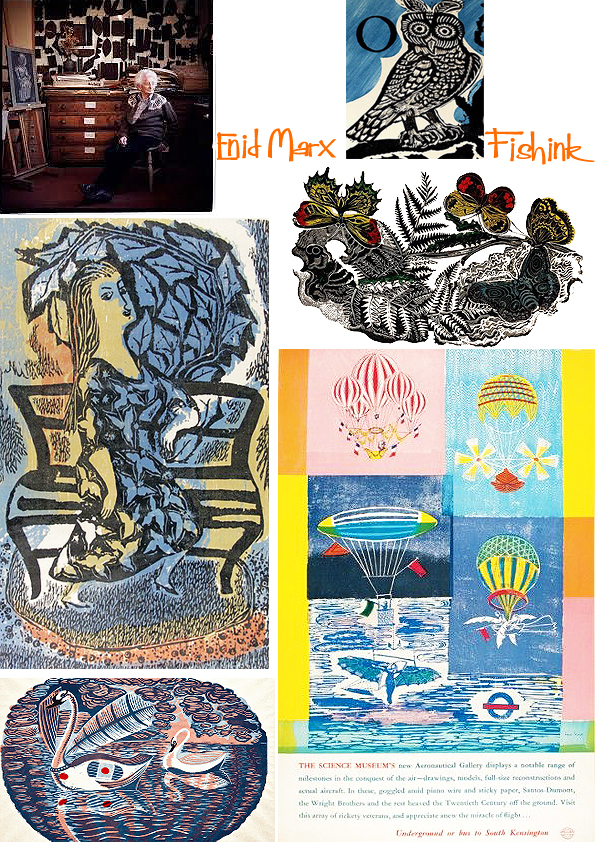
A small, dark determined woman of considerable stamina Marx campaigned ceaselessly for the continuation of the direct, unaffected, but human design values that her generation had established before the war. Enid Marx died in London, at the age of 95, on 18th May 1998.
Many thanks to the University of Brighton Design Archives for the information for this post.
Green Walk Arts and Crafts Weekend Manchester
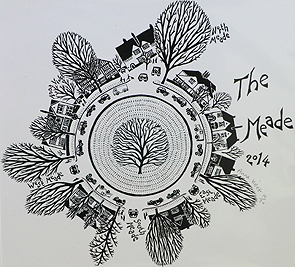
I was sooo lucky to attend this fab event at the weekend.
Now in it’s twelfth year the Green Walk Open House Weekend is a unique, community run event, championing the array of local artist, craftspeople and designers that live locally. About ten houses at the bottom of this leafy cul-de-sac all open their doors to the public, to wander through a couple of rooms looking at the array of artists work on display. There’s a little green at the bottom of the road where singers sing, people lounge on deck chairs and children run and play.
It’s the nearest thing I’ve experienced to really living in an artists community and it was a wonderful day.
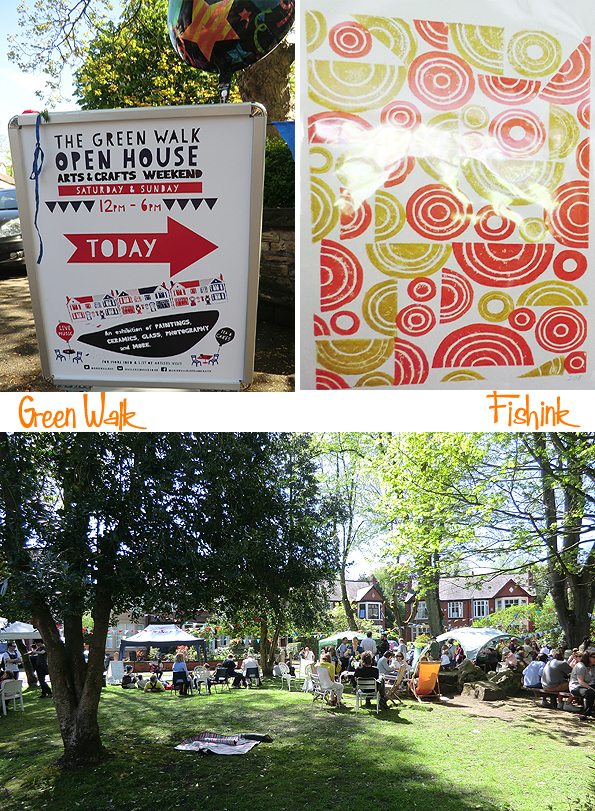
Showing you around some of the exhibitors, I’ve started with the delightful, mid-century inspired range of designs and fabrics by Prints and Press owner Alison.

They would certainly help bring a ray of sunshine into any room.
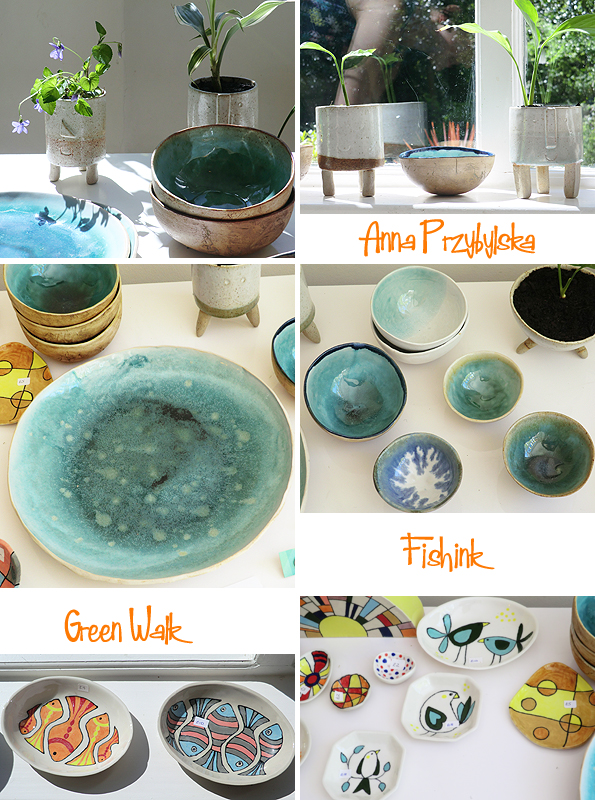
Ceramics by Anna at Wonk Creations, who had this beautiful space looking out onto the sun-filled garden of one house. Little characters on legs, moody yet refreshing blue and green plates and bowls and a selection of more illustrated work by her friend Ann Tarpey, were all available to buy.
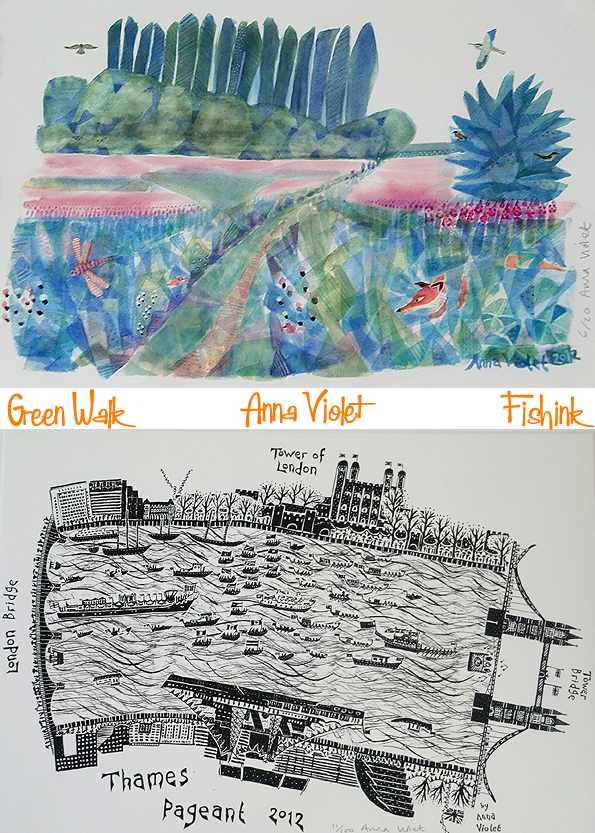
I’m familiar with the black and white work of Anna Violet who lives on my dog walking circuit in Chorltonville. I’d not, however, been introduced to her beautiful children’s illustrations depicting scenes from Aesops Fables. Brilliant characters.
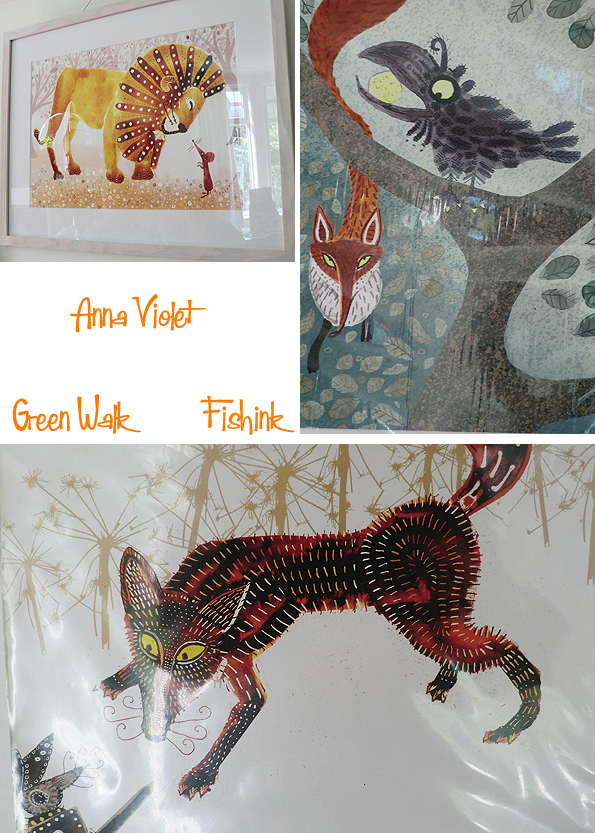
I also loved this watery coloured painting of Chorlton Ees, another fav walking spot of mine.
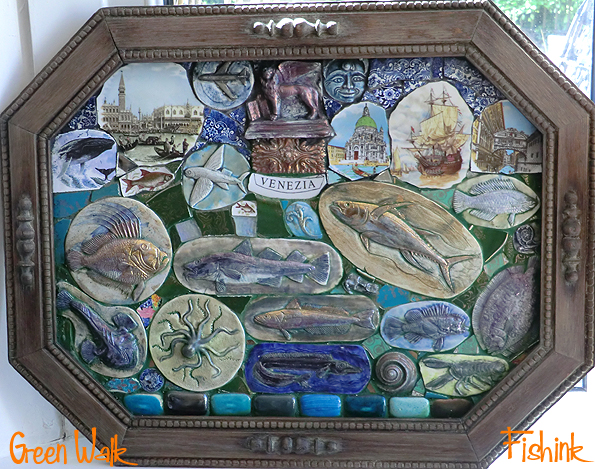
Wonderful to meet the very talented sculptor and ceramist Philip Hardaker, and take in the hours and hours of work that go into his intricate panels, mirrors and framed hangings. Stunning work that needs to be seen up close to appreciate how much time is involved in each piece.
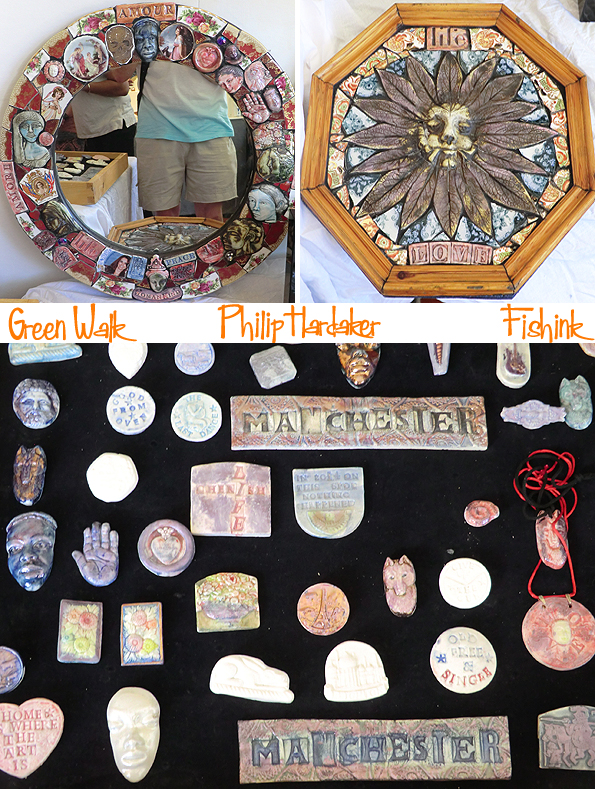
Philip takes casts from objects, sculpts pieces himself and creates photo decals to adhere to the ceramics pieces he assembles. Each piece is 100% unique and personal, hr takes on community projects, personal commissions and even welcomes visitors to his workshop near Stoke-on-Trent, with prior arrangement.
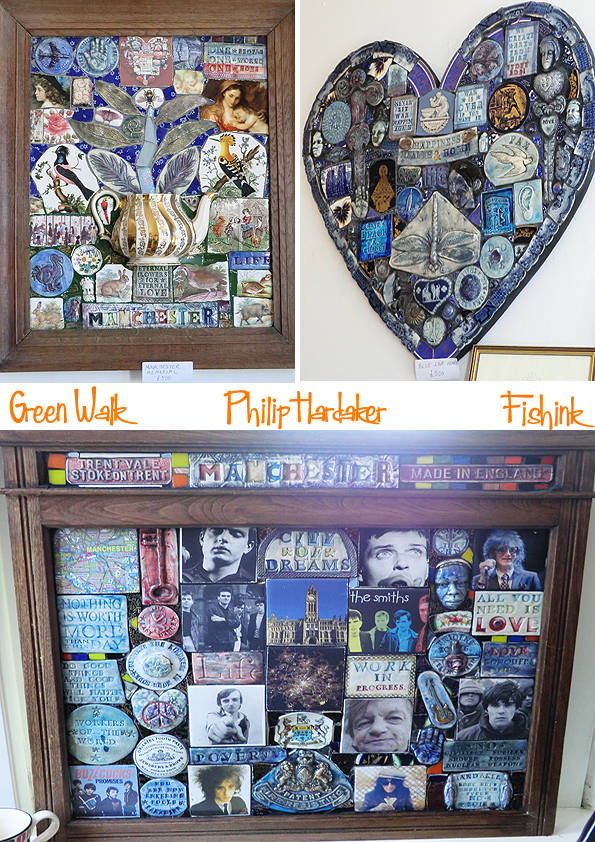
A fish inspired one, just for me lol.
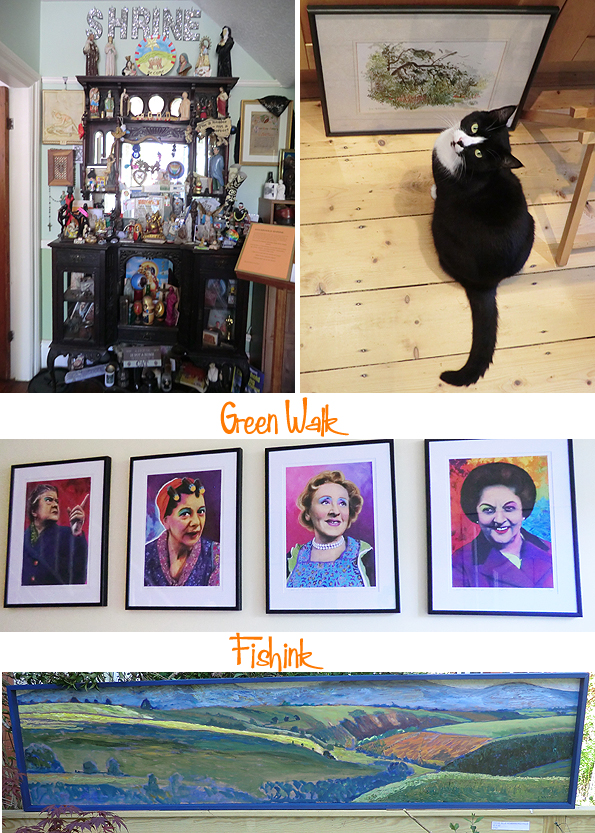
You do see some amazing things wandering around artistic homes. Look at this Shrine, it had religious icons, superheros and all kinds of amassed artefacts and bits and bobs that people adore, admire or just like to have around. The cat was admiring the artwork too. One home owner used to work on the TV show Coronation street, hence some of these colourful portraits of the early stars.
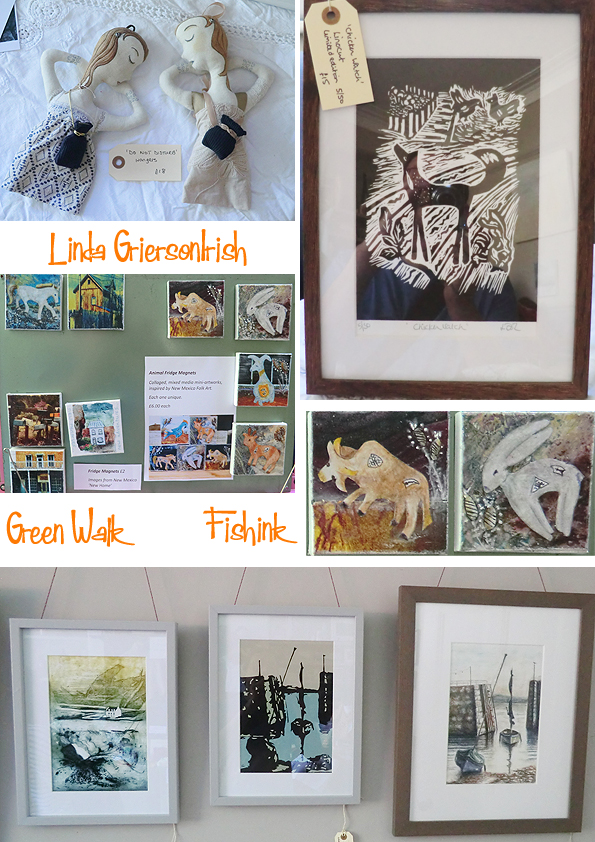
Some lovely illustrations by Linda Griersonirish.
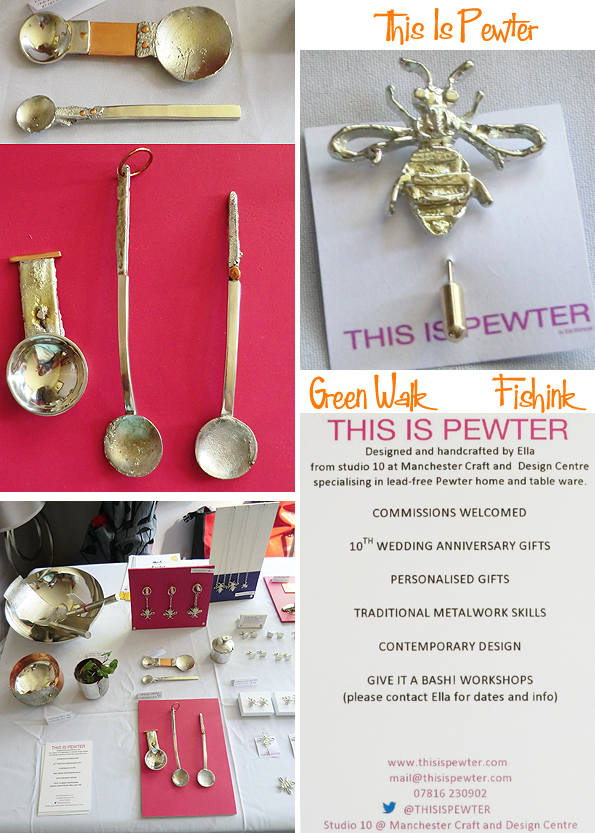
Another familiar face was that of Ella who runs workshops and has a shop in the Northern Quarters’ Manchester Craft and Design Centre. Ella has been busy designing a whole range of spoons, bowls and Manchester Bees. They looked amazing catching the sunlight too.
Finally I got to meet ceramist Barbara Chadwick. I say finally because Barbara is part of the Northern Potters group, and I bought one of her birds a couple of years ago from a show in Didsbury. The show is actually on again in a couple of weeks time, called Pots at the Parsonage.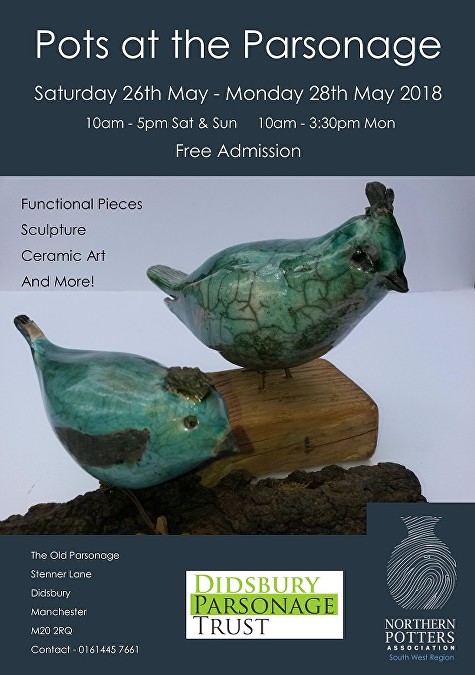
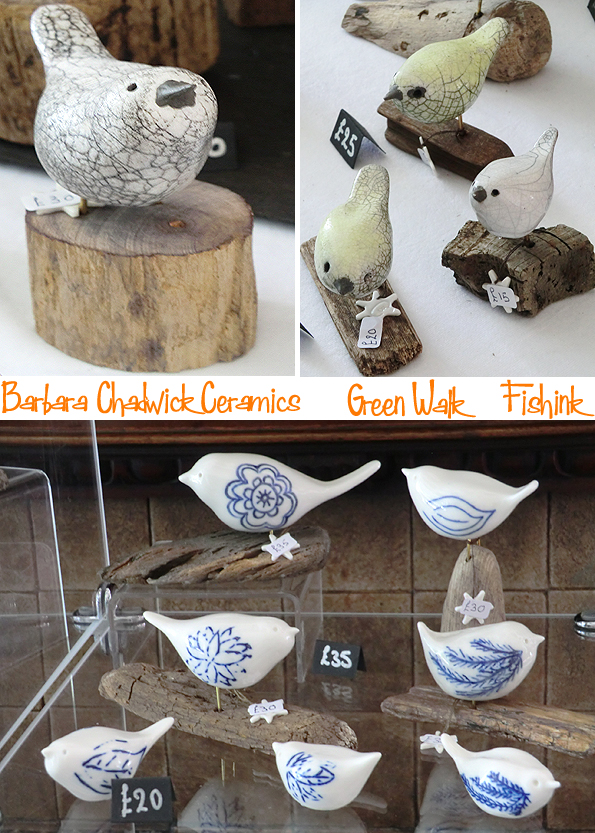
Barbara’s work has a charm of it’s own. Raku fired and crackle glazes really add beauty and texture to her wee feathered friends.
Even some newer wall mounted ones for those of us who have run out of surface space lol.
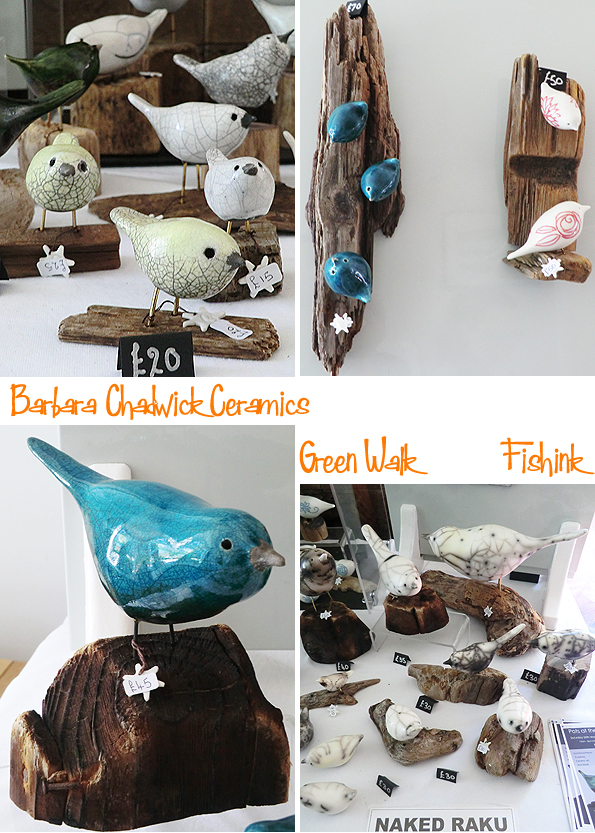
Thanks to the organisers, home owners and artists for letting us all into their lovely homes and to view such amazing work. I hope everyone had a great two days.
Andrew Ludick More Ceramics
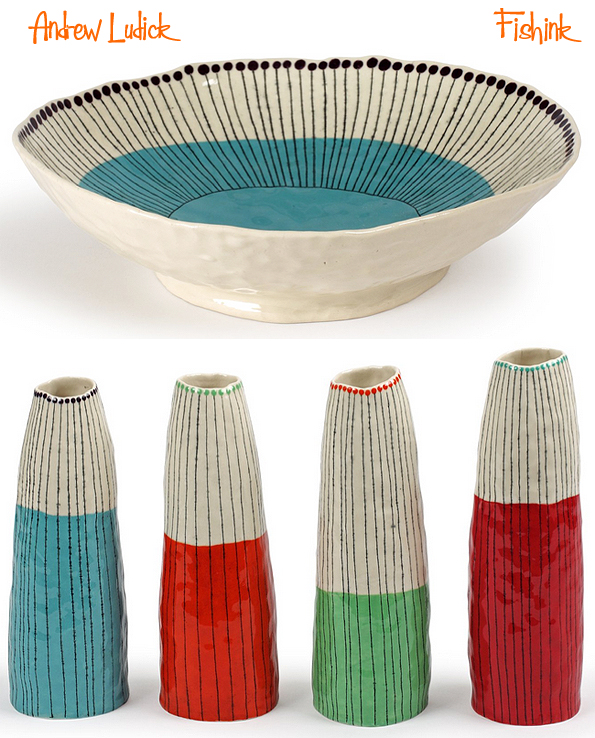
I’ve spoken before about the wonderful ceramics by Andrew Ludick and I know his work delights you too as the post I created is constantly searched for. One of my readers recently asked a question about Andrew’s ceramic techniques and that prompted me to get in touch with him and bring us all up to date with his work.
How long have you been making ceramics now and did you do something else artistic prior to this ?
I have been making ceramics for about 12 years. Before that I did painting and drawing mostly, selling work through galleries and trying to make a living that way, I still do lots of drawing in sketchbooks and some painting but mostly as preliminary design work for ceramics.
Here’s some of Andrew’s sketchbook drawings he kindly photographed for us.
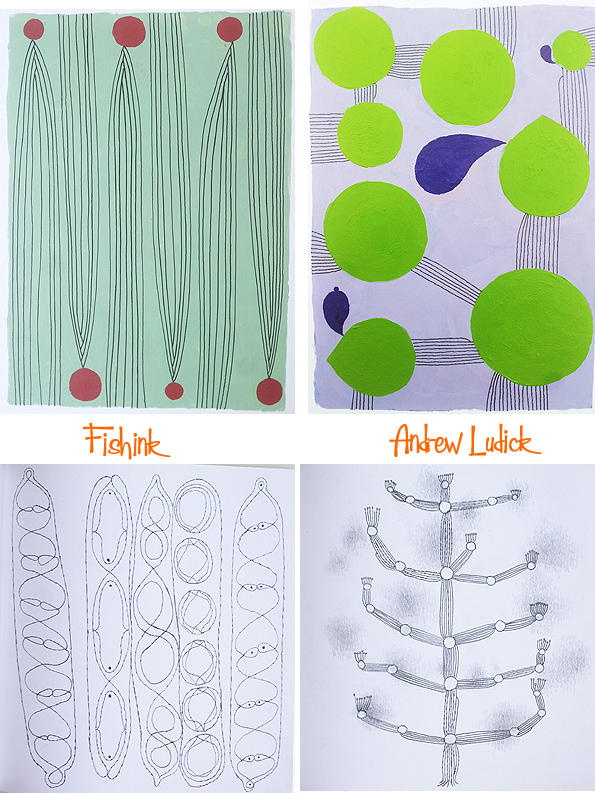
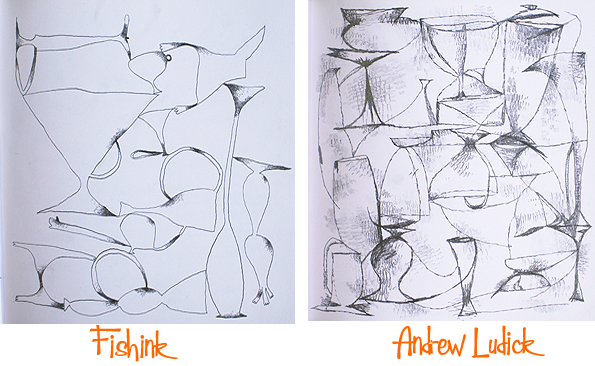
What first inspired you to start making ceramics for yourself ?
I think I was inspired by ceramic work made by some of the more poplular painters, like Picasso, Miro, and Gaugaun. I thought it was really interesting how it could be viewed as another medium for painting, much like printmaking is. Also work by South American people of Peru and many works by African artists.
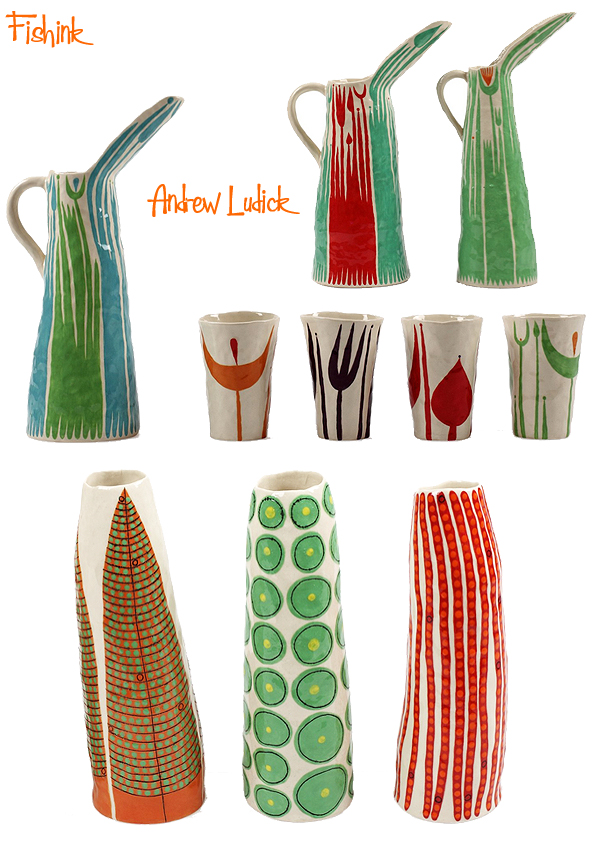
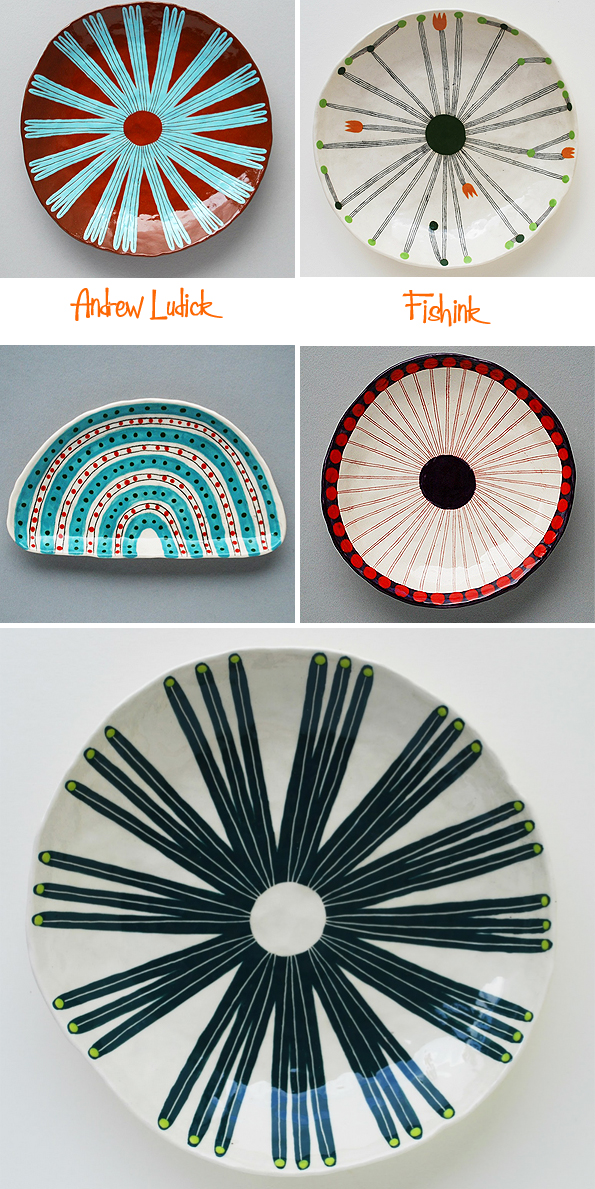
At times your work reminds me a little of papier mache. What made you decide to hand build your pots and plates rather than use the potters wheel ?
I like the pace of hand-building, its much slower than throwing and I feel like I have more time to think and interact with whats happening with the piece as I create it. I think the pace of hand-building also matches that of drawing and painting, I have time to stop and make decisions, get up, walk around and stare for a while or even cover it in plastic and come back to it a week later and see it with new eyes. I also can do that while I’m decorating the piece. Sometimes I can make a form and wrap it in plastic and come back to it a month or more later when I’ve finally figured out how to decorate it.
The reader who prompted me to contact Andrew asked ” I have a question about the thin lines you draw on your pottery. I can see you use a pencil to draw them, but how do you paint such thin lines? “. Andrew replied “I draw my lines in with a needle tool when the clay is leather hard, then I bisque fire it. After the bisque firing I mix a bit of black stain pigment with water and brush over the lines and then rub any excess into the lines. Then cover with a clear glaze and fire. ”
Here’s a short video of Andrew making a bowl.
I love the splashes of bold colour and spidery black lines that you use. Do you sketch ideas for your work beforehand or does the shape or decoration process determine what the finished piece will become ?
I think both of these things happen. Sometimes I will create a decoration or pattern or something while I’m working in my sketchbook and then try and create a form that matches up or compliments it somehow. Sometimes I will make a form and have no idea what I’m going to paint or draw on it, so I make some sketches with that in mind or I look at some old sketchbooks to see if anything I’ve already created might work. Recently I’ve started drawing ideas onto the leather hard clay very lightly with a pencil just to give me an idea if something would work. If I find a decoration or something that really works with a form then I will reproduce that piece a few times but just change it slightly each time. So sometimes the first form and design can look quite different from one made later on. It’s really nice to see work evolve like that in a natural linear progression.
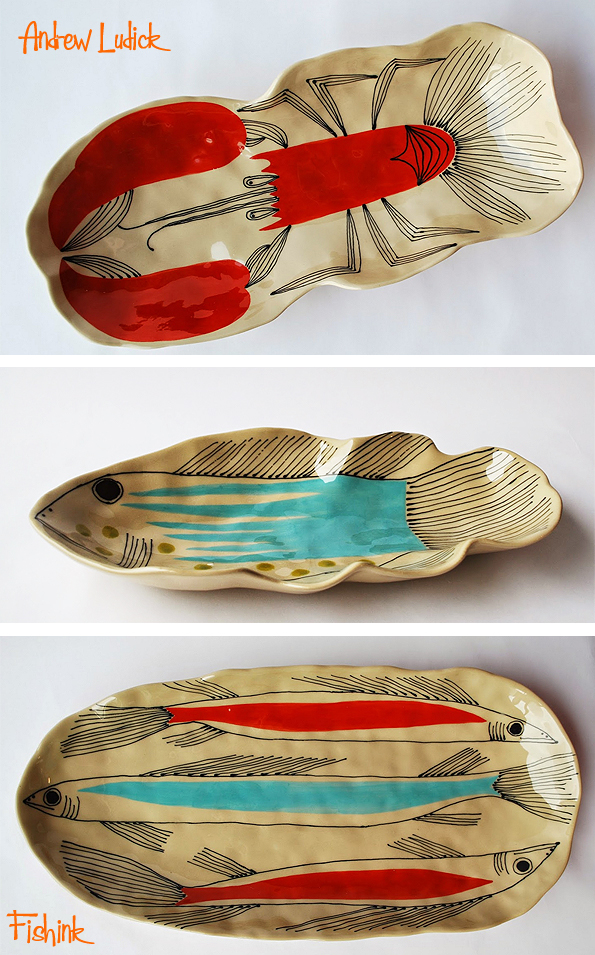
What plans do you have for your work going forward, new shapes, places to exhibit and display your work in ?
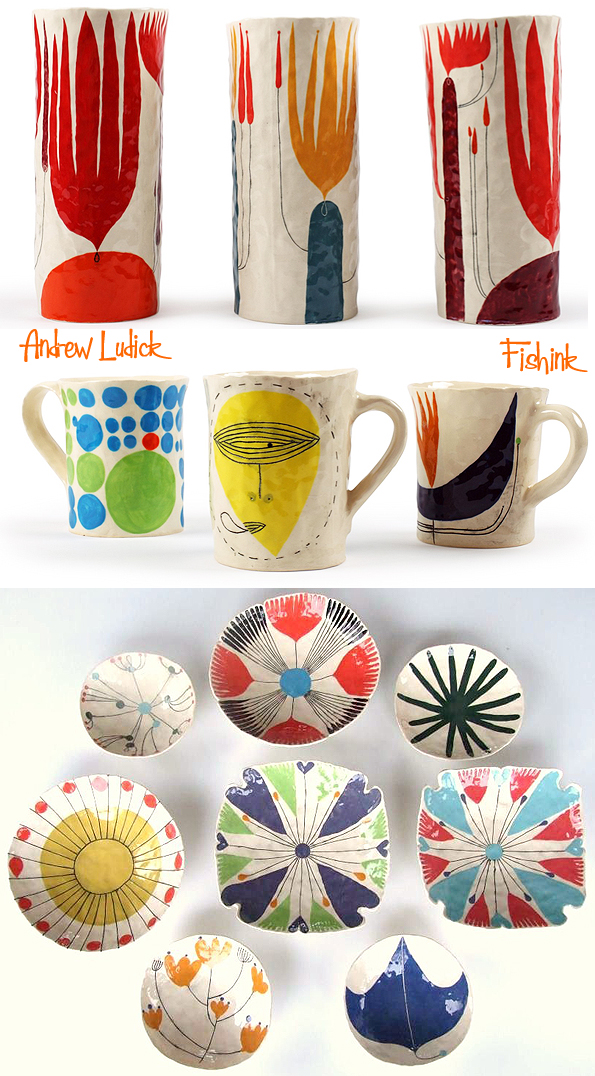
I sort of have a backlog of shapes and designs that I want to work on, they are all sitting and waiting in my sketchbooks to be created. I started working in a red earthenware which is a nice change. The clay that I use at the moment is white earthenware so it is very versatile in what colours work on it and the black line drawings show up beautifully like on paper. With the red it has its limitations, which I like, as to what colours you can use, and it is very nice to work with in hand-building. I am also starting to work larger and larger. Pieces that I had made in the past in smaller sizes I am remaking in much larger sizes which give them a bigger presence.
Here’s how Andrew builds up some of his pot shapes.

The decoration and shape of the ceramic share equal importance to the look of the finished piece.
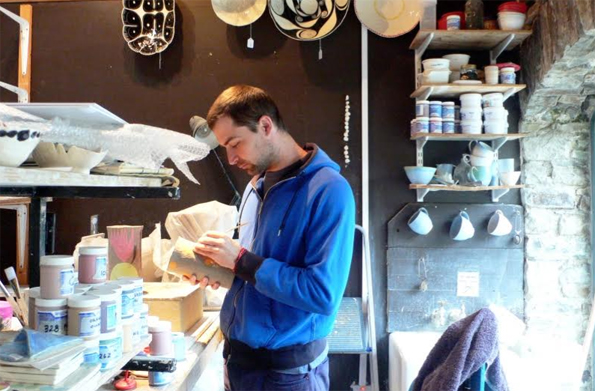
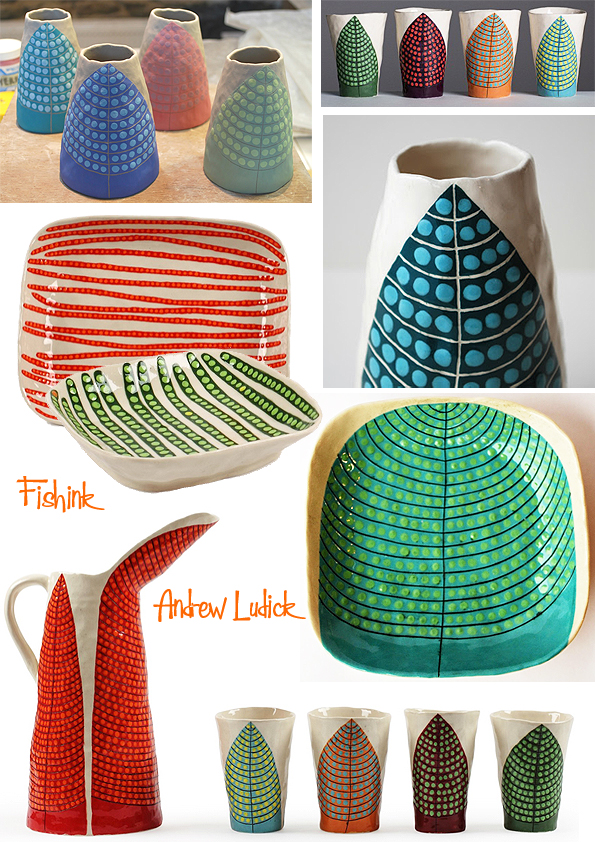
Many thanks Andrew for answering my questions today, it’s been great having you back on Fishinkblog.
You can see more of his work or contact him to purchase something here.
www.fishink.etsy.com New Ceramics
I have finally been able to pick up my newly fired ceramics… Yay!
The glazes have come out a wee bit stronger and darker than I’d imagined, and I had hoped some of them would have been a little nearer to the unglazed colours as I liked their subtlety. But that said, I’m pretty pleased with them. This was the unglazed stage.

Whats more, I’ve reopened my Fishink Etsy Shop to sell them from. Please feel free to pop over, have a browse and spread the word to your friends and family, I’ll be adding more over the coming weeks so if you don’t see anything to your taste, do call back.
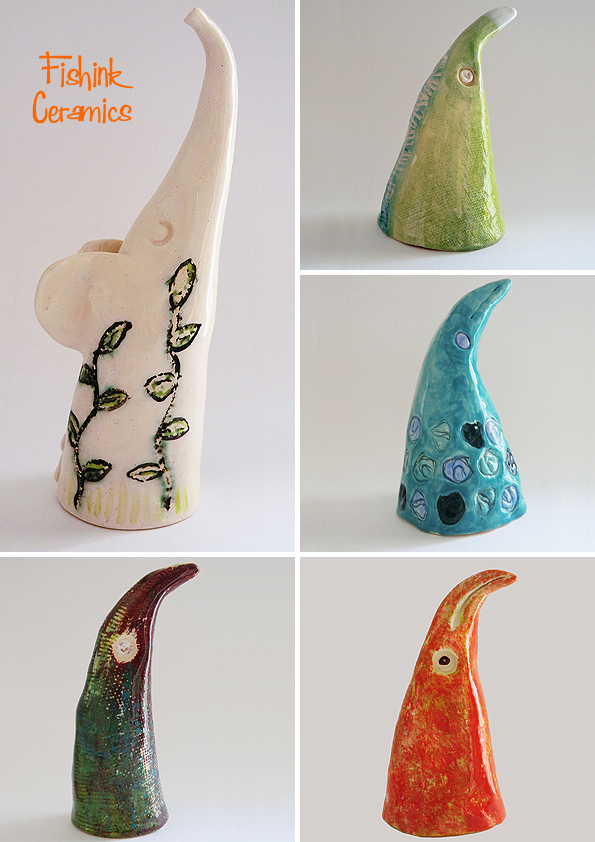
Everything is made by hand and exclusively a ‘one-off ‘, i.e. no two items will be the same. They are based on my quirky drawings and creative creatures and I hope you like them.
Do let me know your thoughts.
Issey Miyake

Another creative’s work I admired from my college days, was that of the Japanese fashion/textile designer Issey Miyake.
Along with other strong oriental designers like Rei Kawakubo working for Comme Des Garcons and Yohji Yamamoto also designing in the Eighties, Issey’s beautiful sense of line and form, grace and design struck a real chord with me.
I even entered a textile competition designing a collection of fabrics with him as the inspiration !

Issey Miyake was born on April 22, 1938 in Hiroshima, Japan. (Happy Birthday for yesterday !)
He studied graphic design at the Tama Art University in Tokyo, graduating in 1964. After graduation, he worked in Paris and New York City. Returning to Tokyo in 1970, he founded the Miyake Design Studio, a high-end producer of women’s fashion.
From the outset, Miyake’s creative process has been based upon the concept of “one piece of cloth.” His process explores the fundamental relationship between the body, the cloth that covers it, and the space and room that is created between these elements, divesting itself of the labels of “East” or “West”

The outlandish model and singer Grace Jones made an excellent collaborative choice, to show off Miyake’s amazing creations to the fashion world.
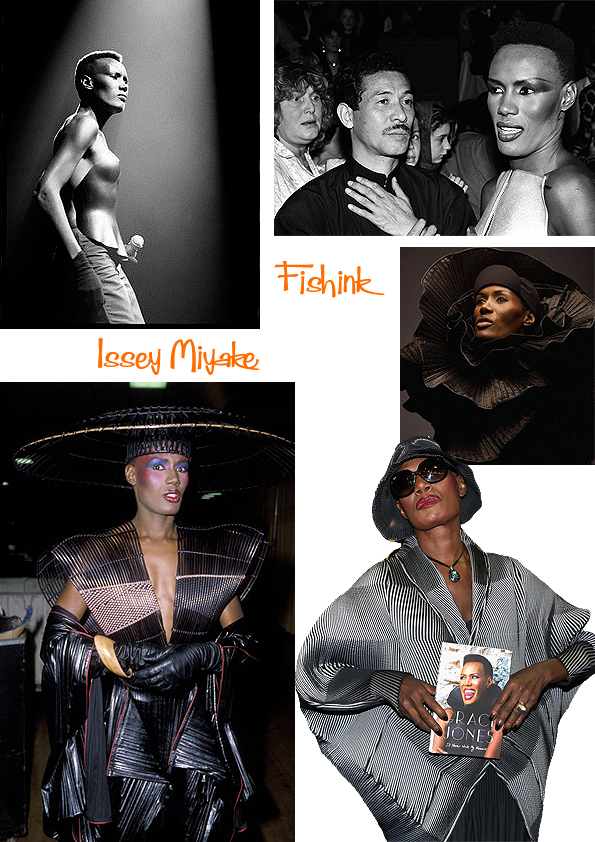
He’s the master if creating unusual shapes on the body.

After the ISSEY MIYAKE A-ŪN exhibition in 1988, Miyake began to experiment further with pleats, in the hopes of expanding the possibilities of the medium. When William Forsythe came to Miyake asking him to create clothing for his new production The Loss of Small Detail for the Frankfurt Ballet (first performed in 1991) Miyake was inspired and attempted to create pleated clothing that would move, using a new lightweight knitted material and introducing a new technique called “garment pleating.” Traditional pleated clothing is made by pleating fabric, then cutting and sewing the individual garments. Here, an oversized piece of cloth was cut and sewn in the shape of the desired garment and then sandwiched between two layers of washi paper and fed into a heat-press. Unlike its predecessors, these pleats remained permanently in the fabric’s “memory” and never had to be returned for re-pleating.

This experiment lead to further changes and adjustments and in 1993, the line PLEATS PLEASE ISSEY MIYAKE was born. The label offered clothing as a product that was easy to to wear, care for and to travel with; PLEATS PLEASE ISSEY MIYAKE was the perfect, elegant, yet practical and affordable solution for the needs of a modern woman, translating effortlessly from work to play to suit her diverse needs.

It is impossible to tell the story of Miyake’s work without mentioning the unique collaboration with photographer Irving Penn that lasted for over 10 years, beginning in 1986. Penn’s photographs, which number around 250 and were styled by Midori Kitamura (current president of Miyake Design Studio), burst with energy and surprise, and were compiled into 7 books. This body of work represents not only an archive documenting a unique artistic collaboration but also of the spiritual connection between two creators, separated by two continents but which resonate and transcend the realm of fashion photography.

In 1998, Miyake began to develop A-POC (A Piece Of Cloth) with Dai Fujiwara. A-POC was not only able to create clothing with a high degree of variation, but was also able to control the amount created through the process of casting, where each thread receives computerized instructions. A-POC was revolutionary in that it began with a single thread and resulted in fabric, texture and a fully finished set of clothing in a single process. It led the way, along with the concept of engineering design, to a new methodology of clothing design.

More recently he has worked with brands like Adidas to create backpacks and sport bags.
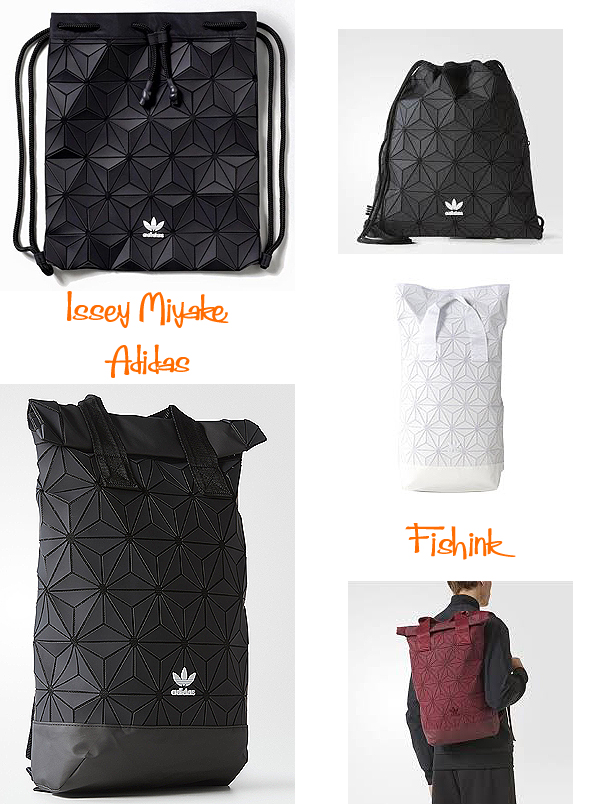

Today, Miyake is working on the next phase and new projects. He and longtime Issey Miyake Collection production chiefs Sachiko Yamamoto and Manabu Kikuchi have assembled a select team of experienced and young staff members from within the Studio known as the “Reality Lab”. The Reality Lab ‘s focus is on new designs that are intimately connected to society. Many of these projects come out of the extensive research undertaken in preparation for the XXIst – Century Man, an exhibition directed by Miyake at 21_21 DESIGN SIGHT in 2008. The work at the Reality Lab includes a focus upon the development of environmentally-friendly materials that recycle and recreate new and better things from pre-existing ones.

Such a creative mind and spirit.
Thanks to Wikipedia and the Issey Miyake official site for the written information used in this post.


 fishinkblog.com