Adrian Johnson Illustrator of Modern – Vintage work
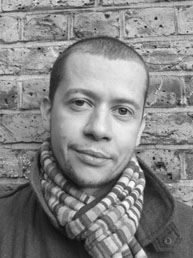
Over the years, Liverpool born Adrian Johnson has developed a unique and strongly identifiable
body of work. His trademark economical, highly crafted, graphic work is constantly evolving,
whilst always maintaining a healthy distance from current trends and passing fashions.

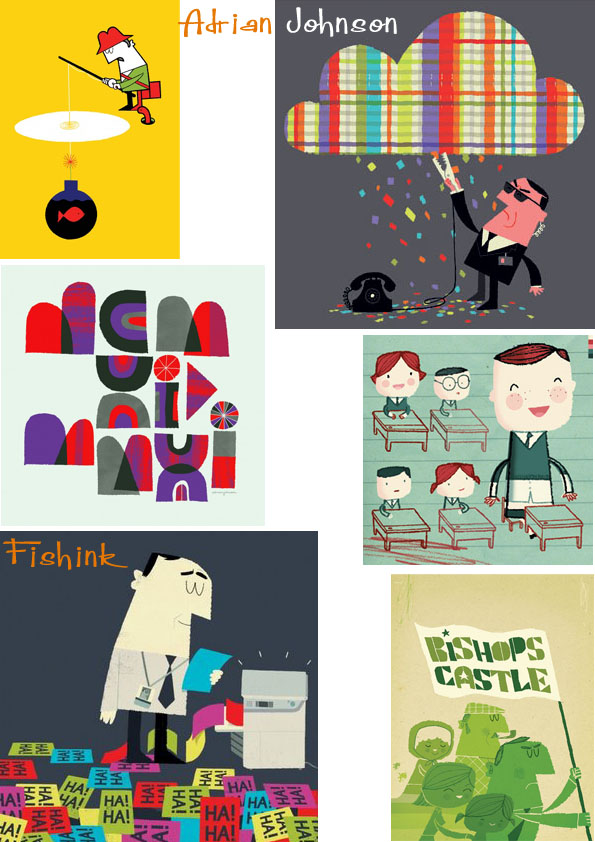
Adrian’s work has already led to a prolific working career and a client list which includes
Paul Smith, Adidas, Stüssy, Monocle, The New York Times and Unicef. Attention to detail,
humour and a simple timeless sophistication mark him out as one of the leading illustrators
currently practising. He has exhibited work in London, New York, Los Angeles and Tokyo.


He has a great stylish flair to his illustrations and a quirky sense of humour when it comes to getting an
emotion or message across. He has also illustrated numerous books, such as ‘ Thats’ Not Funny ‘ and
‘ What ‘ and has a range or printed T shirts for sale on his website store.
Cyril Edward Power and Sybil Andrews
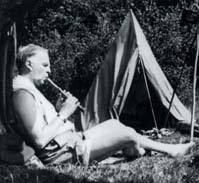
Cyril Edward Power 7 December 1872 – 25 May 1951 was born in London. He trained as an architect
with his father’s firm, won RIBA’s Soane Medallion in 1900; then continued practising until
World War I, when he served with the Royal Flying Corps.

In 1921 he met Sybil Andrews, with whom he maintained a close and somewhat informal working
relationship which lasted some 20 years. Power and Sybil Andrews enrolled at Heatherley’s School of
Fine Art, London in 1925 when he was also elected a Fellow of the Royal Historical Society.

Power also helped Iain McNab and Claude Flight set up The Grosvenor School of Modern Art
in Warwick Square, London. By now Power was busy as a printmaker and watercolourist, showing
at pioneering Redfern Gallery print exhibitions in 1930s. Later in his life he turned to painting in oils
with a palette knife. Exhibited at RA, RBA, Goupil Gallery and Royal Glasgow Institute.
A retrospective exhibition was held at Redfern Gallery in 1998.

I love the way that his rowers here almost look like a stained glass panel or a textile floral print.
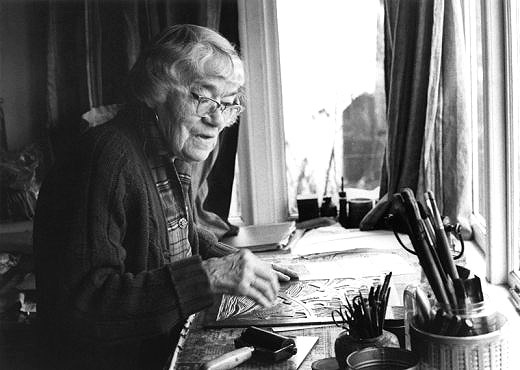
Sybil Andrews 19 April 1898 – 21 December 1992 was a printmaker, painter, graphic artist
and educator, who was born in Bury St. Edmonds, Suffolk, England.
She moved to London (England) in 1922. In 1947, she emigrated to Campbell River ,Vancouver Island,
British Columbia, Canada,where she worked, taught and lived for the rest of her life.

Her mediums were the colour linocut, etching, posters, pastels, ink, watercolour, monoprint and oil.
Her subjects were human activity (at work, sports, travel, etc.), figures, animals, genre, allegory,
architecture and landscape. Her style was Art Deco, Futurism, Cubism and Vorticism.
Her work is identified by a simple format, clean lines, distortion, vivid colours, drama and rhythm.
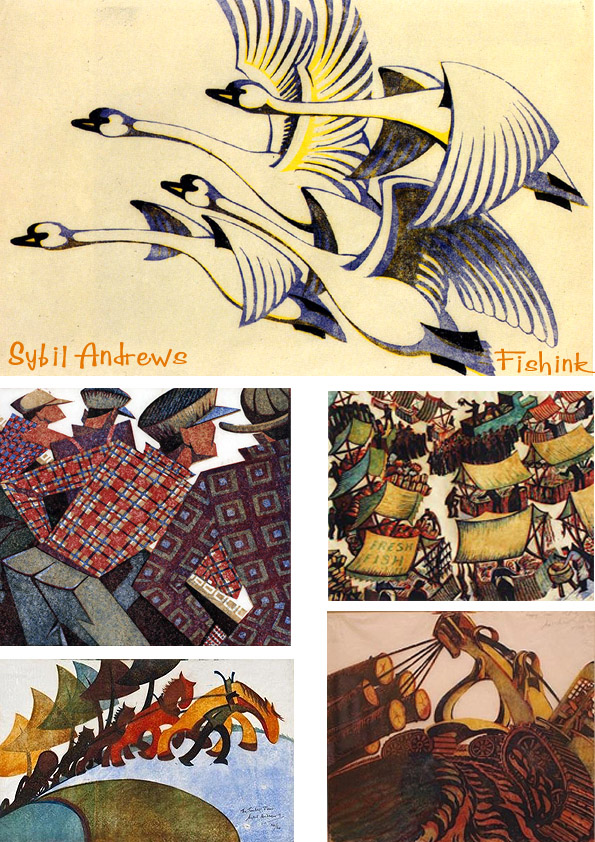
She said “The colour linocut was just the medium for me, being interested in dynamics and ideas
and patterns… It is impossible to be fussy with lines, you have to simplify, you are forced to simplify
your idea to its fundamentals.”
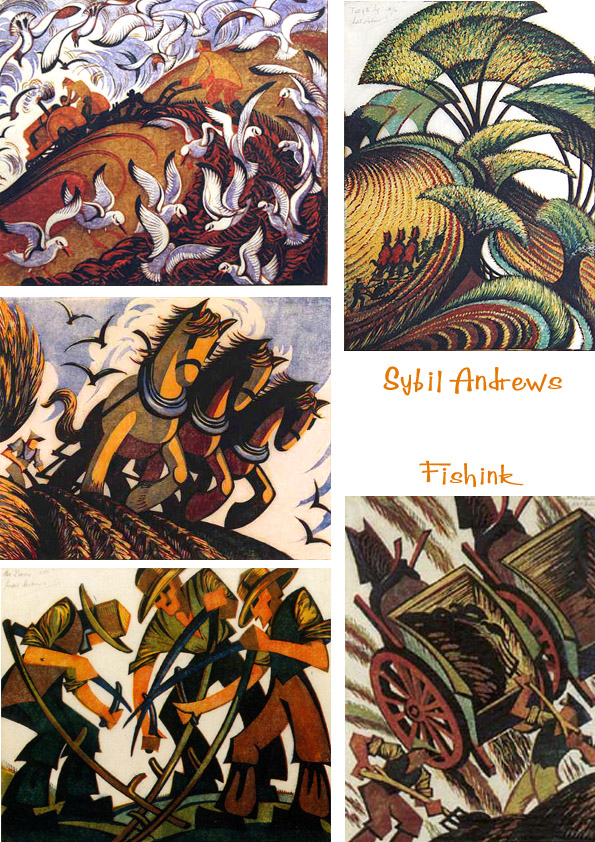
Andrews produced 76 linocuts in her life, of which 43 were made from 1929 to 1939, which is considered
to be her best period. Her work with figures on the land is both dynamic and a real capture of the times.
I love the way she captures the striding ploughing horses from such a low perspective that it makes them
appear to be thundering towards you whilst working the land. Great dynamic illustration.

Naturally Cyril and Sybils’ work went on to be very influential. It strikes me of an odd joining of russian
war posters mixed with the beauty of a Samuel Palmers’ rustic landscape ! lol
Samuel Palmer Rustic Artist
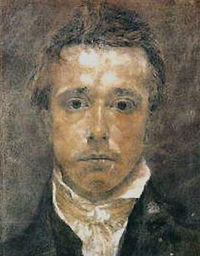
Samuel Palmer (1805-81) makes me think or warm summer meadows, lazy days and the rustic rich
life in the countryside. His work has been in my mind a little after all the walking I’ve been lucky to do
whilst the sun has been so glorious. I decided to find out a little more about him.
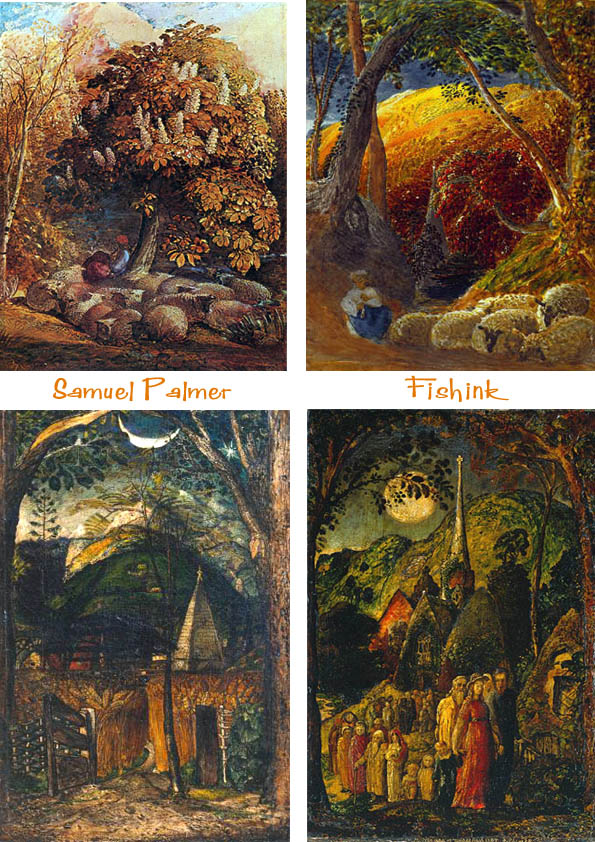
He was one of Britain’s greatest artists. He painted familiar scenes using trees, villages, the night sky
as his subjects also using rich forms and vivid colours. It’s still surprising to see that his work looks
so bold and modern even though they were painted nearly two centuries ago.
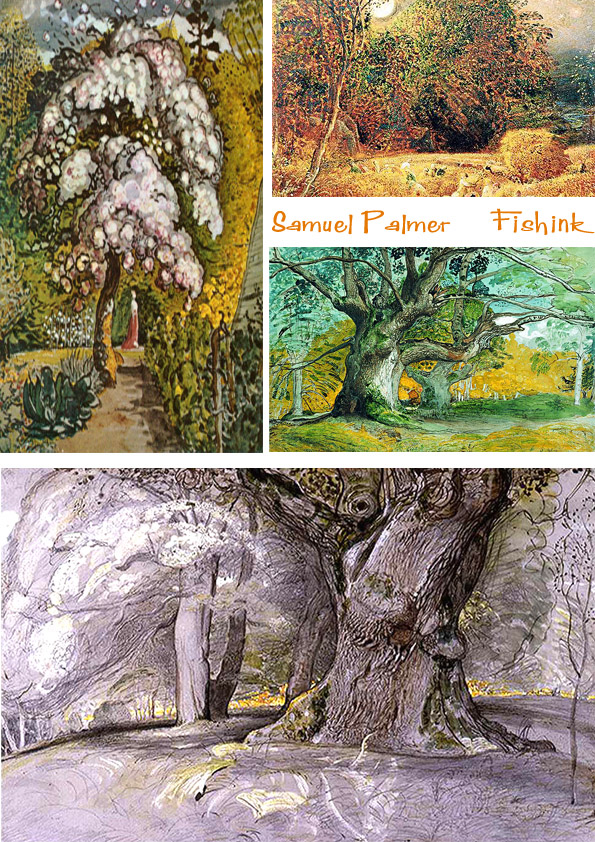
He became an artist at a young age and was strongly influenced throughout his career by the work of
his friend and mentor William Blake. Palmer’s early work was partly shaped by his interest in the
primitive’ artists of the fifteenth and sixteenth century. For a time, he lived in the Kent village of
Shoreham, whose surrounding countryside became his ‘Valley of Vision’.
After this he married and spent time in Italy.
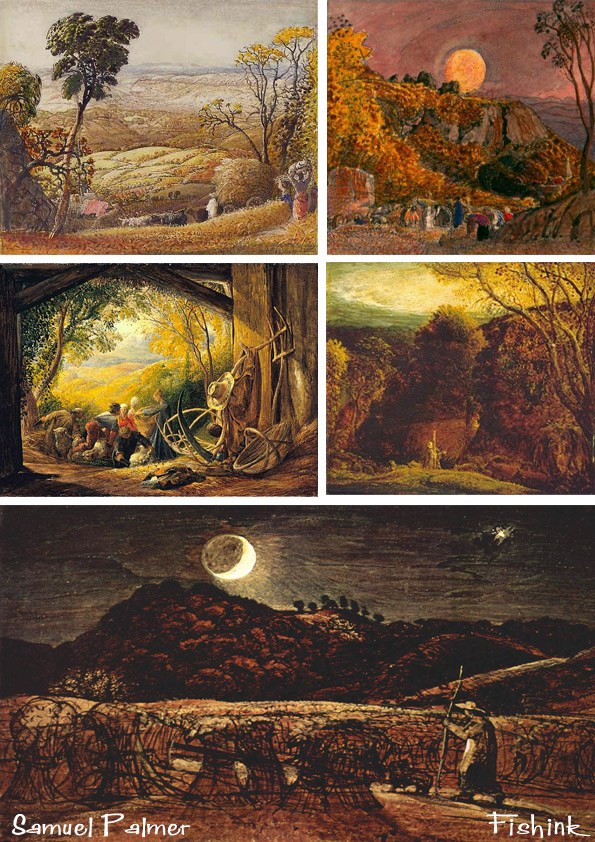
Following his return to London he worked in watercolour and took up etching. Sadly in his later years,
Palmer suffered a series of personal hardships – including the death of his favourite son and ended
his life living as a recluse.
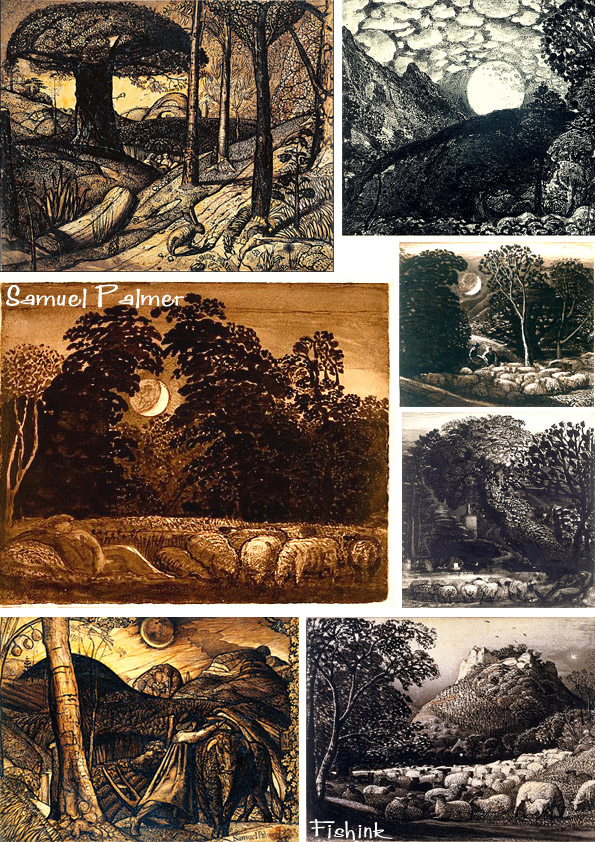
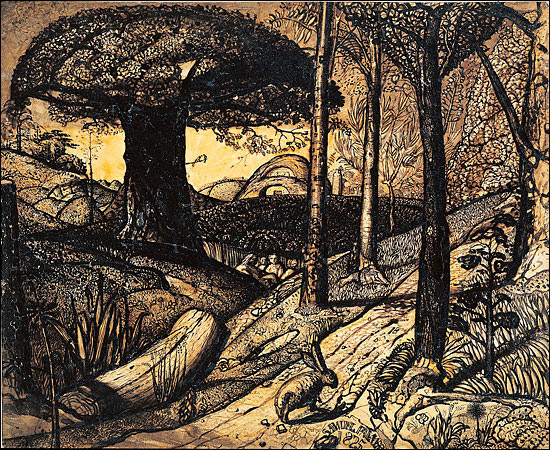
I think the above etchings are some of his favourite work of mine. The way he skilfully plays with both
light and nature, whilst portraying such form and depth in his layered landscapes makes me sigh in a
happy, but kind of envious way lol. I’ve enlarged the one below called ‘Early Morning’ painted in 1825,
to show his wonderful command and understanding of his line, medium and subject matter.
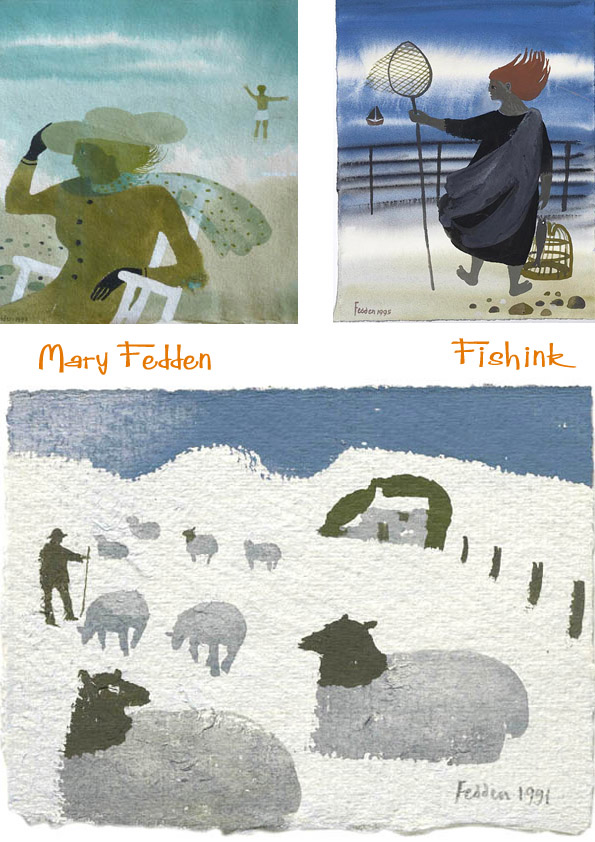
Mary Fedden Painting since the fifties.
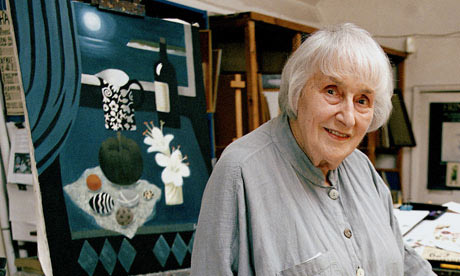
At the age of 16 Mary left Bristol and moved to London to study at The Slade School of Art.
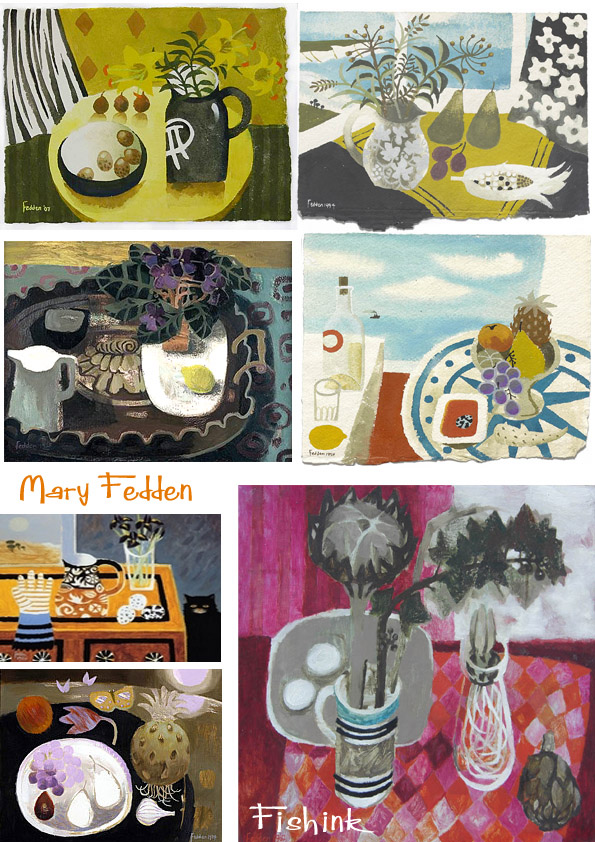
© Mary Fedden c/o Portland Gallery http://www.portlandgallery.com/artist/Mary_Fedden
From 1936 she began her career as an artist painting theatrical sets for a number of prominent theatres.
During the war years she served in both the Land Army and Woman’s Voluntary Service and in 1944
was sent abroad as a driver. She was also involved in designing propaganda posters for the war effort.

© Mary Fedden c/o Portland Gallery http://www.portlandgallery.com/artist/Mary_Fedden
In the early 1950’s together with her husband the well-respected artist Julian Trevelyan (1910 – 1988)
she travelled extensively throughout Europe, America, India and Africa. Once she had settled back into
life in England she accepted a prestigious teaching job at the Royal College of Art (1958 – 1964)
and became the first female tutor to teach painting. During her time at the RCA, she taught an elite
generation of art students including David Hockney, R.B Kitaj and Patrick Caulfield.
She also at this period enjoyed many friendships with aspiring (and now prominent) artists.
After this well-respected teaching position she began to teach at the newly founded Yehudi Menuhin
School for gifted Musicians.
” Sometimes people comment that a certain object doesn’t look a bit like the real thing. I’m glad it doesn’t
I prefer to use my imagination and change things around, I am not after a representational image.
Generally I start by placing a shape tentatively in the composition, but if it doesn’t take form
and begin to interest me, then I drop it and move on to something else.”
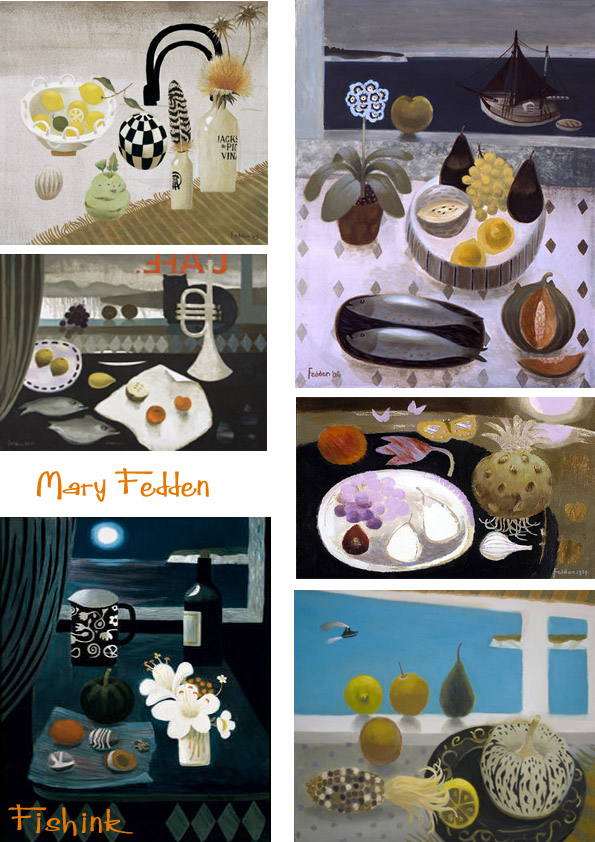
© Mary Fedden c/o Portland Gallery http://www.portlandgallery.com/artist/Mary_Fedden
Fedden’s career has a notably domestic undertone; exhibitions in furniture shops, regular magazine
commissions, set designs, and ultimately the embracing of a habitually ‘homely’ subject matter.
This year she has designed products for the Royal Academy shop and also for the popular
kitchenware brand, ‘Emma Bridgewater.’ Despite being in her nineties she continues to paint
everyday and is said to be painting more “prolifically than ever”.
“As well as coming from my sketchbooks, or from particular objects that interest me,
ideas might come from talking to people or looking at things,” Mary says, “and other ideas
for paintings come to me in bed. Also, sometimes people put things through my letterbox if
they think I might be interested in them.”

© Mary Fedden c/o Portland Gallery http://www.portlandgallery.com/artist/Mary_Fedden
Her work features in many major art collections around the world and she has had work in prominent
exhibitions at both the Tate and the Royal Academy of Arts.
She was deservedly elected a Royal Academician in 1992.
Later this year there is an new Mary Fedden exhibition of Oils and Watercolours at the
Portland Gallery in London running from 8th June until the 24th June. It is a selling
exhibition of oil, watercolours, gouaches and drawings.
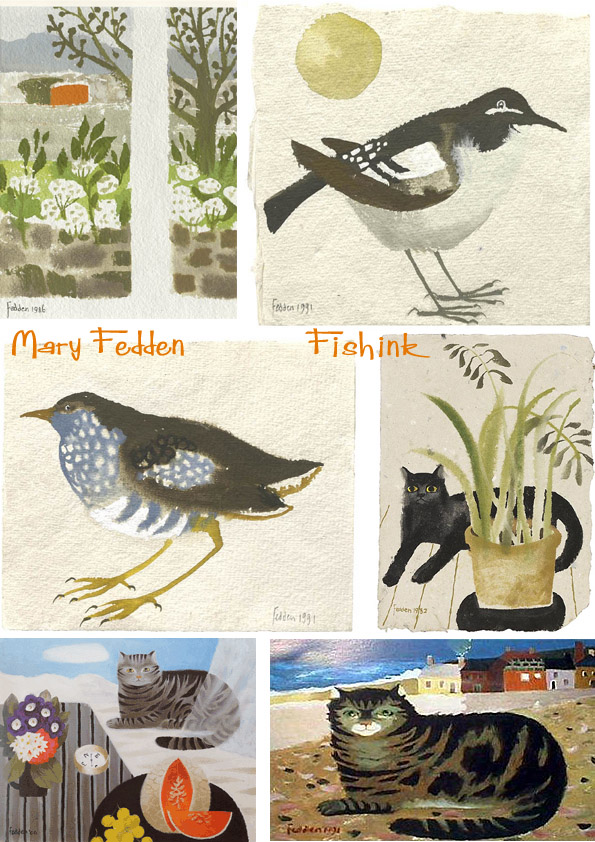
© Mary Fedden c/o Portland Gallery http://www.portlandgallery.com/artist/Mary_Fedden
The show will include early works as well as examples of Fedden’s recent work. Mary has kindly agreed
to lend a few of her stunning travel sketchbooks to the exhibition. These books, dating back to the 1950s’
include drawings and watercolours of scenes all over Europe, in India, Malta, Jordan and Morocco.
© Mary Fedden c/o Portland Gallery http://www.portlandgallery.com/artist/Mary_Fedden
More of her work can be seen here and an interview here.
Update 24th June 2012.
So sad to hear that this wonderful lady passed away two days ago aged 96. A lovely tribute was posted here in The Telegraph.
Fishinks’ Green Walk
There’s a fairly local walk around Calf Hey Reservoir and it was sooo green that I thought I’d share some
views with you again. I couldn’t resist one last walk over the weekend whilst the weather made it’s mind
up as to whether it will be warmer for longer or not.
This is on the misty return from the walk.

and here are the shots taken when it was slightly sunnier.
I came across the work of Mai Thomas at the Ruthin Craft Centre where she is presently working as an
Artist in Residence.
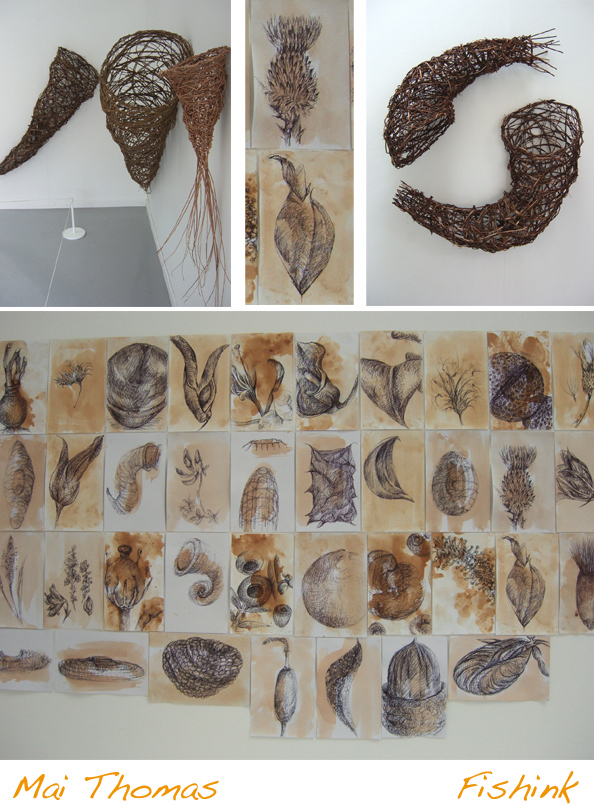
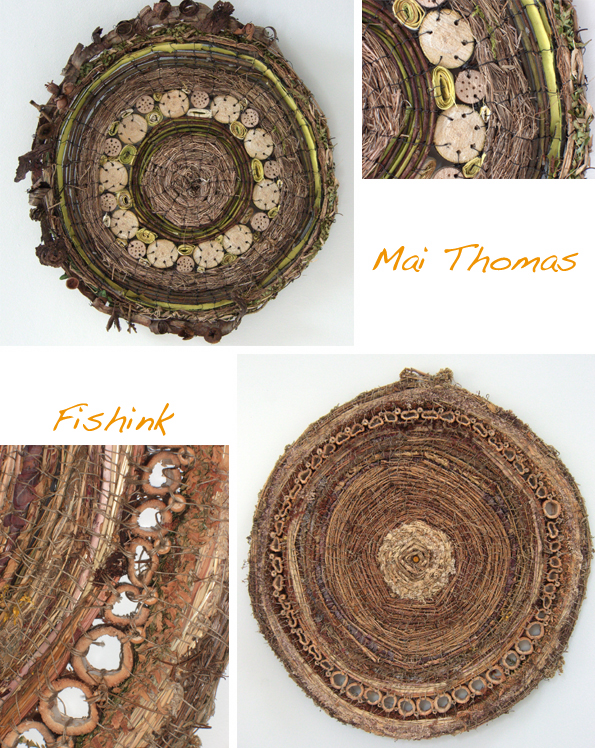
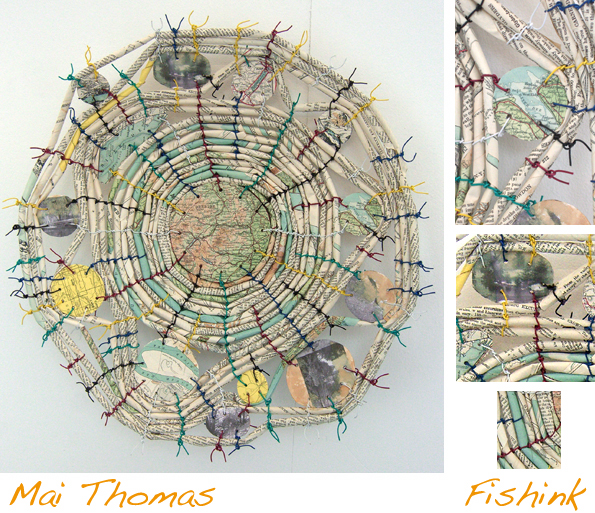
Mai Thomas was born and brought up in North Wales and her work has always been influenced directly
by the diversity in the landscape around her. She is fascinated by natural forms and plants –
their sculptural and textural qualities informing work. Over recent years she has developed her ideas
by making forms out of natural materials including sheep’s fleece, willow and wire.

‘During my residency at the Ruthin Craft Centre I aim to develop my project called
‘Weaving through Tradition’ which focuses on a journey along the River Dee from Bangor on Dee
to the river’s source above Bala. My journey is documented using photos, drawings and 3d sketches.
I will focus on the path the river takes and how it has shaped the landscape and the lives of the
communities near its banks from the makers of baskets, fish traps and coracles to the
brightly coloured kayaks and wading flyfishers.’
Mai will be in residence on the following dates in April: 4-6, 8, 9, 11-13, 15, 16, 18-21
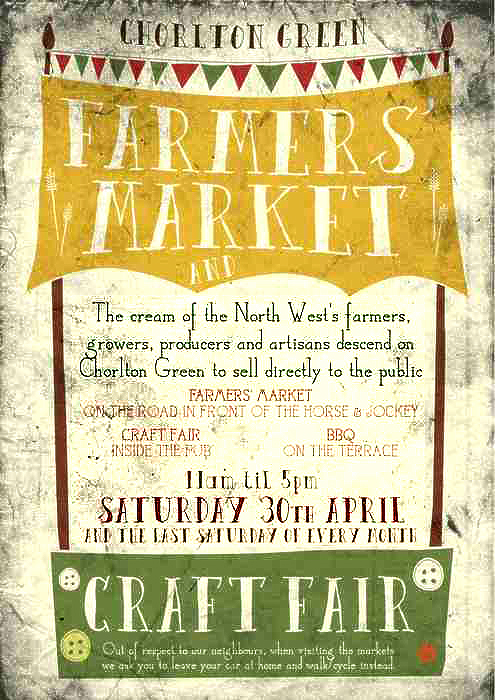
Craft Fair tomorrow in Chorlton, Manchester
I’ll be exhibiting at the Craft Fair at the Horse and Jockey pub in Chorlton, Manchester tomorrow.
There’s a farmers market outside too and plenty of great stalls to check out between 11am and 5pm.
I’ll have stationery and ceramics for sale so please drop in and say hi if you’re in the area.
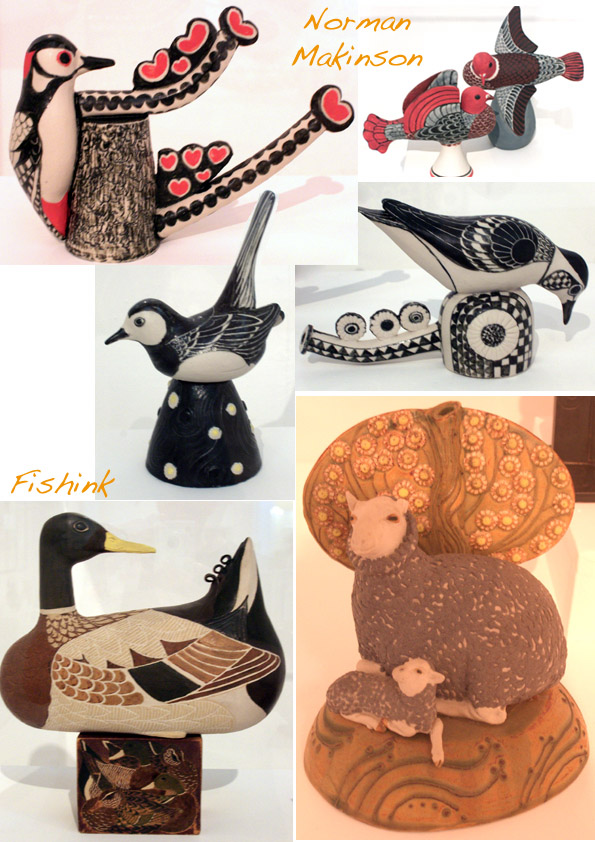
Norman Makinson Ceramist, Illustrator, Artist and Designer

I wasn’t familiar with the name or work of Norman Makinson, until I visited the
Ruthin Craft Centre on sunday, where there is an amazing exhibition of his work on now until
May 11th. He was such a talented man, artist, designer, craftsperson, ceramist, painter
and it was fabulous to see his pottery, drawing and sketchbooks laid out to inspect and admire.
Well worth a trip.



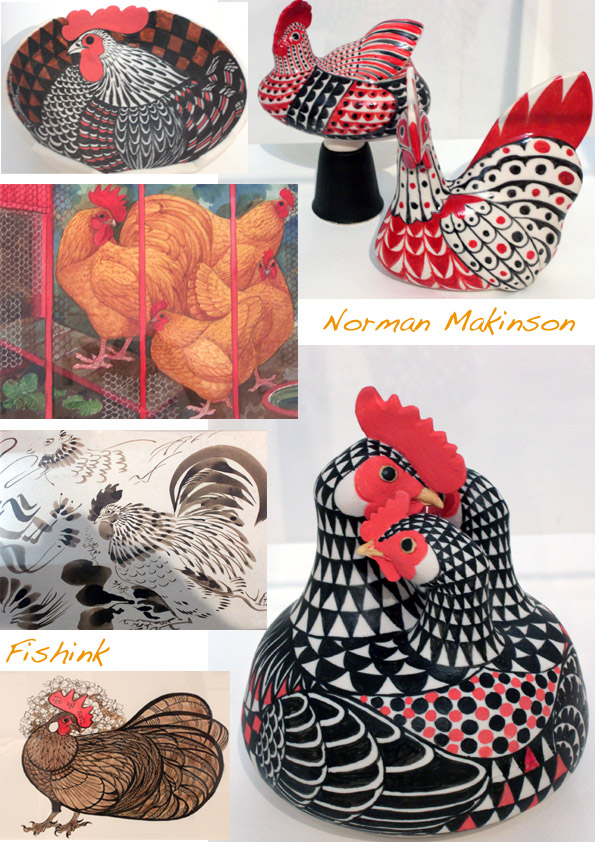

Largely remembered for his Festival Of Britain Cup in 1951 (below), he did other work for Wedgwood
like the partridges in the pear tree (above).

Sadly Norman Makinson died last June at the age of 88, he is remembered in the Guardian here.
Fishink Blogged
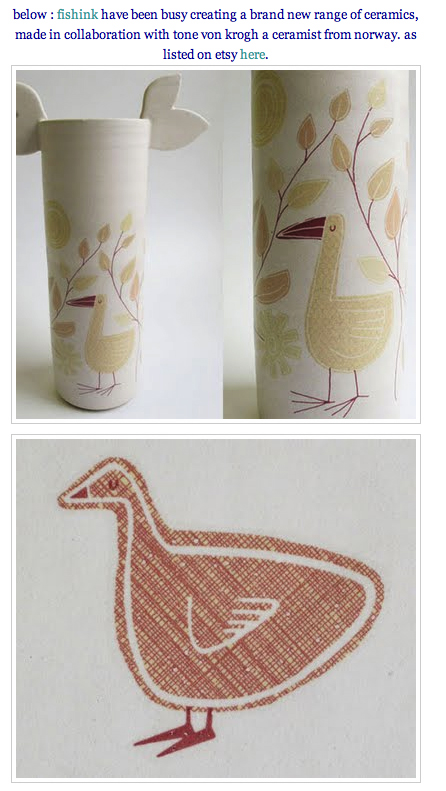
Just a quick mention that the New Ceramic Range from Craig and Tone did get a lovely mention here.
Many thanks to Bowie Style who hosts the lovely Print and Pattern blogspot.
Nora Fok Designer of Jewellery, Beasties and Knitted Nature

I was lucky enough to see a the first ever solo exhibition tour by the extraordinary jeweller, textile artist
and 3D designer Nora Fok presently on at The Ruthin Craft Centre between 2 April 2011 – 5 June 2011.
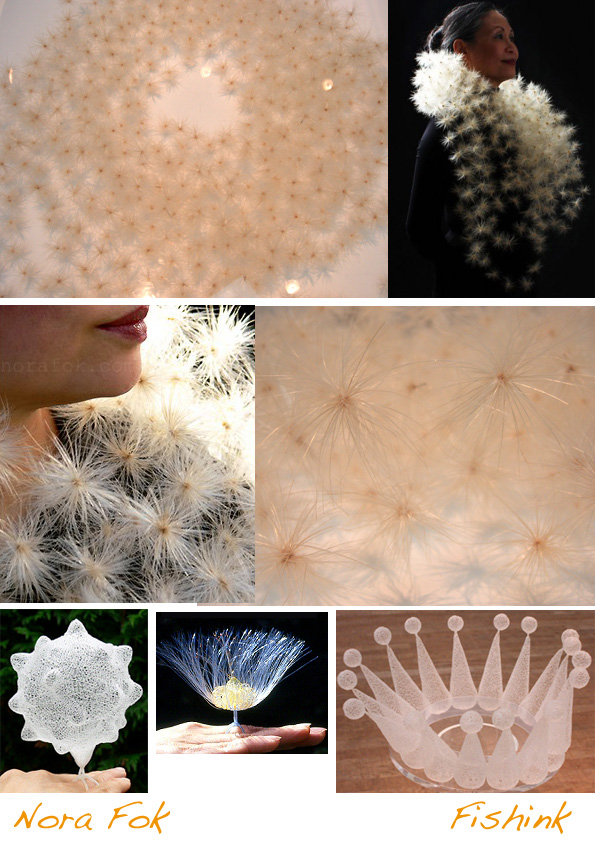
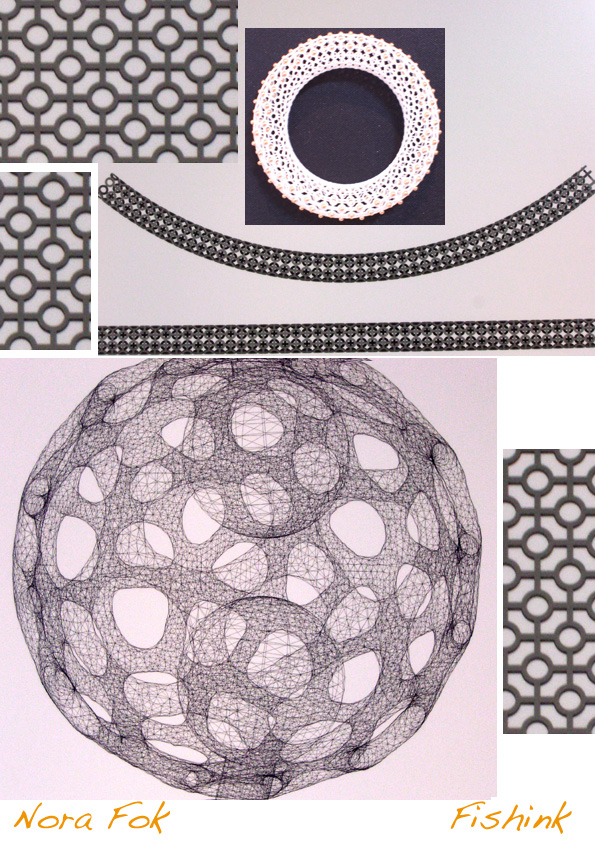
The artist has established herself as a pioneering maker, crafting her delicate, intricate forms from
nylon microfilament. Nora makes her work by hand using techniques she has taught herself:
knitting, knotting, tying, weaving, plaiting.
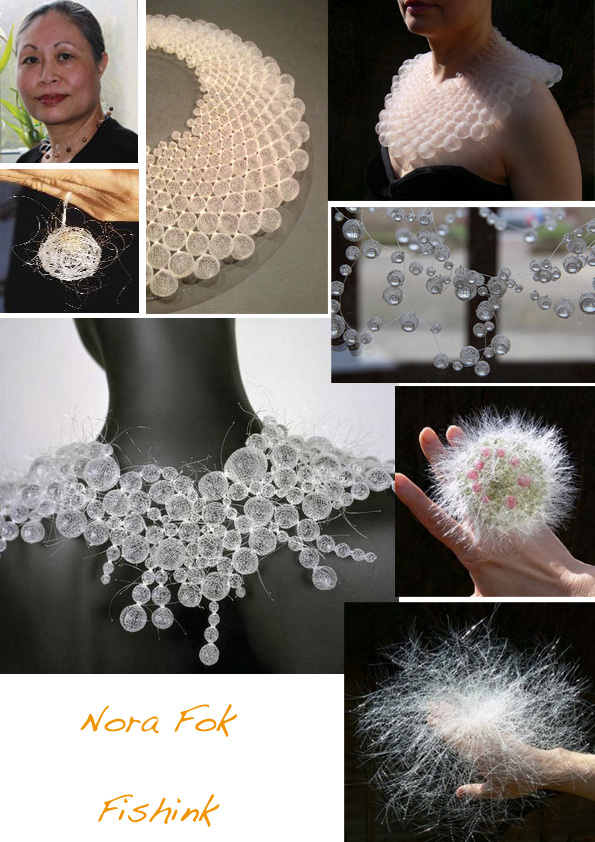
The list is deceptively simple; her chosen material of nylon monofilament is fine and hard to work but
her results are spectacular. These pieces are often very complicated and take many hours, days or weeks
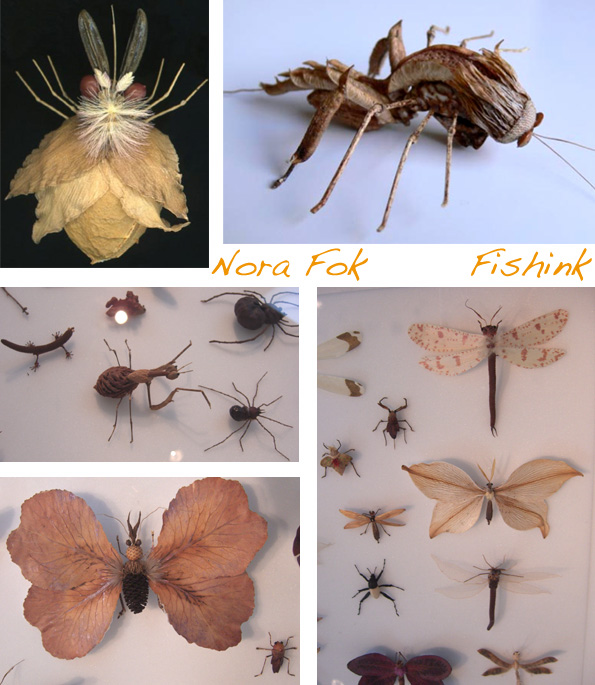
to produce. These clever insects are constructed with natural elements, seed pods, twigs etc.
Born in Hong Kong, Nora had to leave school at 12 to work in a factory assembling toys and
computer components. Nora says the experience gave her the structure and discipline which still
underpins her work. “It also made me determined to leave the factory and have a career in
art and design”. She studied in Hong Kong and worked there as a graphic designer.
In 1978 she was accepted on the three-dimensional design course a Brighton Polytechnic,
which emphasised an experimental approach to materials.
In 1984 Nora married artist and lecturer, Frank Hills. After her first son was born, she decided to work
as a jeweller exclusively with nylon monofilament – it could be done from home using simple equipment
and techniques.
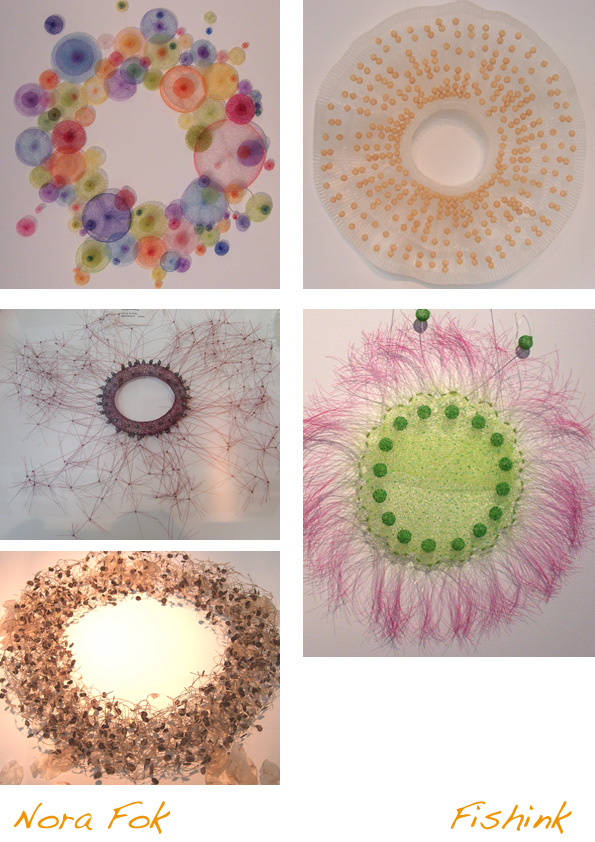
This was quite a challenge as Nora had to learn new processes and develop
creative ways of using the material. “My major break through came in 1997 when
Jackie Binns curated, ‘Galaxies’, my first solo exhibition at Hove Museum and Art Gallery
and Tim Wilcox reviewed my jewellery in Crafts magazine”. Since then her work has been
widely recognized internationally by inclusion in exhibitions, collections, and gallery shops.
In 2010 she was one of 29 makers to be awarded the Jerwood prize for contemporary makers.
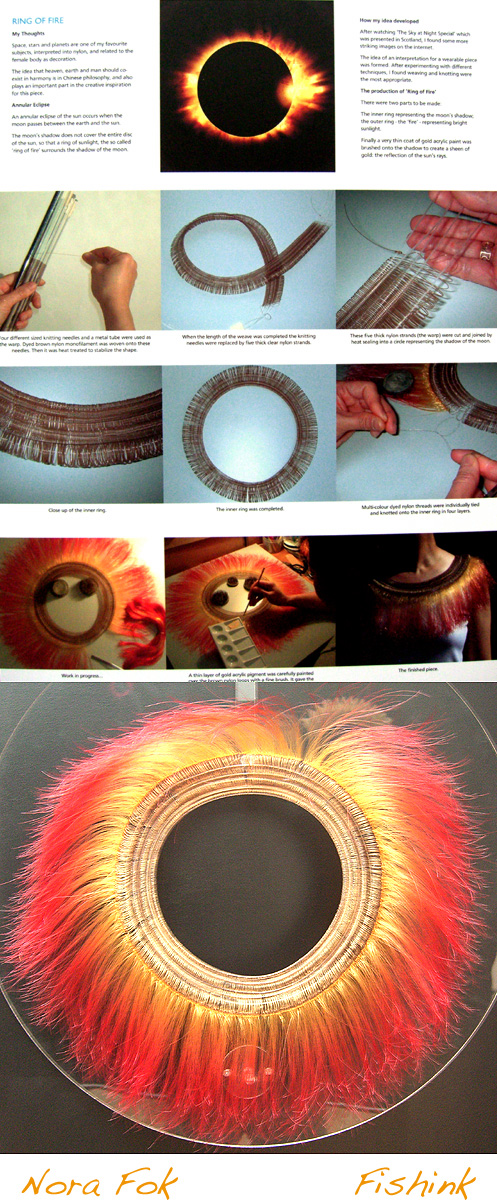
Considering how much of Nora’s work is beautifully knitted and constructed using inticate
or delicate wires and fibres. It’s a pleasure to see such an impressive body of work and ideas.
There’s also an interesting interview with Nora on the ‘ Ideas in the Making ‘ site here.

 fishinkblog.com