Mid Week Mix
Since about 2008, I’ve been collecting images from the internet that have caught my eye. Way back then, I wasn’t so diligent in keeping records as to where images came from, or who had painted, photographed, illustrated or indeed created the artwork in the image. So I apologise in advance for their lack of referencing, but to be honest, it was purely about seeing groups of imagery together, that for whatever reason, I enjoyed. As I have managed to amass quite a few of these ‘collaged sheets’, I thought I would share them with you, in the hope that they may also provide some inspiration to you the readers, from their shape, colour, texture or out and out randomness : )


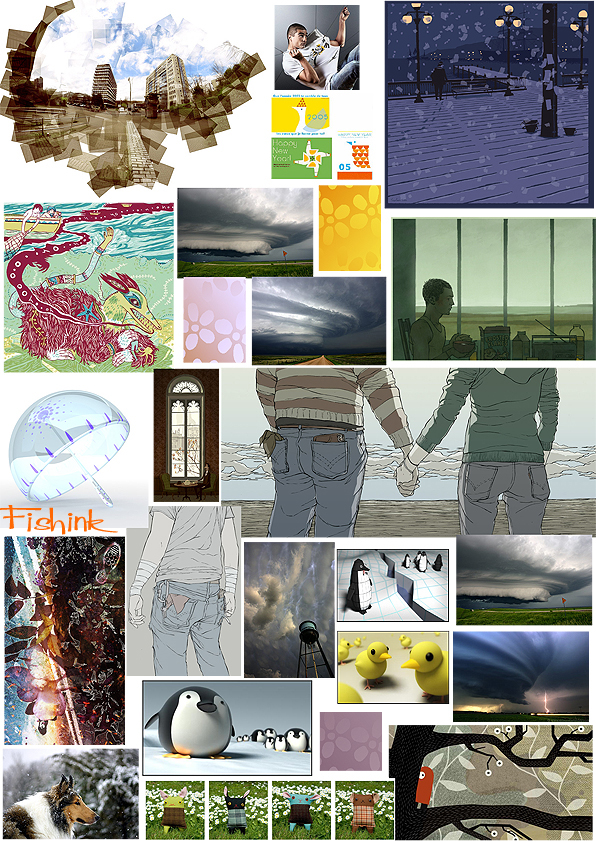

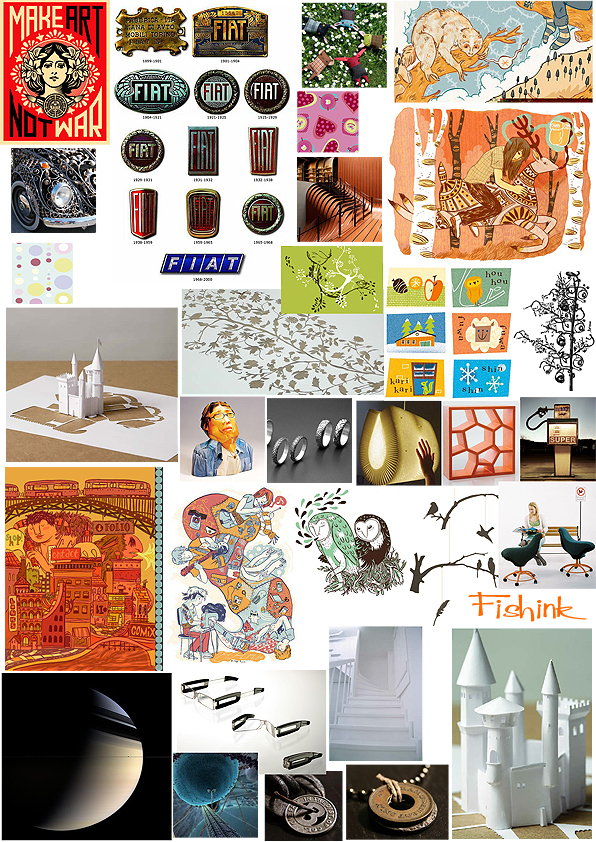
Do let me know your thoughts and which images catch your eye for whatever reason. Also I’d like to mention that I’ve recently started an Instagram page for Fishink Blog. The link is (https://instagram.com/fishinkblog) or you can click on the button on the right of my site. It’s early days but I’ll be building up the collection every week, so if you lovely folk would like to follow me, or leave a comment or see more of my artwork, then please pop on over and check it out today. I’ll look forward to sharing more of my own illustration with you.

Fishink in Manchester

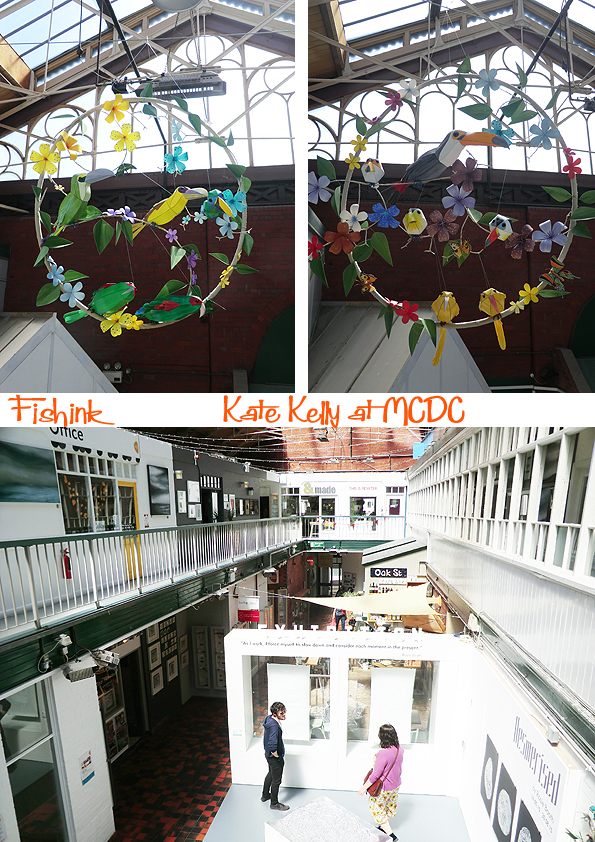
It’s been a while since I’ve had the chance to spend a day in town. The weather was glorious, so I took the tram into Manchester, to do a little exploring. First stop was to drop some work off at ‘Wall of Art’ at the Manchester Craft and Design Centre in the Northern Quarter. If you visit (or live in) Manchester, I’d really recommend a trip here, as there are plenty of fab design studios and you’re always guaranteed to discover a unique present for someone, or fancy some great home-made food. I spotted these beautiful 3D bird hangings by Kate Kelly who owns ‘Kaper’ in Studio 9. A great sunny buzz of activity.
It’s over a year since I have visited my favourite bar and eatery Common, which has undergone a total refurbishment. They have done a great job, but sadly, in my opinion, it has lost it’s warmth and cosy atmosphere as it now feels more like an urban sushi restaurant. Also to my dismay, the cutlery was filthy and the food wasn’t as tasty as I’d remembered. I’m hoping it was just a bad day and that the place will change over time and become a little less industrial. I will return however and not write it off just yet.
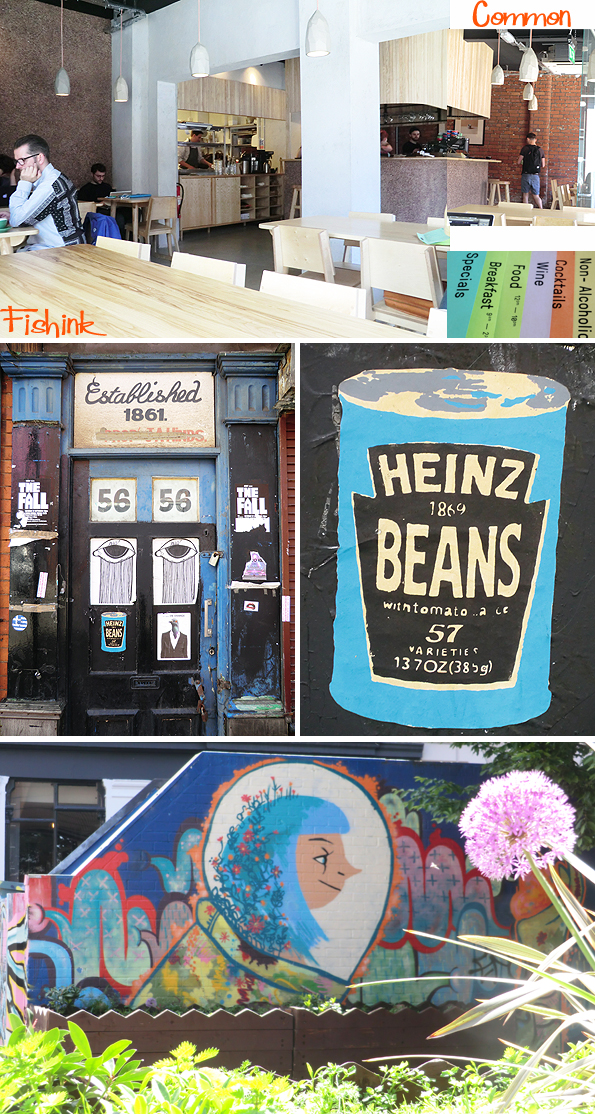
Some interesting graffiti (above) in the streets around the northern quarter.
I then popped into the Manchester Art Gallery and discovered a great collection and display of interior items from throughout the 1900’s.
I have one of these Tangerine, Meadow Green and Ruby Vases, designed in 1966 by Geoffrey Baxter and mould blown by Whitefriar’s glass in three sizes between 1967 and 1980. They are part of Baxter’s textured range, which used surfaces inspired by the natural world. The surface used here was known as Bark. Recruited in the mid 1950’s, Baxter reinvigorated the firm with his contemporary organic style and his use of colour, which matched the new look interiors of the time.
Parallels have been drawn between Baxter’s work and Scandinavian designers’ interest in texture and the natural world. However what makes these stand out is his bold use of bright colours. He also experimented with different textures from the man-made world using moulds made from impressions of plywood, copper wire and tin tacks.
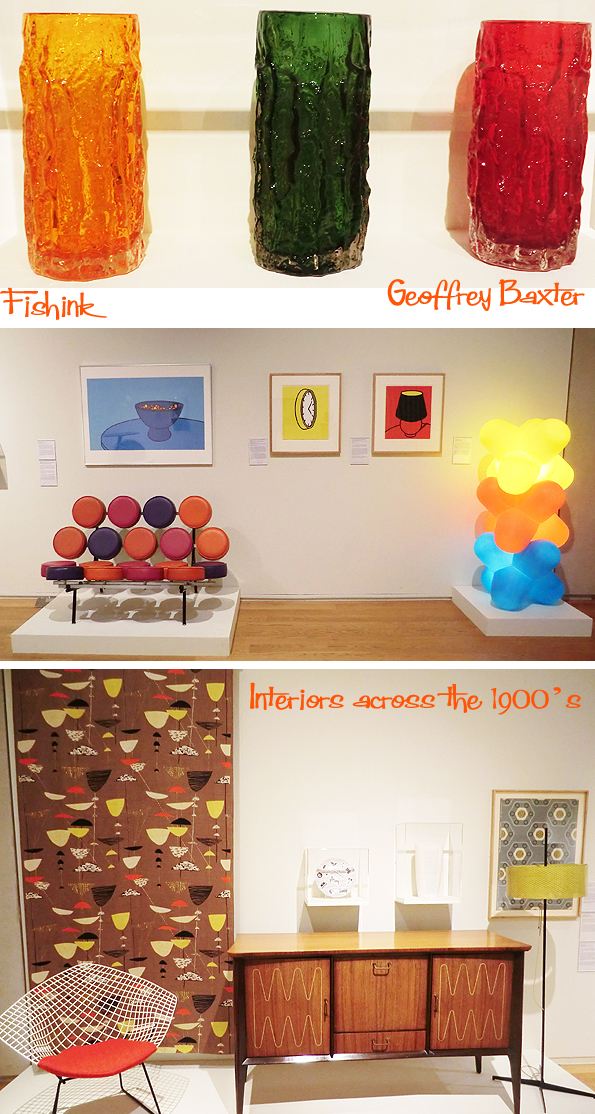
Spot the Lucienne Day brown fabric above and the plate, below, (like my parents owned) from the Homemaker range, designed by Enid Seeney for Ridgway Potteries Ltd.
Seeney was chosen because of her skills in line drawing. She based her design for Homemaker (previously known as Furniture) on items of contemporary interior products she had seen in London shops. Her objects are sometimes invented ones, but there’s also recognisable items such as the sideboard designed by David Booth, the reclining chair by Robin Day and a settee by Sigvand Bernadotte.
The Homemaker range was an affordable piece of design, retailed by Woolworths, (and later Paul Smith) and remained in production until 1970.
Sue Timney and Grahame Fowler’s work was a huge 1980’s influence on textiles and wallpapers and it largely influenced my own printed textile degree show, which was also predominantly black and white. the parallels between their designs and those of of the Italian designer, Piero Fornasetti, led to a revival of interest in his work in this country.
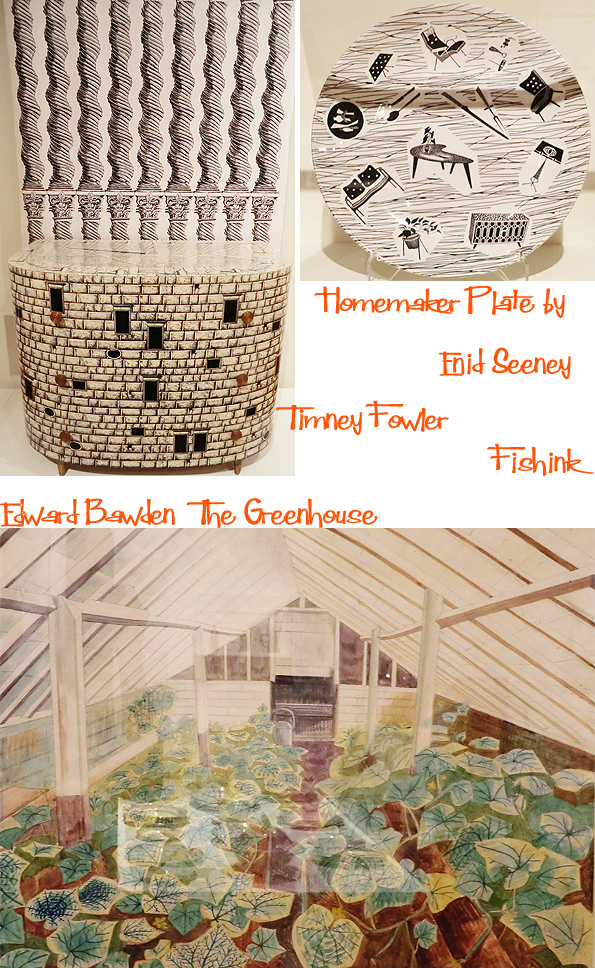
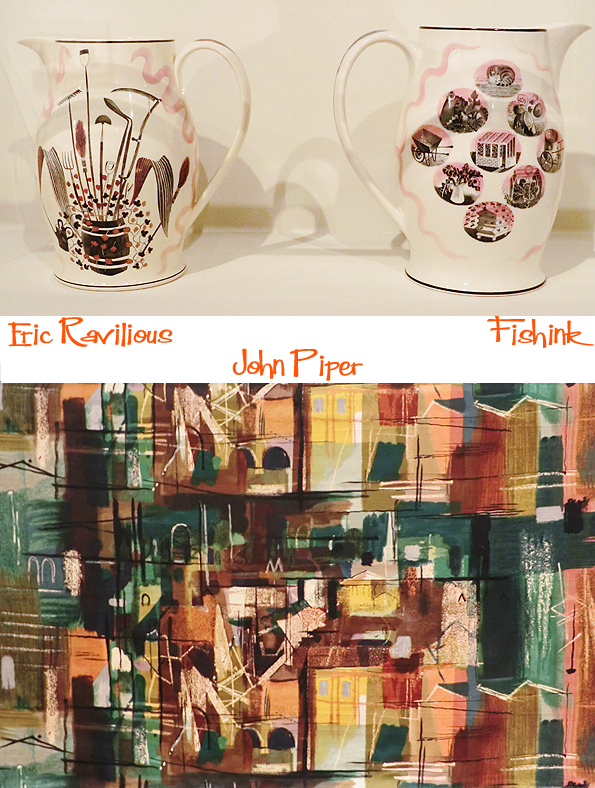
During the 1930’s Edward Bawden (who’s Greenhouse sits above) lived at Brick House in Gread Bardfield, Essex. It enabled him to be close to the things he wanted to paint, many of those being countryside scenes around the village. He was fond of greenhouses as was his friend and neighbour Eric Ravilious. Eric’s collection (below) is part of the Garden Implements Lemonade Set, designed for Wedgwood around 1938.
He was possibly influenced (or asked to bear in mind) an earlier design from 1787 on a jug depicting a random array of scattered farming implements. Ravilious’s illustrative response was much more organised, beautiful and decorative !
I didn’t realise that the artist John Piper’s paintings had been turned into textile designs in the early 1960’s by Sanderson & Sons Ltd. Piper created a series of 5 designs as part of the companies centenary celebrations. The one below ‘Stones of Bath’ was a best seller and screen printed in much larger repeats than had previously been seen, allowing long lengths from floor to ceiling.
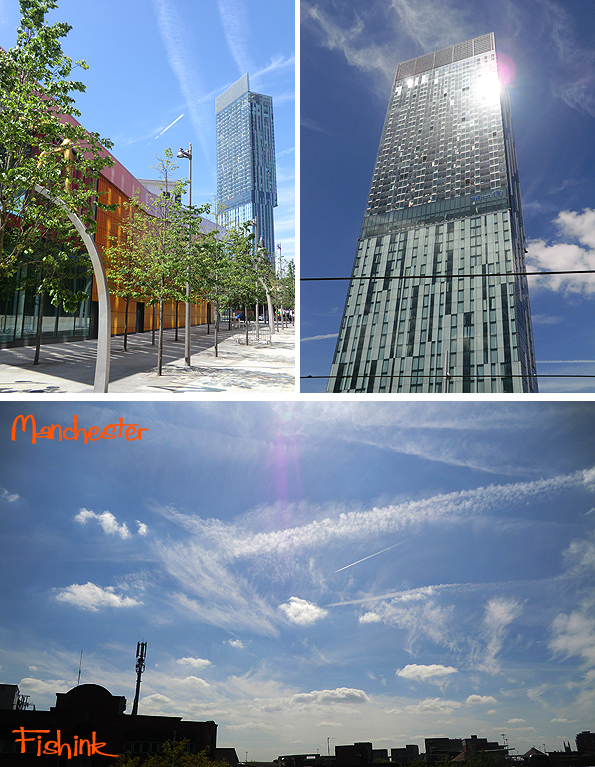
Moving along I decided to visit Home, a rebirth and joint venture between the much loved Cornerhouse and Library Theatre establishments. There’s such a changing face of Manchester and it’s certainly, industrial, decorative and skyward.

Through the arch way from where the old Hacienda used to be, I love how the old and new are viewed together.

As is a strong theme for the spaces I’ve viewed today, Home is warm but heavily industrial. Imposing and yet welcoming with bars, cafes, theatres and cinemas to spare. I picked a great day to view it for the first time, with all that lovely light pouring in.
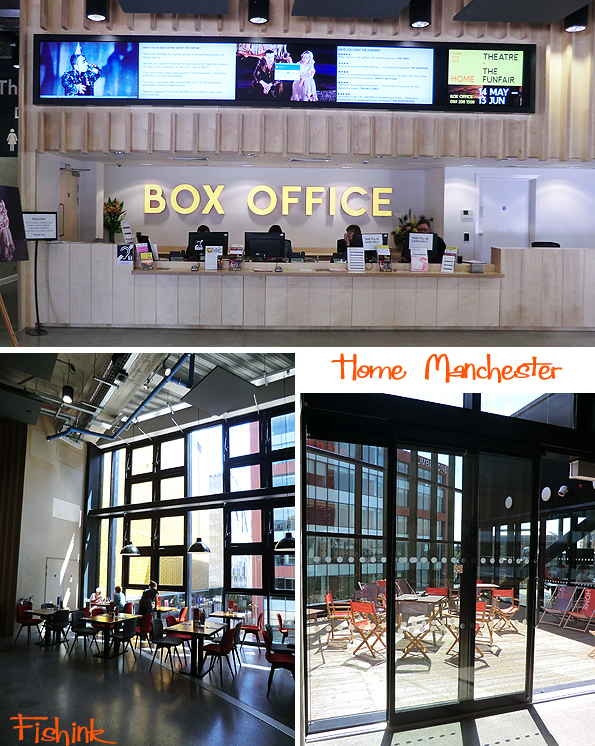
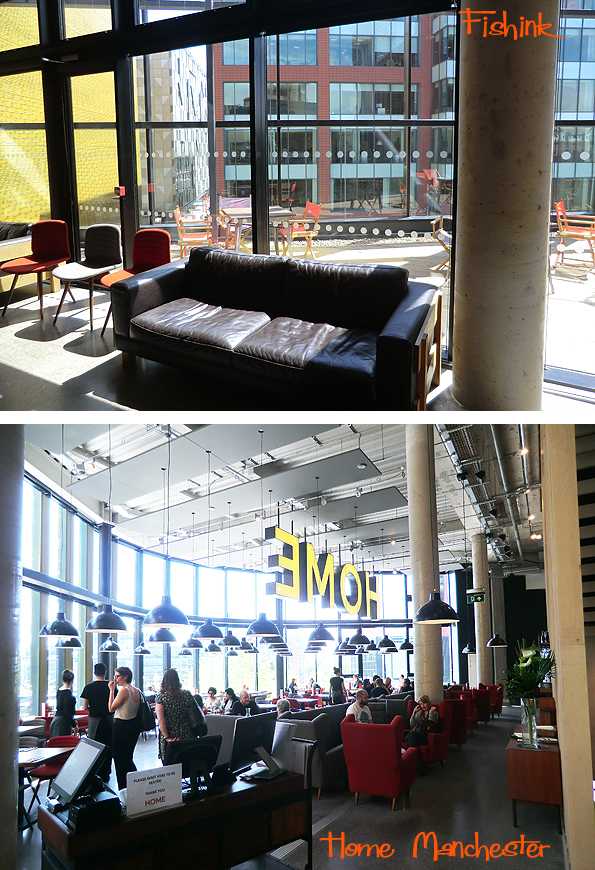
My one complaint would be that the book shop needs to be about three times the size. I’m hopeful that with all the huge offices springing up around Home, (at an amazing speed), that the need for a decent card and gift shop, will prove that it needs to be seriously expanded.
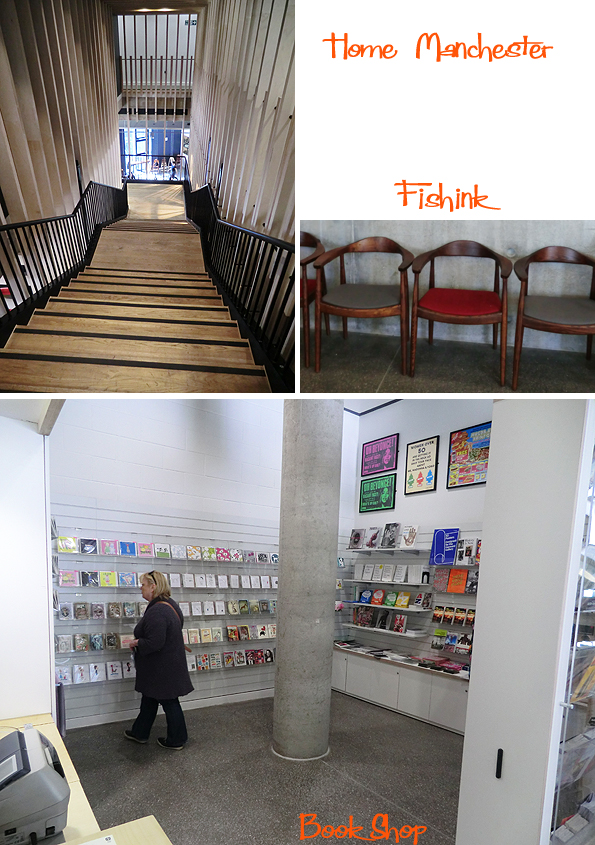
The new architecture looks great in the sunshine and I really like the fact that the outsides aren’t just grey concrete.
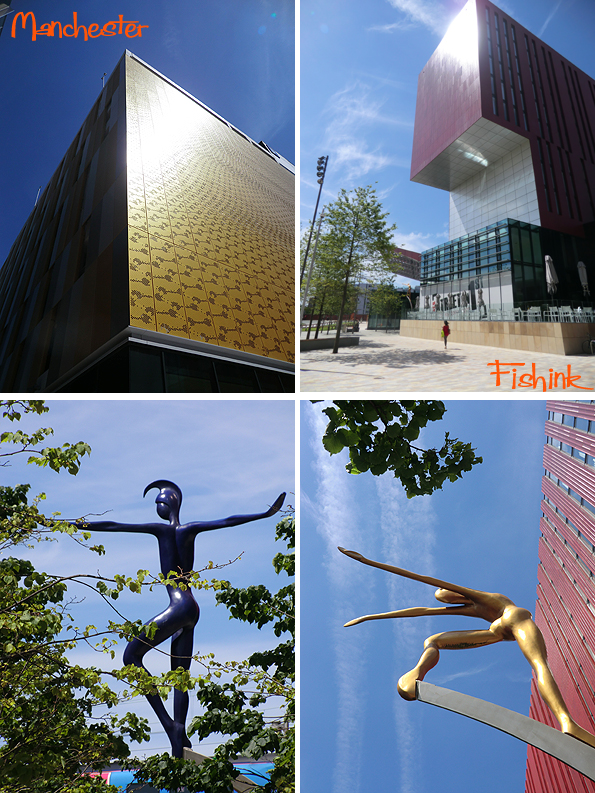
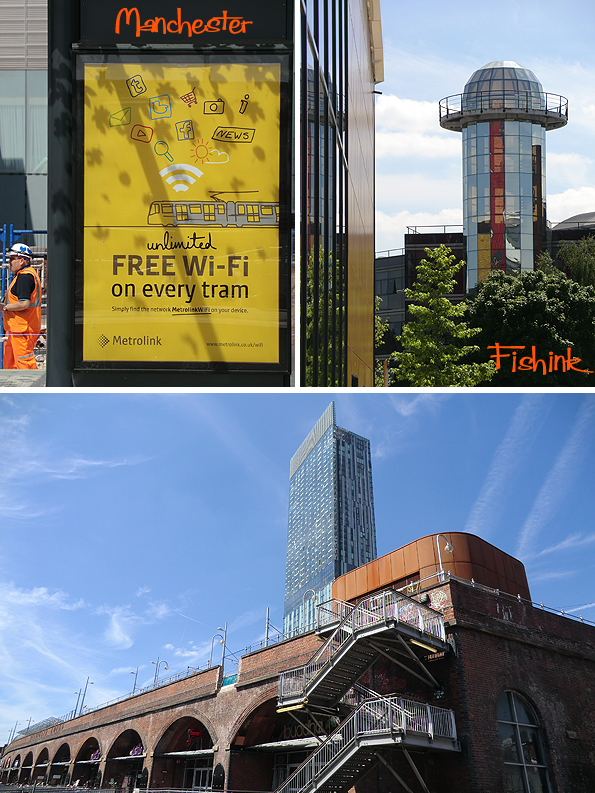
More old meeting new as Manchester changes it’s face once again. It’s a great place to live.
Polly Noakes Children’s Illustrator

Polly Noakes tells me that illustrating and storytelling are central in her life and what really makes her happy. I’ve known Polly (online) for sometime now and was interested to hear more about how her illustrative journey was progressing.
” I love to draw children and animals from observation or imagination and am forever scribbling in my sketchbook. Capturing those funny interactions between people or when the essence of an animal fascinates me. ”
I fired a few excited questions in Polly’s direction.
How did you first get interested in children’s illustration?
At 14, I knew I wanted to be a illustrator and luckily my mother encouraged me, she was always buying Arthur Rackham and Charles Keeping books for my birthday. I studied on the HND Illustration course at Cambridge School of Art years ago and was tutored by Martin Salisbury and Warwick Hutton, both were to be huge influences on my career. Children’s illustration wasn’t part of the course then, so when I graduated, my direction was uncertain. Warwick took me under his wing, I owe him so much as he encouraged me to illustrate fairy tales and I found my niche. From there, I started writing my own stories and in 1991 my first picture book was published with Orion. Through Martin Salisbury, whom I kept in touch with, I became represented by his, then agent, Linda Rogers who specialised in children’s books.
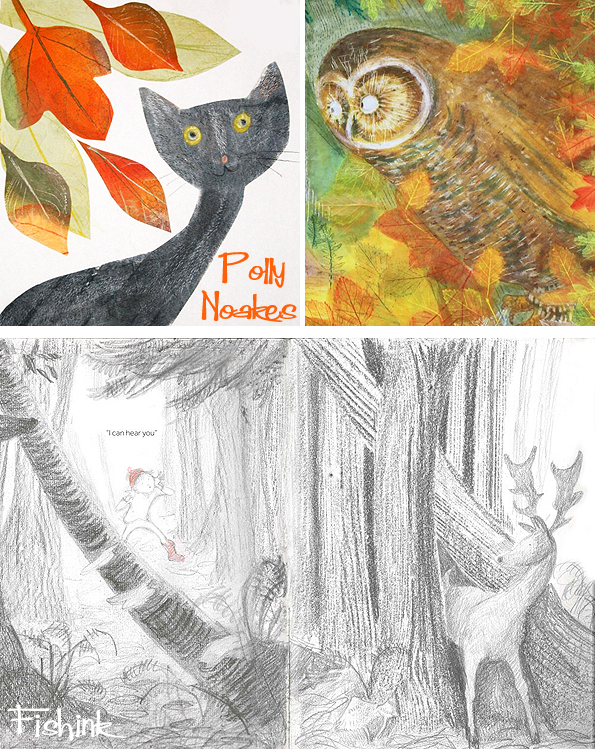
She creates work and textures by hand, colouring with inks and crayons. She then collages with glue or digitally, incorporating a loose and fluid line to add movement and spontaneity. Her lion (below) has strains of the work of Roger Duvoisin, such a lovely style.

What picture books have you recently seen that have inspired you and why ?
I tend to be attracted to books that display superb drawing skill, unusual composition, use of colour and light, for example the Selfish Giant by Alexis Deacon is a book I often refer to, he is a stunning draughtsman and his compositions are incredible. Alexis’s ability to convey so much in his line work is sheer magic. Lorenzo Mattotti’s illustrations for Hansel and Gretel are full of energy with a dynamic use of use of black and white that I’ve never seen before. ‘A First Book of Nature’ illustrated by Mark Hearld, is another firm favourite. His skill at combining collage, print and drawing is amazing. ‘I Cinque Malfatti’ and ‘Le merveilleux dodu velu petit’ by Beatrice Alemagna are visual feasts. I adore her quirky sense of colour, texture and pattern… it’s so original. There are many more I could mention, some not published yet !

Who would you say are your favourite artists/ illustrators ?
Brian Wildsmith has been a constant inspiration with exuberant colours and compositions, his work mesmerises me. Warwick Hutton for his use of colour and dramatic lighting which is simply remarkable. Helen Borten, (whom I discovered through your Fishink blog), always leaves me in awe. More contemporary illustrators – Komako Sakai with her unique use of media, creating depth to her images which are beautifully observed and tender. I admire MA graduate Melissa Castrillon’s work as it’s also so original and her use of colour and pattern is exquisite.
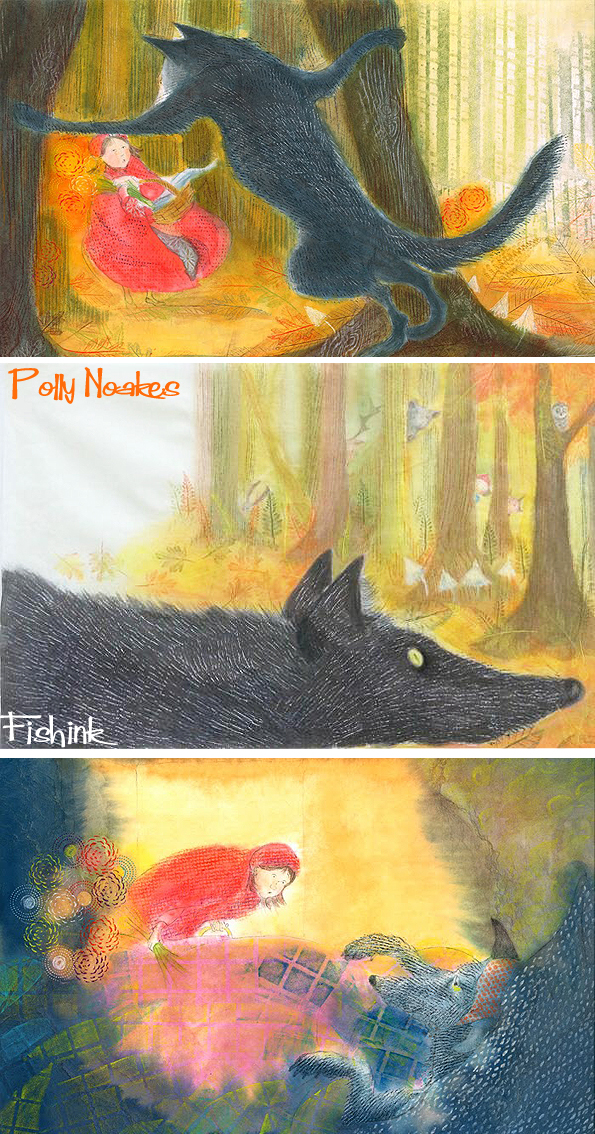
I love Polly’s rendition of this famous classic and particularly her textures, colouration, patterning and mark making.
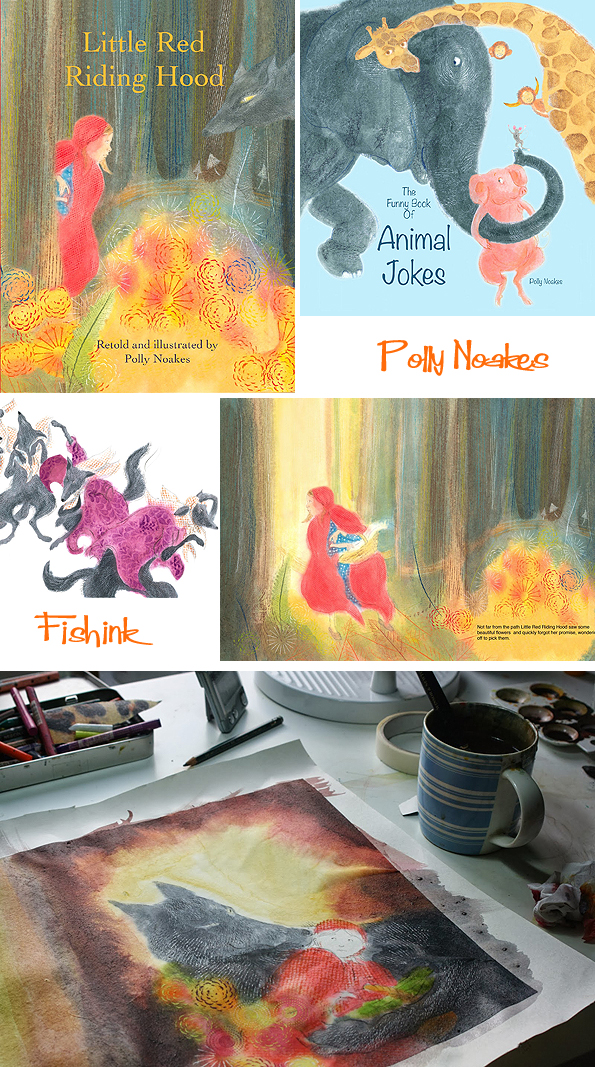
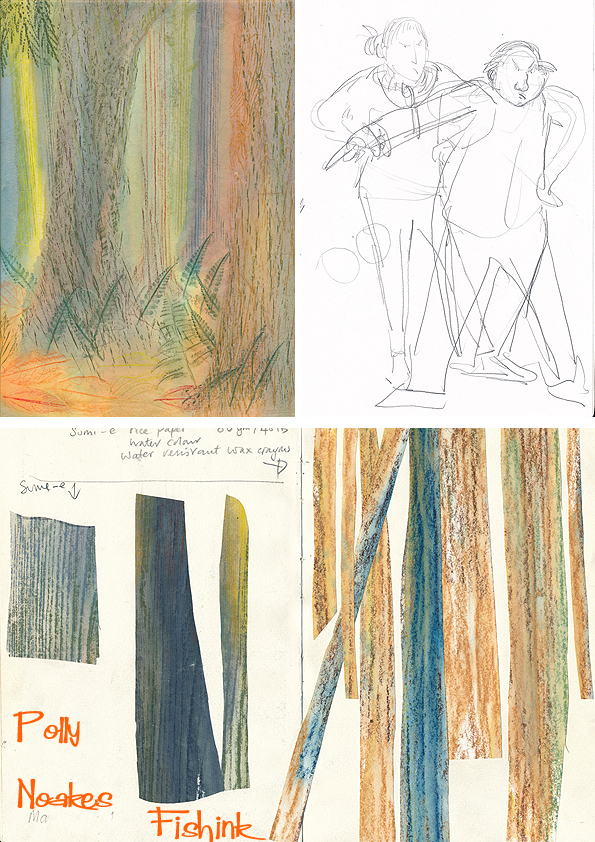
” I work into an illustration with texture and pattern, all done by hand. I love the process of physically working on the rice paper and seeing the luminous colours build up slowly. Rice paper when wet is not the easiest medium to use but it seems to have chosen me and I am hooked! What I have learned these last few weeks is that instead of feeling the need to control the painting – let go and allow it to unfold. To relax and keep the fun and inspiration alive by pretending it’s a rough.
Whenever I start to dread working on a illustration, particularly a section of it, I have realised that actually it is because it is not working, either compositionally or the characters are not integrated into the composition. I now realise this is a flag to say , come on Pol, redo it ! You know in your heart, it’s not right ! Sometimes it really is good to sit back, take a break and start again. Learn from the mistake !”
You recently graduated from the MA Children’s Illustration course at Cambridge. Can you tell us how you found the experience?
It was fantastic, life changing I would say and great to be tutored by Martin again. I left illustration in 2001, disillusioned with the work I was doing and burnt out. I retrained in another career but missed being creative, so I arrived on the MA feeling very rusty but open to the challenges ahead. It was extremely hard work, fortunately the environment was supportive and my peer group brilliant. The tutors were amazing, their insights and comments were invaluable – I look back at it as an incredibly creative and intensive two and a half years that really fulfilled me.
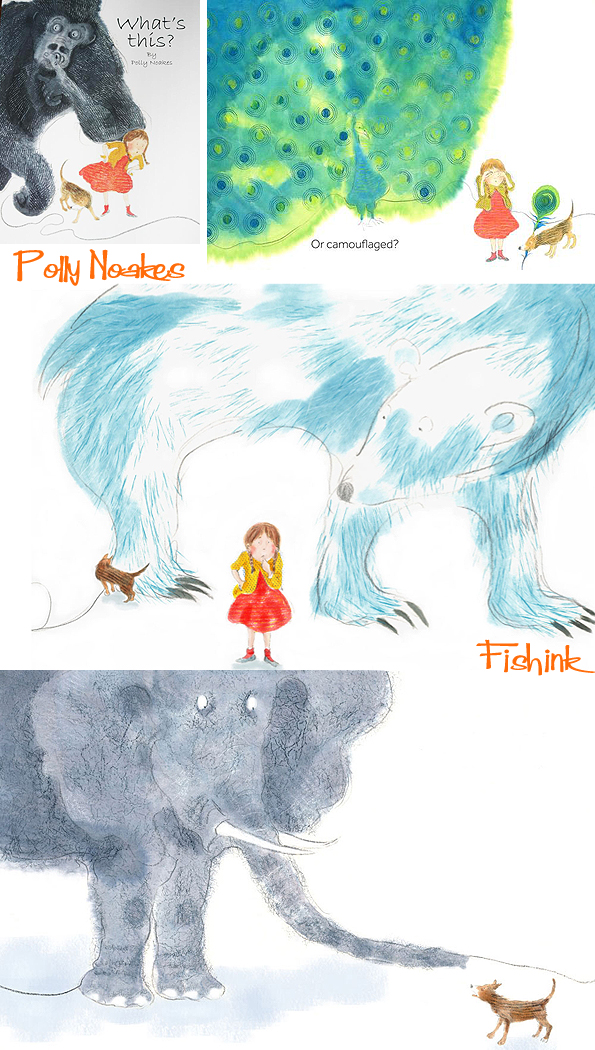
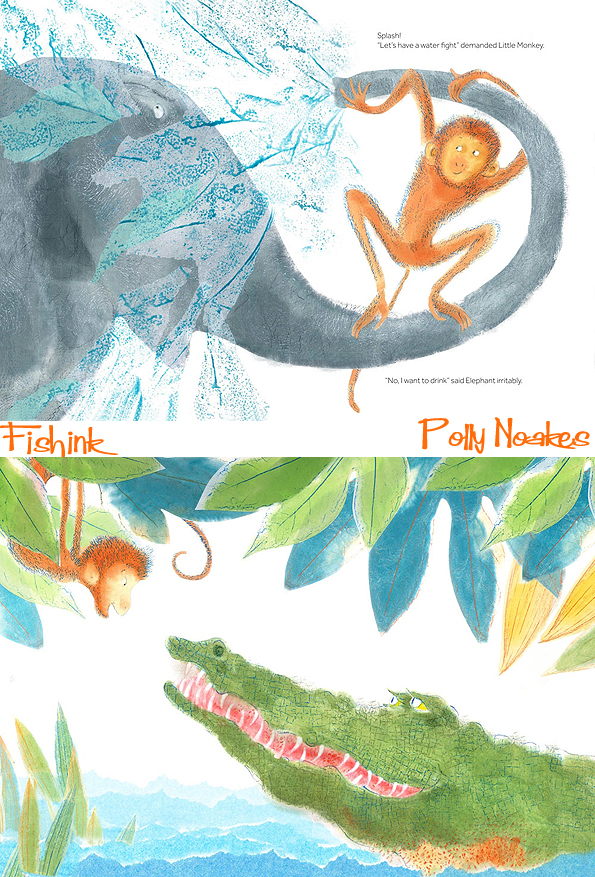
Some of Polly’s beautiful work with textures and layering here.
How many people were on your course with you ? Did you study there everyday or meet for a couple of days a week ? How was the course structured ?
I did the part-time course and attended every Wednesday in Cambridge with 26 students. The course is extremely well structured. In the first semester, its back to basics with observational drawing. Students receive a one-to-one tutorial every week and group crits twice a semester. Time with tutors is precious, so producing enough work for them is essential. Each module feeds the next, so learning about sequencing, pacing and structure followed. This fed the next module, creating an actual book/project with an intended outcome. We had one written assignment each semester supported by lectures, often given by top illustrators discussing their work. The course is more practical and creative than academic, although students do write a dissertation.

What were the most memorable up’s and downs that you encountered ?
Ok let’s start with the downs first ! Personally it was the sheer physical energy needed to produce the work (on top of a weekly long commute). It can be relentless, one basically eats, breaths and sleeps the MA. But that’s not really a downer, as I loved it.
I remember the moment when I had to let go of all I had known in my previous career as an illustrator and felt totally de-constructed…it was unnerving. I didn’t know where my work was going, everything I did looked awful and I couldn’t see light at the end of tunnel. It was like jumping off the cliff edge and having to muster faith for a good landing ! For me, my landing was Pam Smy, our tutor flicking through my sketchbook and noticing scraps of textured, collaged paper. She nurtured this, whilst Martin encouraged me to incorporate my loose line work and somehow I found my ‘visual voice’. If anyone had told me I would be using texture, collage and pattern three years ago, I would have laughed ! Meeting my classmates has been incredibly positive and we all supported each other and continue to do so.
Do you feel the course has led you onto a more directed pathway forward ?
Most definitely, without the course I would have gone round in circles. It ignited my passion for illustration again and led to a totally new way of working. I would not have attained it without the MA, Martin and Pam.
Look at these beautiful illustrations, the hedgehog is such a warm favourite for me.

How much of the course is about illustration/ using materials/ writing/ the industry ?
Drawing from observation is the basis of the course and used as a springboard for creating images whether real or imaginary. Any medium is encouraged to be embraced, which is great. Students have the use of fantastic print making facilities, which is a much respected tradition at CSA. There is an expectation students will be familiar with various techniques prior to the MA, so they are not taught, but tutors always help. The emphasis of the MA is illustration and visual storytelling, not writing. Publishers and agents visit regularly, giving talks about the industry which is extremely helpful. Plus there is a strong link between the course and the industry, which exposes students to important eyes !

Without attending the MA where do you think you would be now ?
Not where I am now ! It’s a tough industry and the MA has facilitated my new work, catching the eye of agents, who approached me. On another level it lead me towards being fulfilled with my illustration again and I acquired a deeper understanding of my own needs as an illustrator.
If you have any thoughts, pointers or useful tips for people considering a similar course to the one you have done, what advice would you offer them ?
Be open and embrace change, criticism and most of all, experiment a lot.
Let go of goals and any pre-conceived ideas about where your work is going and allow it to unfold, you might just be surprised ! What you put into it, you get back, so invest as much time physically, emotionally and creatively as you can. Don’t be scared, jump in and enjoy the experience and make the most of being a student. Mess up, get it wrong and don’t try and create perfection from the outset- that’s a creative killer !
So Polly, where next ?
Recovering and getting a life ! No seriously, I have a wonderful new UK agent, Elizabeth Roy Literary Agency who saw my work on the MA. We are working on a couple of projects and fine tuning them. I am also about to start on a small commission for the House of Illustration in London, which will be fun. Editorial illustration is an interest and a completely different pace to children’s book publishing, so I am building my editorial portfolio. Occasionally I stop, relax and leave my studio, my favourite room…. and go out !
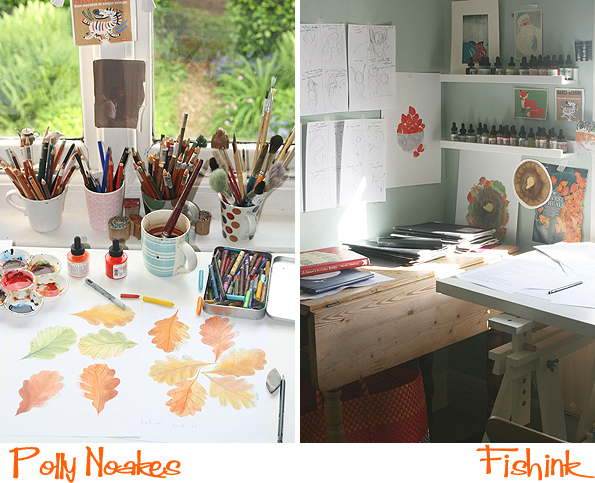
And what a beautiful room it is too !
Many, many thanks Polly for your honest insights and open thoughts on the MA Course at Anglia Ruskin University, Cambridge. I’m also a big fan of Martin Salisbury’s Books, so I imagine any course he’s involved with, would be pretty amazing. Thanks also for sharing your beautiful work with us here today and I look forward to seeing your picture books in a bookshop near me, very soon !
Mid Week Mix
Since about 2008, I’ve been collecting images from the internet that have caught my eye. Way back then, I wasn’t so diligent in keeping records as to where images came from, or who had painted, photographed, illustrated or indeed created the artwork in the image. So I apologise in advance for their lack of referencing, but to be honest, it was purely about seeing groups of imagery together, that for whatever reason, I enjoyed. As I have managed to amass quite a few of these ‘collaged sheets’, I thought I would share them with you, in the hope that they may also provide some inspiration to you the readers, from their shape, colour, texture or out and out randomness : ) 

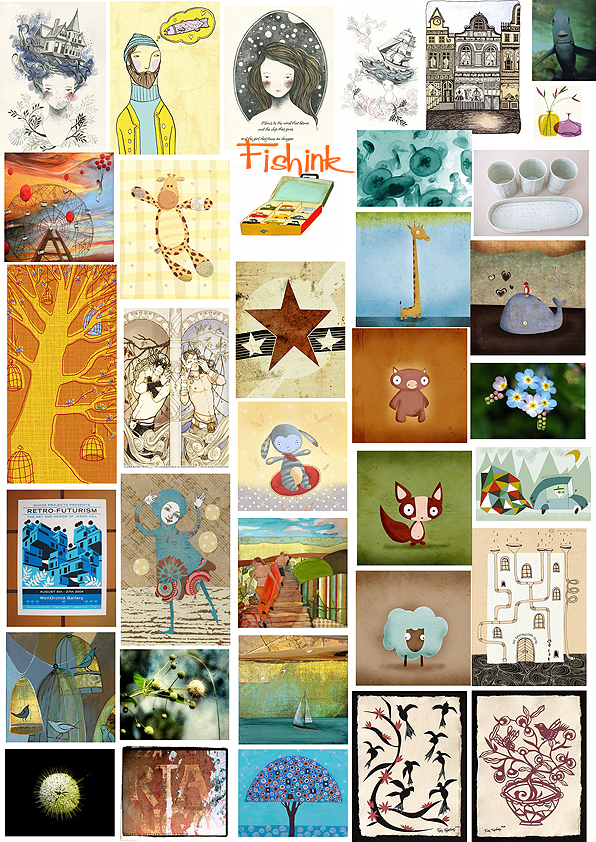


Do let me know your thoughts and which images catch your eye for whatever reason. Also I’d like to mention that I’ve recently started an Instagram page for Fishink Blog. The link is (https://instagram.com/fishinkblog) or you can click on the button on the right of my site. It’s early days but I’ll be building up the collection every week, so if you lovely folk would like to follow me, or leave a comment or see more of my artwork, then please pop on over and check it out today. I’ll look forward to sharing more of my own illustration with you.

Constance Howard Inspirational Embroidery
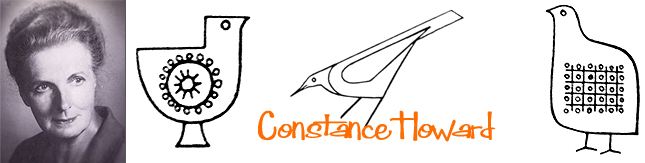
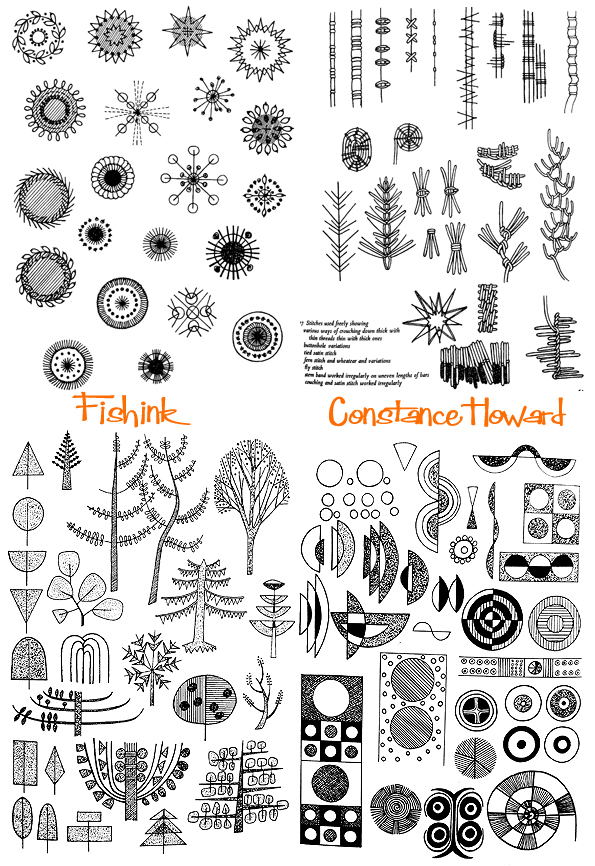
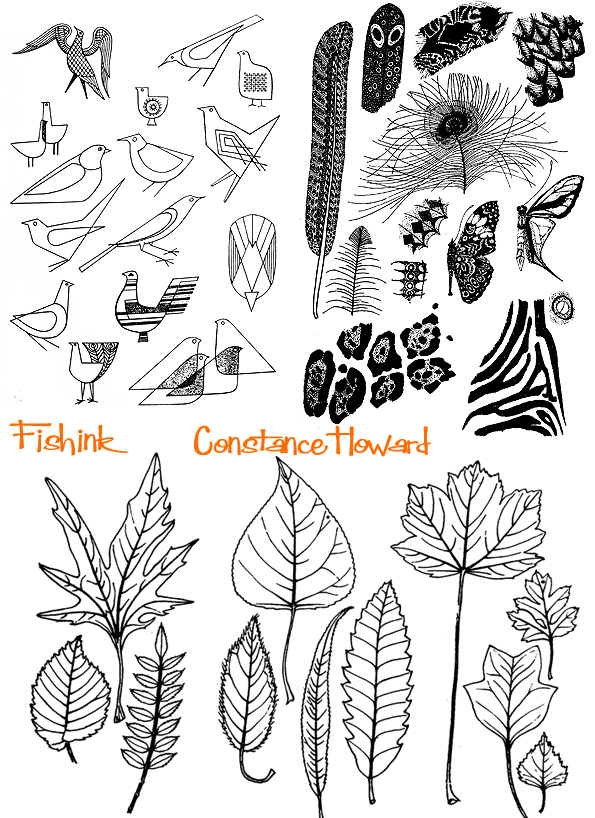
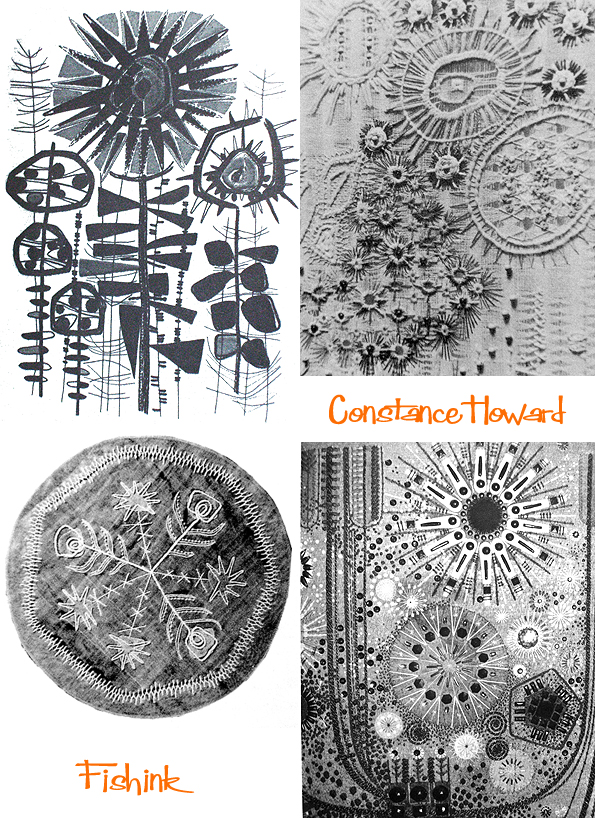
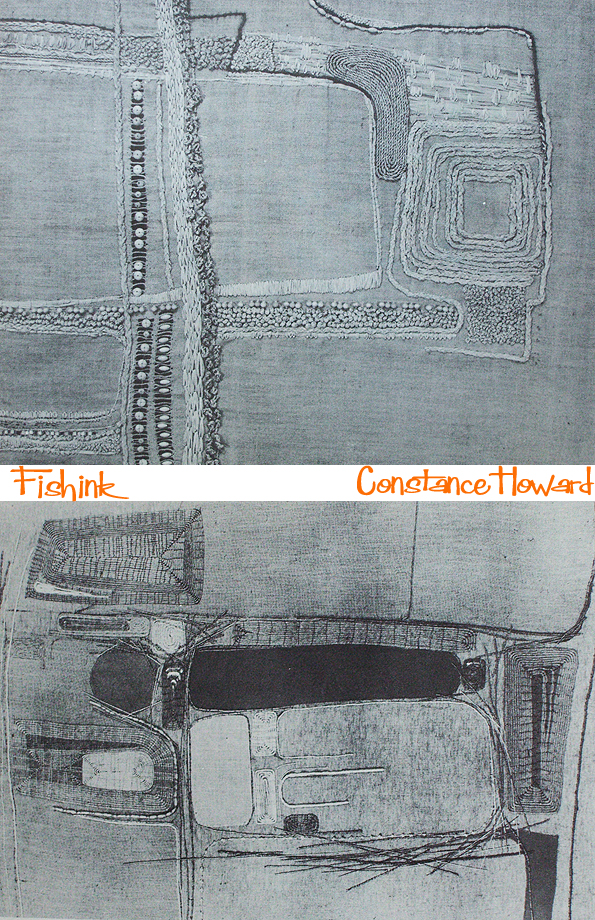
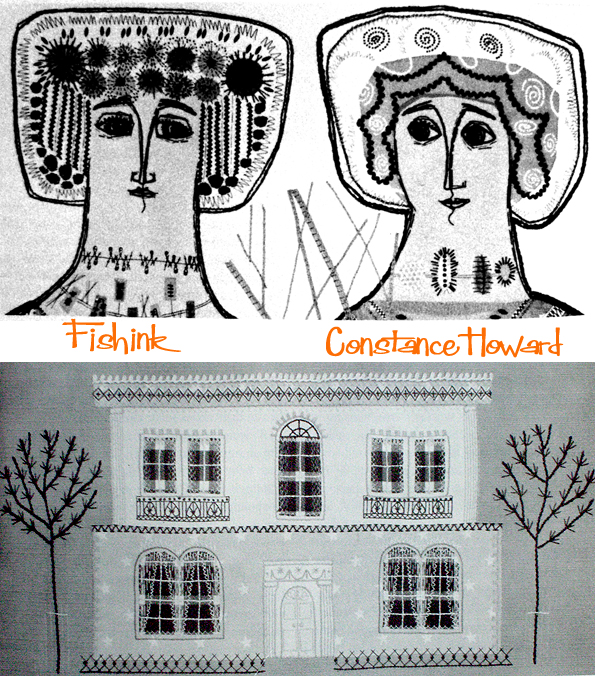
Constance Howard, was 89 when she passed away some fifteen years ago. Like me, you may not have heard of her. I have an old copy of her book, aptly called ‘Inspiration For Embroidery’ from 1966, which has been reprinted numerous times since. It’s crammed with tips, drawings, design motifs and of course embroideries over the 200+ pages.
The Guardian described her as ‘A remarkable artist, an inspiring teacher and an extraordinary character and arguably the most influential British pioneer in textile design of her generation.’ My curiosity was ignited… I decided to dig a little deeper and discover more.
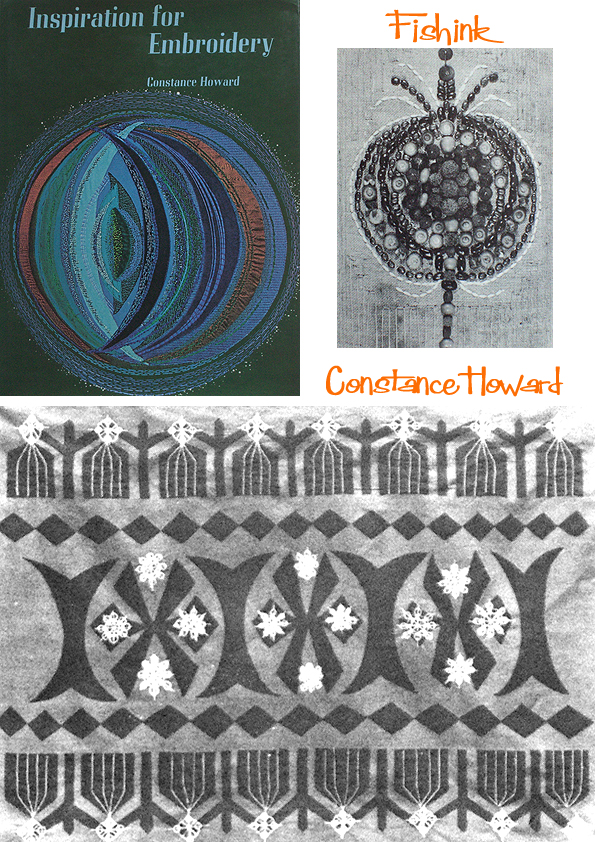
Born in Northampton, the daughter of an impecunious schoolmaster, from the age of 10 she studied art at evening class. After leaving school at 14, she was denied a grant to the Royal College of Art – on the grounds that the money would be wasted because she would end up getting married. The authorities were half right: in 1945 she married the sculptor Harold Wilson Parker.
In 1947, she became a part-time tutor at Goldsmiths College in south-east London, at a time when it was struggling to find its feet again after the dislocations of the second world war. She went on to establish an embroidery department in the arts school, and to become principal lecturer in charge of textiles and fashion. Textiles at Goldsmiths came to influence the field everywhere – partly because of Constance’s energetic proselytising and example, which nurtured the idea of embroidery as an art form and vehicle for artistic self-expression.
Her most celebrated commissions in this period included The Country Wife, a large hanging for the country pavilion of the Festival of Britain in 1951. (Top illustration below)
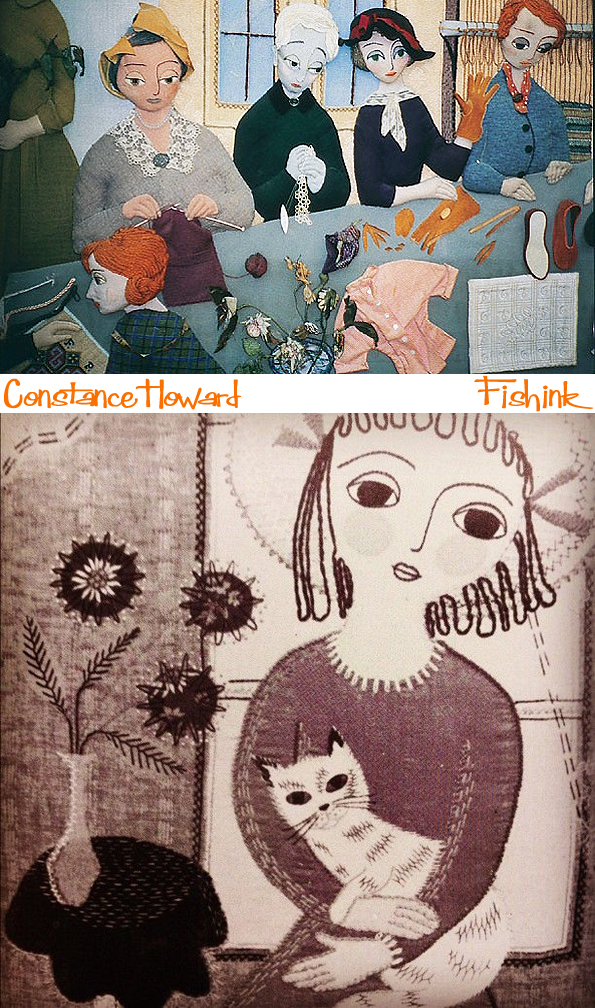
As well as working in textiles, she did much to build the tradition at Goldsmiths that gave the college its leading role in art and design. Following her retirement in 1975, she was awarded the MBE for services to embroidery. Her standing continued to grow, partly on the basis of visiting lectures in Europe and the US, and her authorship of a number of key texts. At Goldsmiths the Constance Howard Textiles Special Collection was established, which now contains more than 2,000 textile pieces and related items, many of major historical importance.
A small, slight figure, Constance remained a powerfully individualistic personality to the end of her life. Her enthusiasm for textiles communicated itself to everyone who knew her, while her kind and patient approach to teaching endeared her to generations of students.
She was no shrinking violet. Long before the arrival of punks, she wore bright green hair. In the 1930s, she allegedly used lithographers’ ink as dye. Later, she switched to fluorescence: at a Goldsmiths lecture held in her honour, the head of the indomitable nonagenarian flashed like a traffic light, unmistakably, from the middle of the audience.
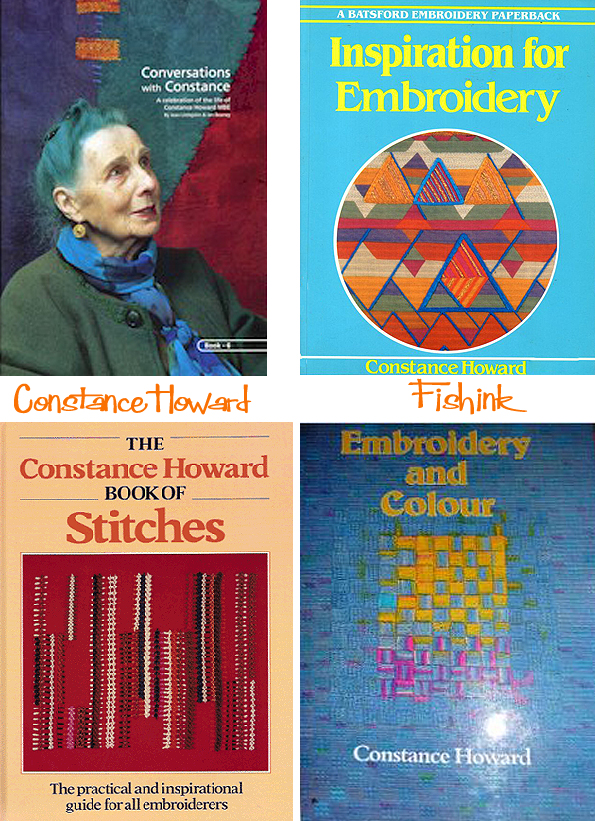
A prolific writer, her books included Design For Embroidery From Traditional English Sources (1956), Inspiration For Embroidery (1966) and Embroidery And Colour (1976). A year later she published Textile Crafts, in 1979 came The Constance Howard Book of Stitches, and during the next few years she researched and wrote a classic four-volume study, Twentieth Century Embroidery In Great Britain (1981-86).
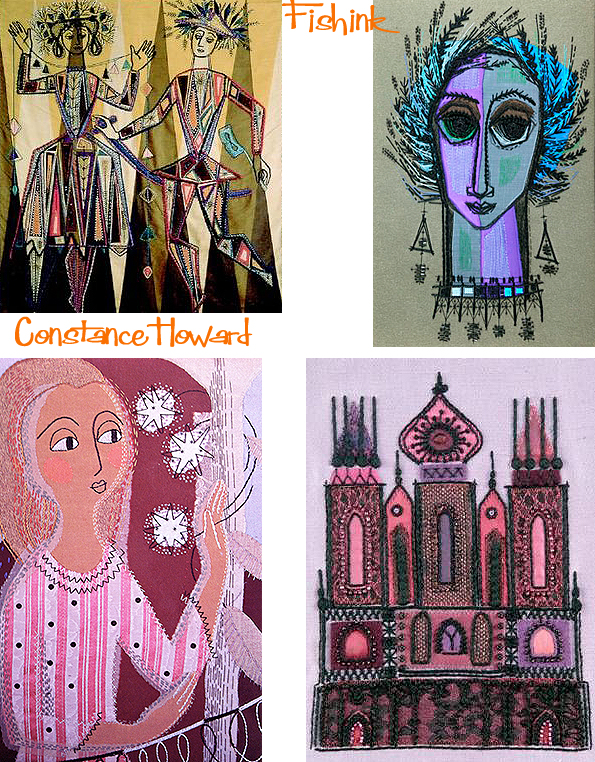
Many thanks to ‘The Guardian‘ for this information about Constance. It’s important to bear in mind that when Constance began working, embroidery and textile design were seen by many people as comparatively minor crafts. That they have since become important artistic genres, is due a great deal, to her work and example.
What an inspirational woman ! I thought you might like to see and share this.
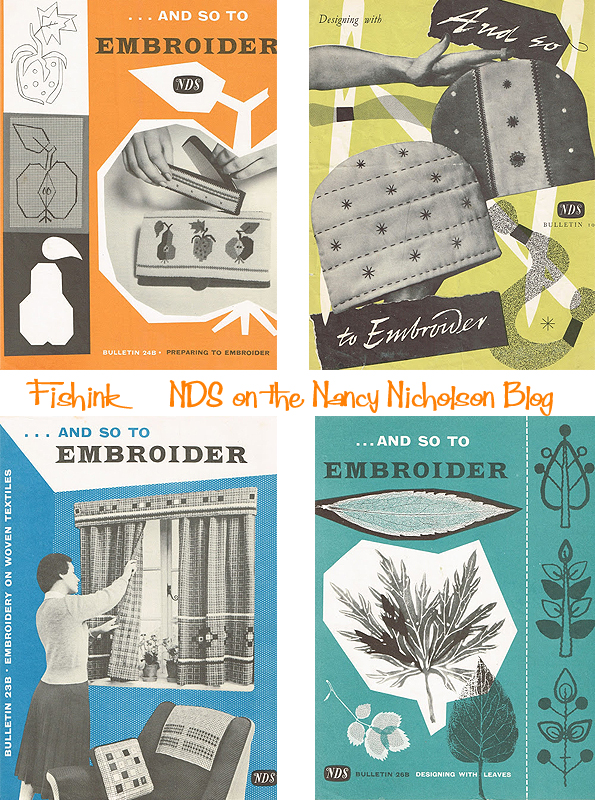
Continuing on a similar theme, I couldn’t help but want to share these amazing covers from 1950’s Needlework Development Scheme (NDS) I saw recently over on Nancy Nicholson’s Blog.
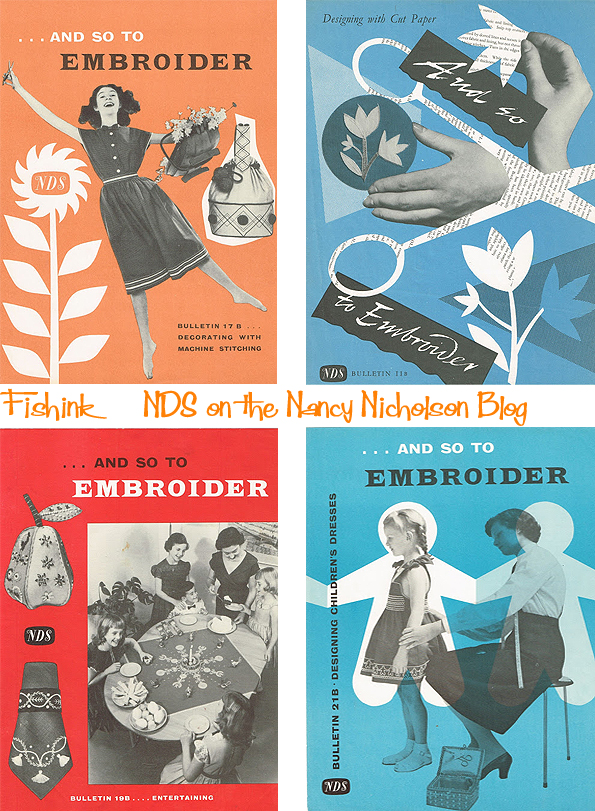
I particularly like their colour palette.
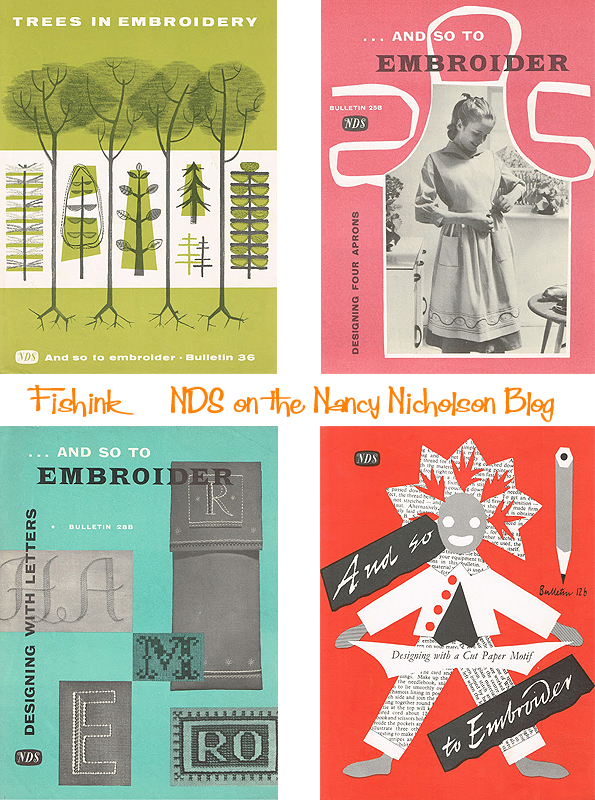
This ‘Trees in Embroidery’ one below really caught my eye. Thanks for sharing them Nancy and there’s more about Nancy’s own beautiful work on an earlier Fishink blog here. Enjoy.
If anyone has any more of Constance’s books and would like to share some illustrations with Fishink Blog then please let me know.
A little fun today with a trip into the realms of make-believe and reality. 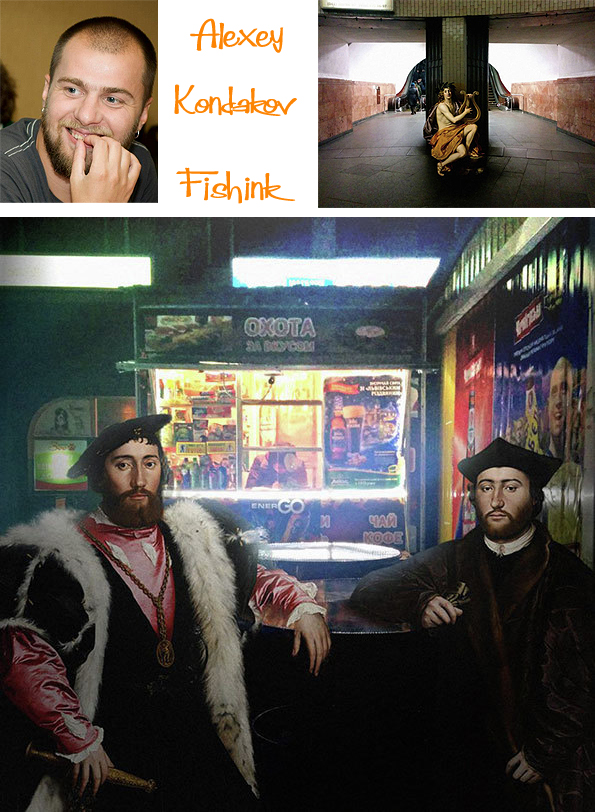 Living in Kiev designer Alexey Kondakov creates collages of pictures and photographs of the city, putting the Greek gods, angels and heroes of classical paintings in household, and sometimes in marginal circumstances. He avoids the more obvious “postcard” scenes of the Ukrainian capital, preferring to shoot backgrounds for their work on the streets, in the subways and underpasses.
  He said that the idea came by accident: he was flipping through graphical blogs and came across the picture of Caesar van Everdingen “Nymphs feed the young Dionysus wine, fruit and flowers.” Then “instantly imagined how it would have changed the perception of the story, if they were sitting in the street” and the idea was born. On the way home, the designer took a picture of the street on his phone, and the next day the first collage appeared.
 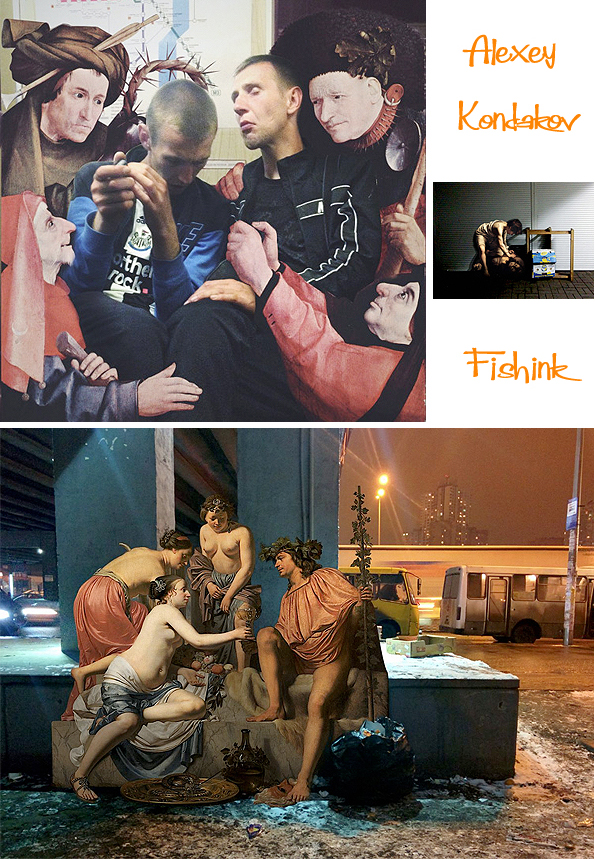 Imagine bumping into a drunken god and a host of nymphs on the top deck of the night bus to Clapham !
  Fun to think of fairies riding the buses with us. Perhaps some people see them already, but where do they keep their loose change ?
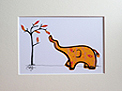
  I recently started an Instagram page as Fishinkblog mostly for showing snippets from my drawing and collage work. I had a fun day yesterday composing some of these images which made me think of my work in a different way.
  Using the Instagram app you can create all kinds of moods by varying the contrast and colouration of the lighting.
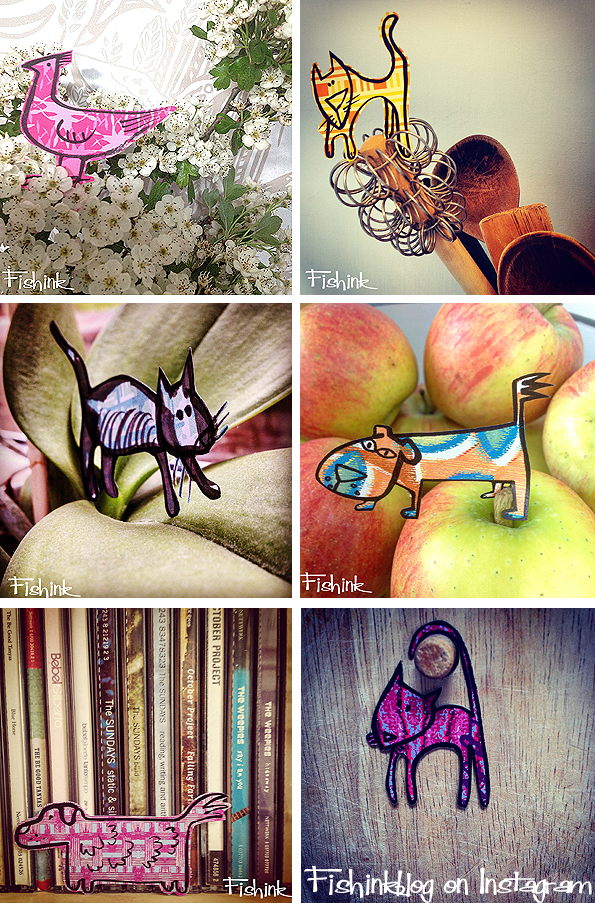 Please pop over to Fishinkblog‘s page and follow me or tell your friends too. Any thoughts ?
Modern Publicity 1955-6 Part 1
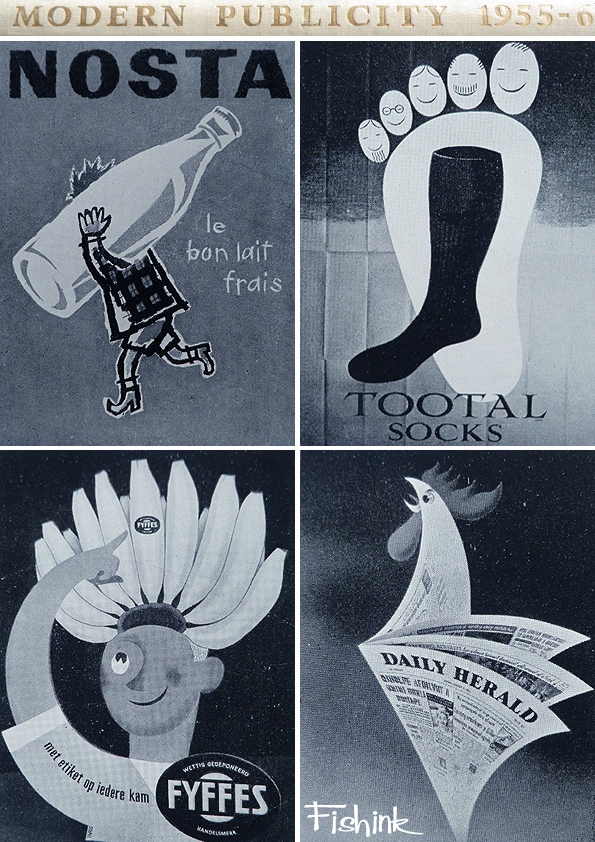
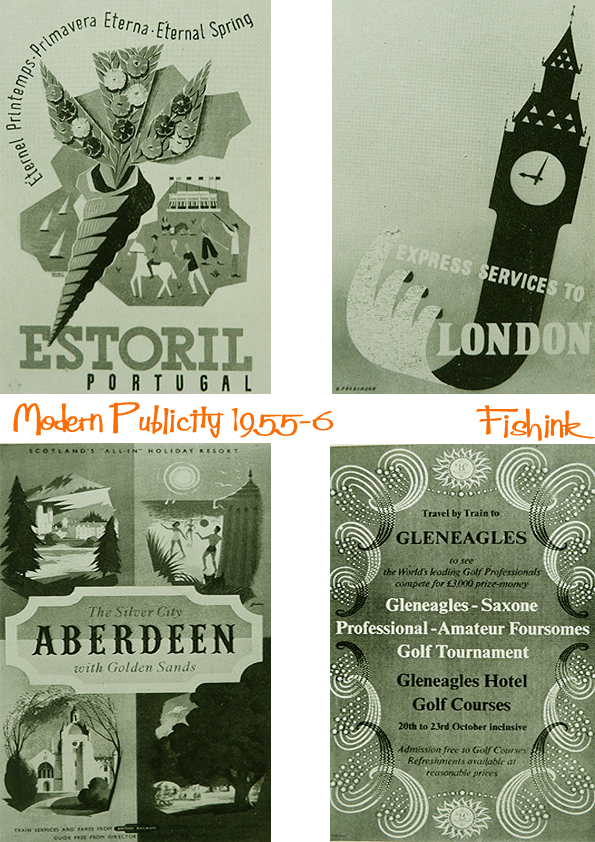
Here is another tribute post to the fascinating series of publications called ‘ Modern Publicity ‘. This annual covers the year 1955-56 and I’ve gleaned enough images to cover 6 posts, so it was obviously quite a creative one.
As a lot of the images are black and white, I’ve subtly toned some of them to add a bit more colour.

I love this poster advertising the British countryside, what a great perspective and rural scene.

Some amusing shape manipulation going on here with the banana head-dress and Cockerel newspaper.
Another fab ‘See Britain from Her Roads’ advert and the beckoning image of Big Ben as it lures you to visit London.
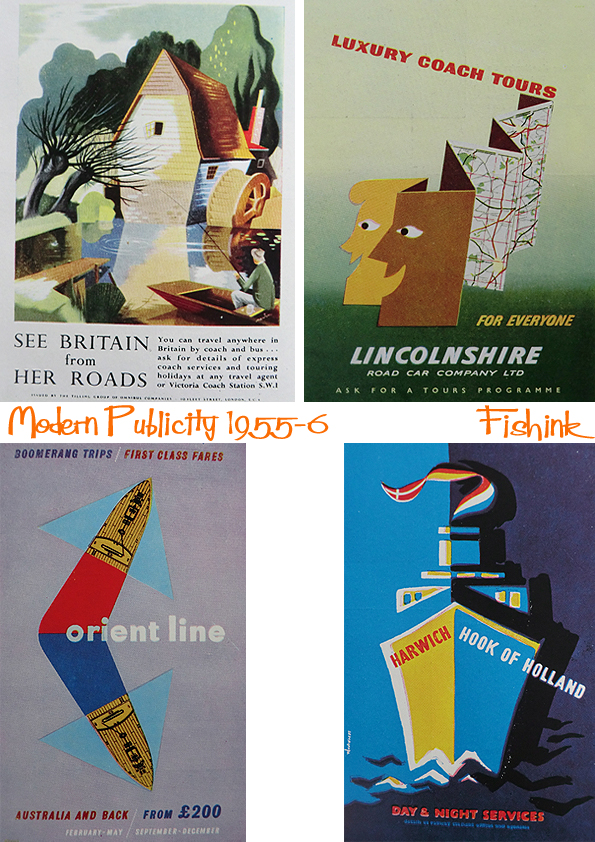
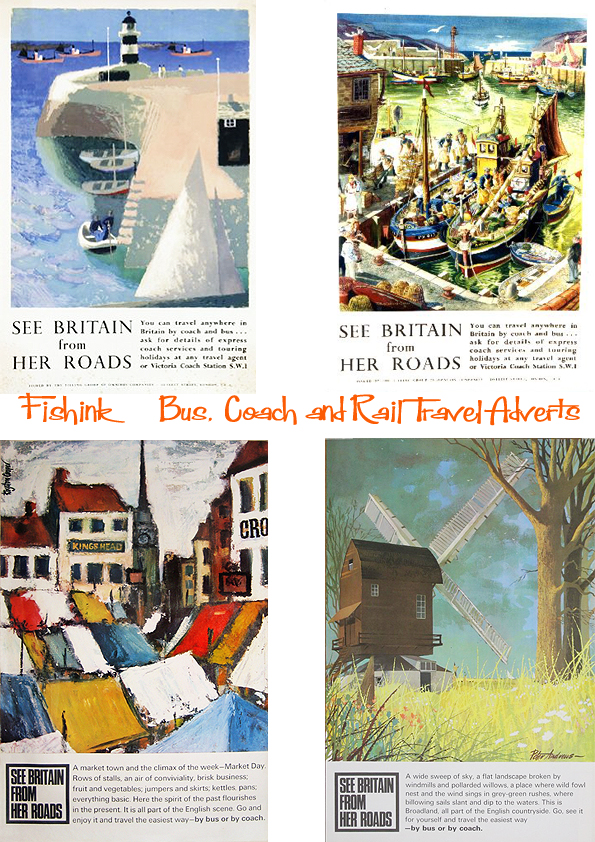
Since I’m mentioning the See Britain From Her Roads posters, here’s a few more I found on the internet. All created by different artists to help promote Bus, Coach and Rail travel around Britain.
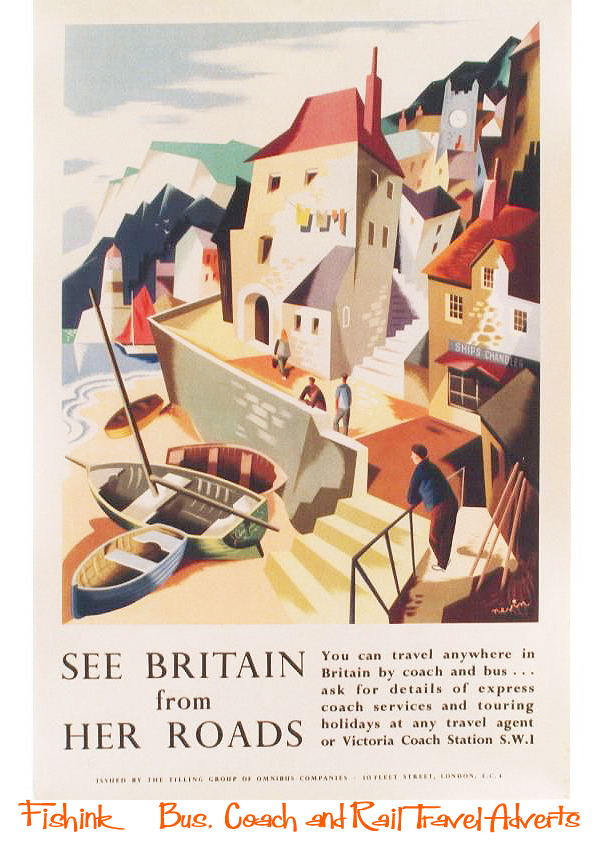
Watch out, more to come from this mid century annual soon. You can also put ‘Modern Publicity’ into the search function on my blog to look for other posts from this series. Enjoy.
Emily Sutton Paintings and cards

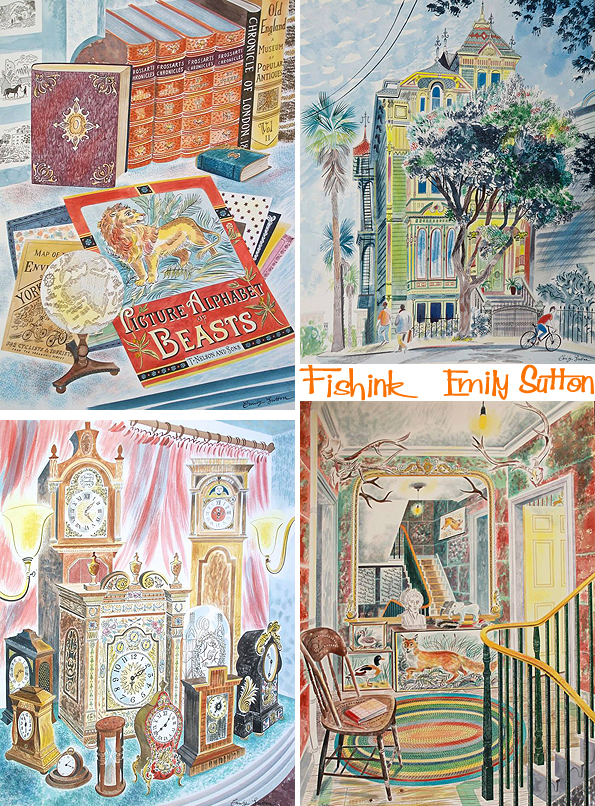
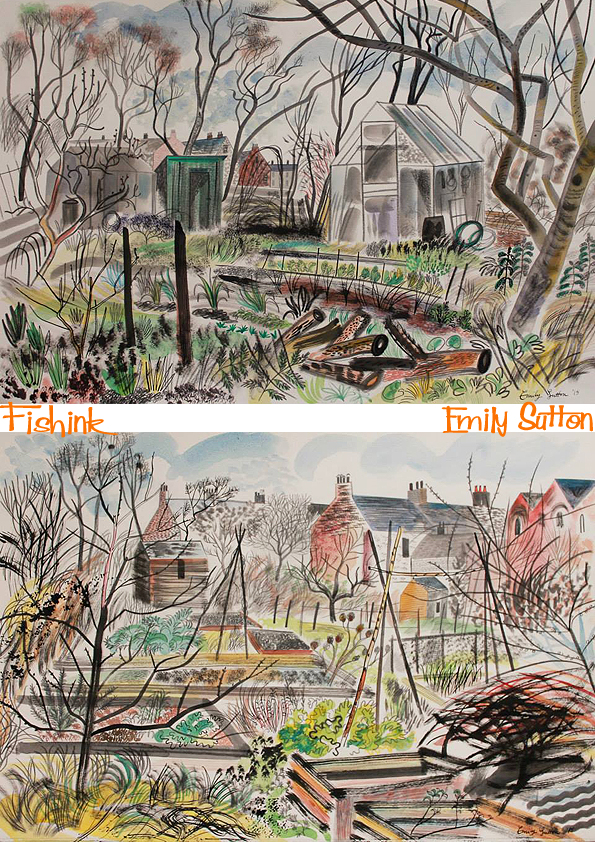
I saw that Emily Sutton, who is featured regularly on Fishink Blog, has been busily painting away again. She’s a prolific artist, who’s work sings with the joy and passion that goes into each piece. You can feel how much she likes her ‘day job’ : )

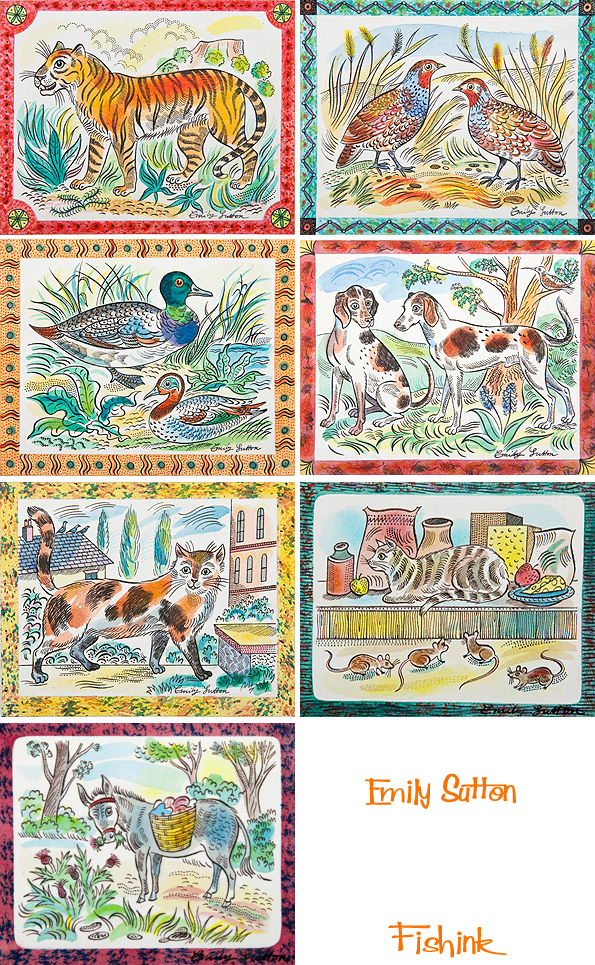
Emily seeks out the unusual. Whether it’s antiques, quirky houses or just painting wonderful scenes from around her own home.

Time spent on the allotments.
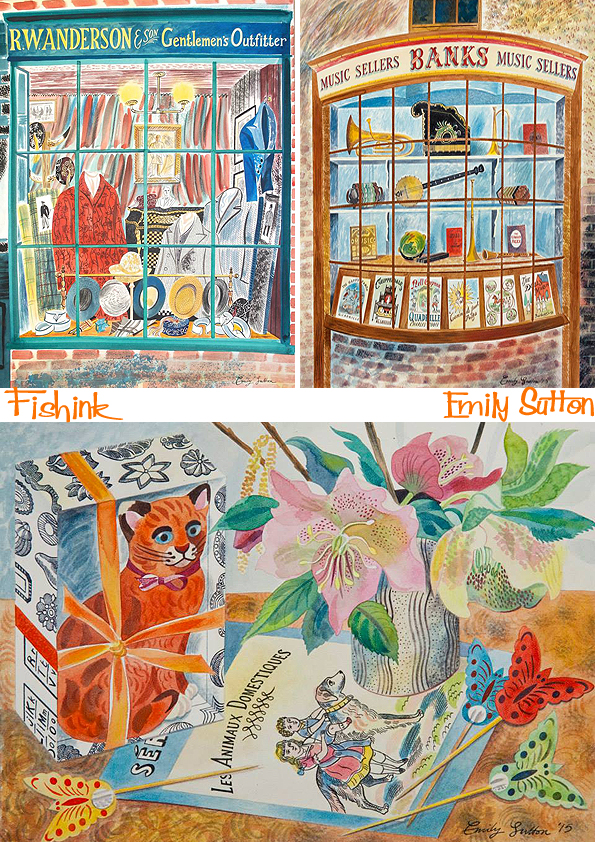
And her continuing love of old shop fronts and the disappearing face of the high street.

It’s great that she’s preserved these beautiful scenes for us to view in another hundred years time.

A range of inspiring 3d cards has been designed for Art Angels taken from her illustrations below.
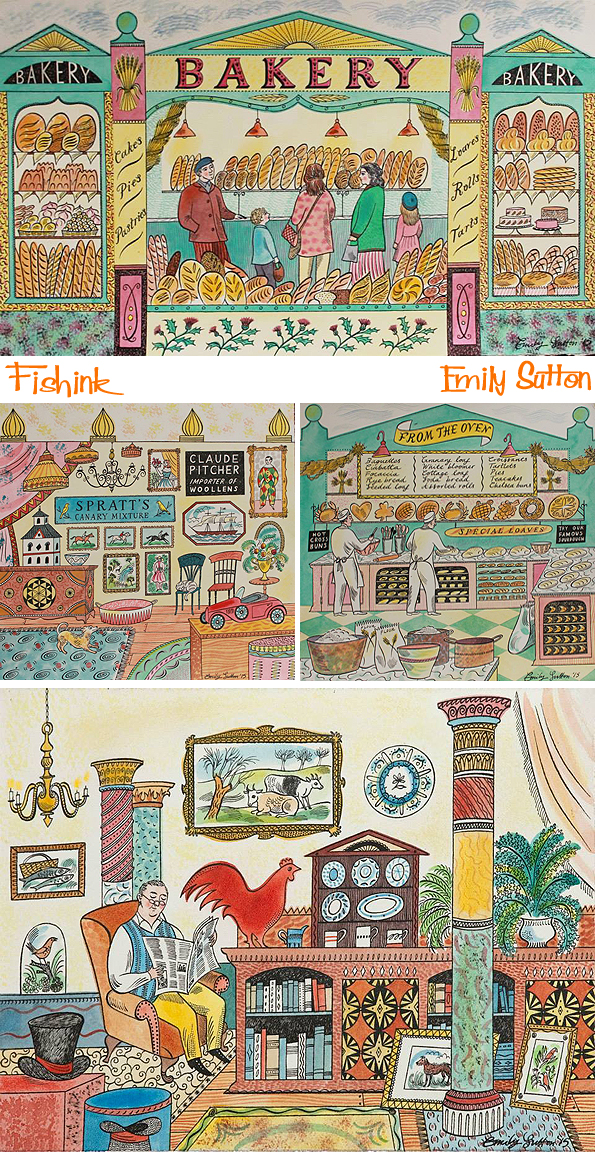
I’d love to see a cartoon series about the owners of the shops from this work : )
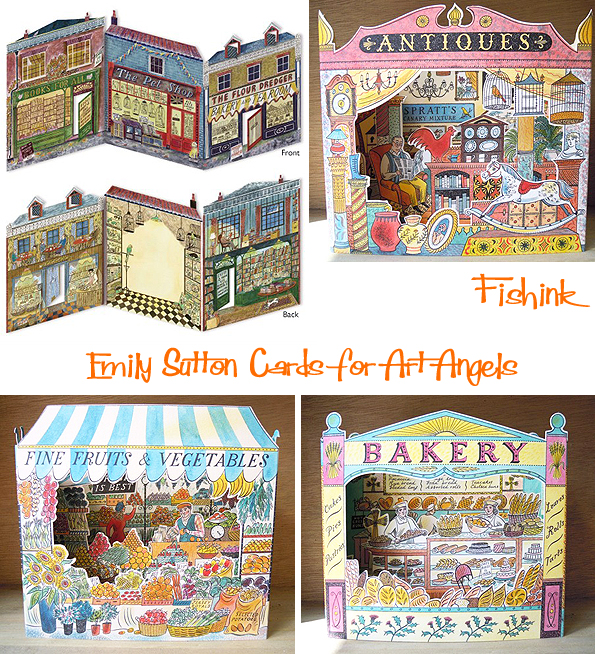
Fabulous work as ever Emily, do keep us smiling : ) To view more of her work on Fishink Blog, simply type Emily Sutton into the search box on the right hand side. Happy discovering.
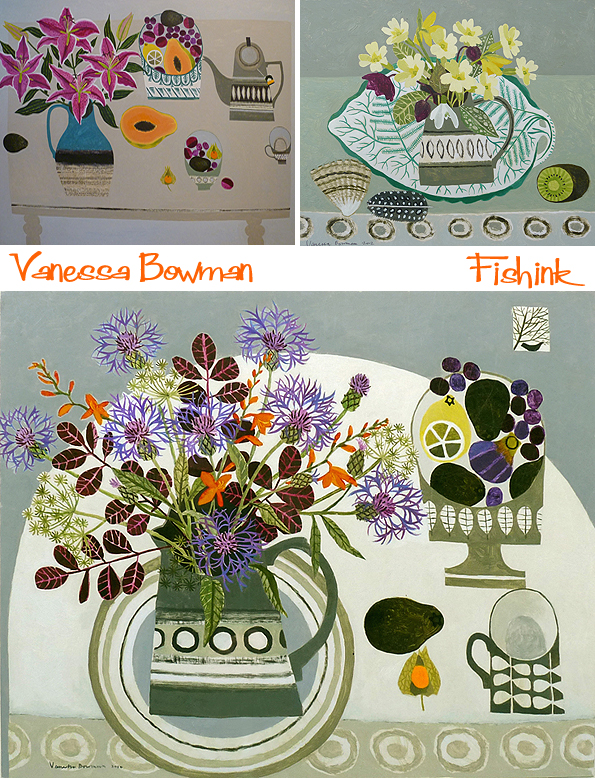
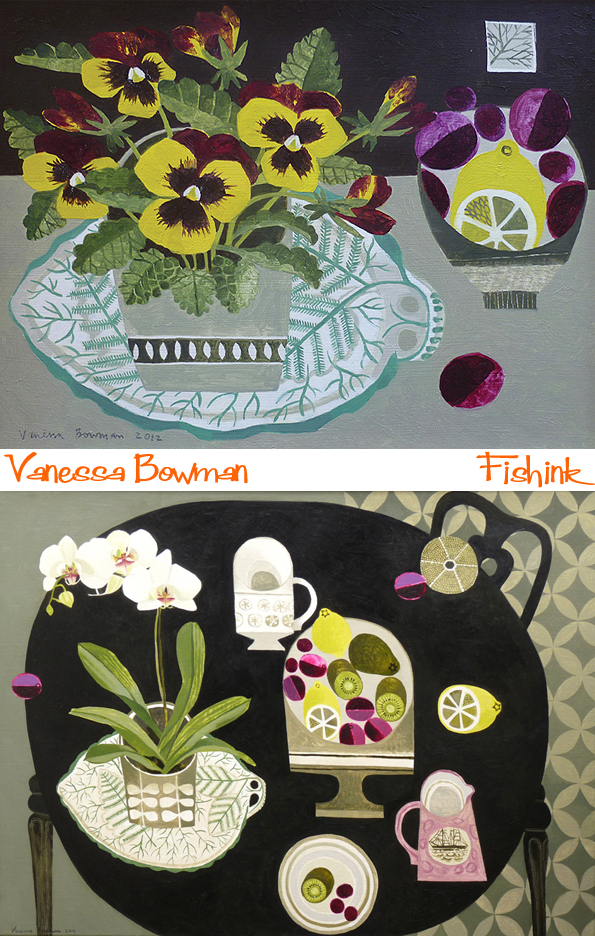
Vanessa Bowman Welcoming nature indoors
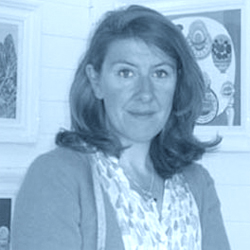
Vanessa Bowman graduated from Winchester School of Art in 1993 with a First Class Honours degree in Printed Textile Design. During her time there she won the Eileen Bendall and the Sanderson prizes for drawing, and the Daler Rowney Young Artist award – for pastels exhibited in the Mall Galleries – two years running.
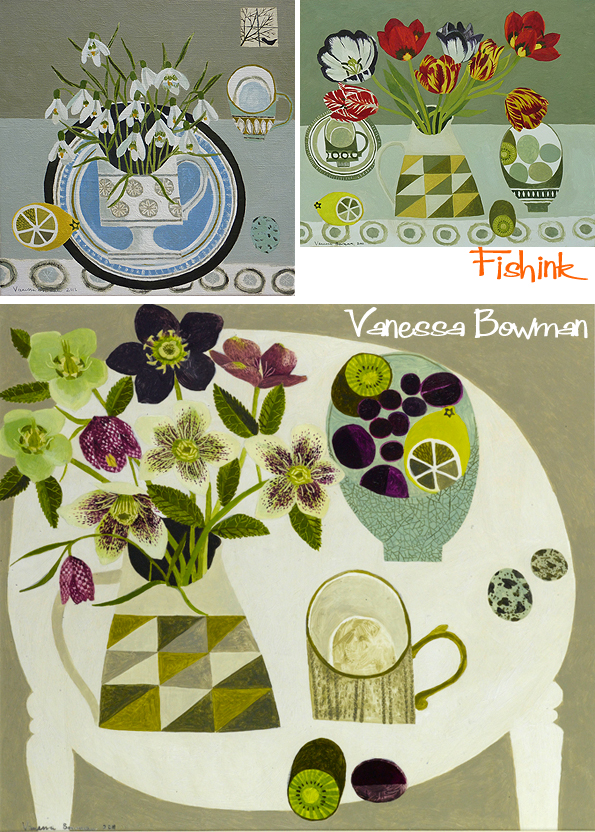
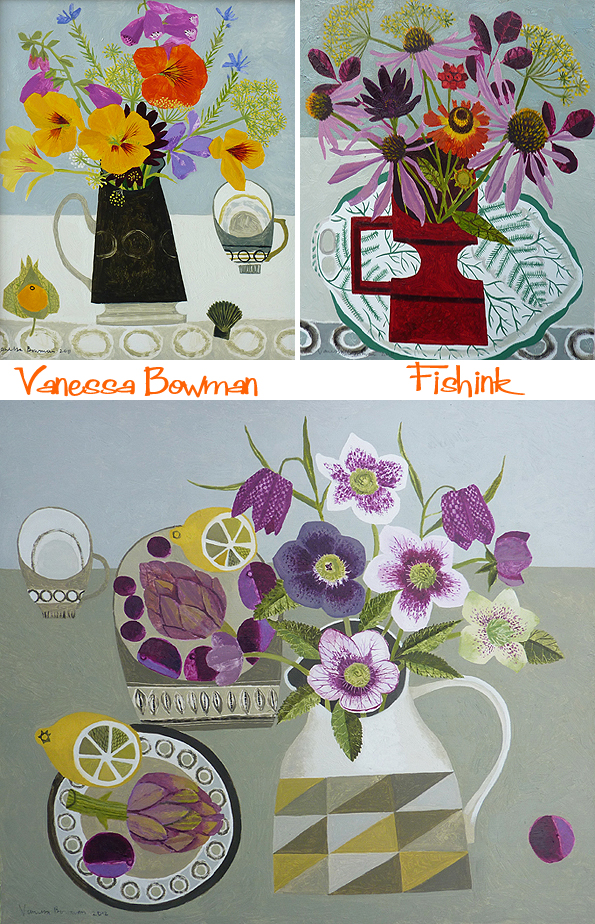
Each of Vanessa’s still lifes observes the simple beauty of everyday objects – a moment captured in time. A vase of garden flowers, a bowl of lemons (their acid yellow placed against the deep magenta plum), a striped shell – each is placed deliberately within the framework of the painting combining muted subtle colour with jewel-like accents.
Vanessa kindly answered some questions for Fishink Blog.
Can you tell me what inspires you to paint and who would you place amongst the artists who’s work inspires you or that you most admire ?
My inspiration to paint comes from all sorts of sources:- walking through the countryside where I live, hedgerows, my garden and plants that I grow, exhibitions, magazines – particularly for colour and pattern. Pinterest- to look at other artists work.
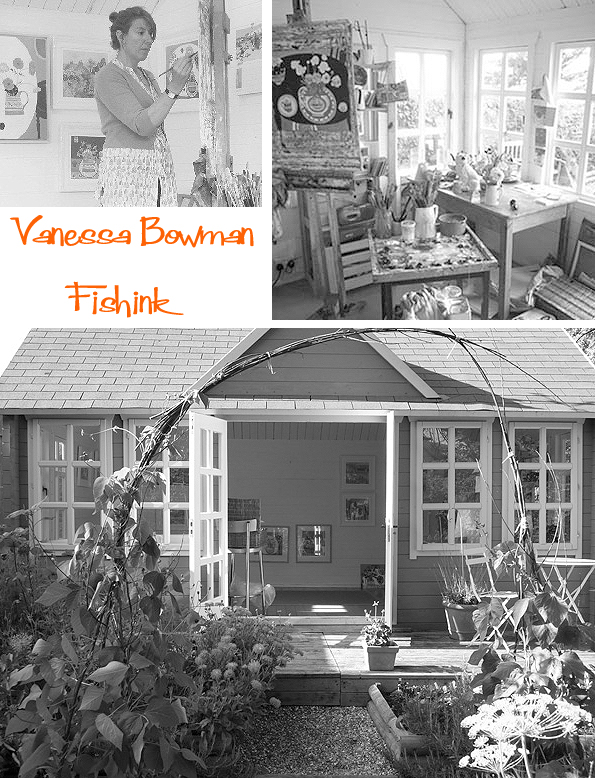
My inspiration for objects comes from pottering round markets looking for 1950’s style objects which often have a pleasing shape, form or patterning. Artists that influence are colourists such as Anne Redpath, Mary Fedden, Rothko, also Elizabeth Blackadder, Winifred Nicholson and Italian Renaissance painters such as Piero della Francesca, Fra Angelico, Giotto. I also like the Bloomsbury group of painters, in particular Vanessa Bell and Duncan Grant.
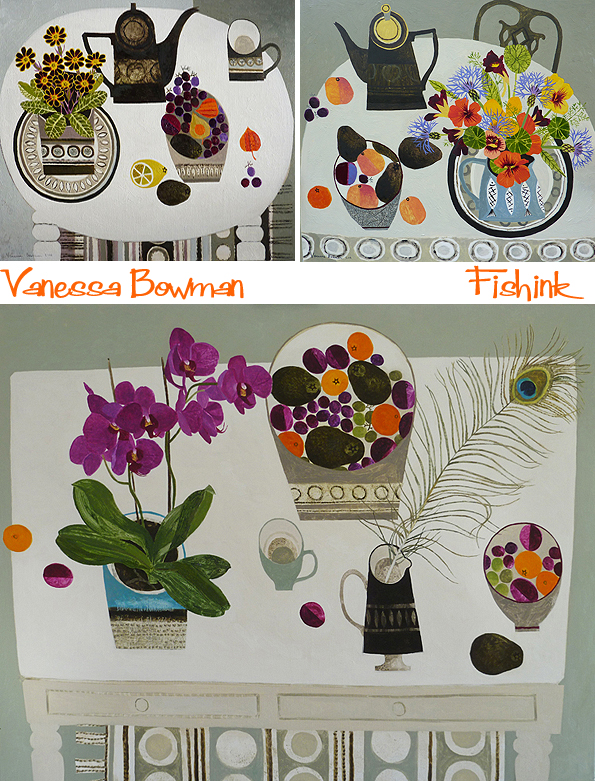
I love the way that familiar pots, cups and tablecloth patterns reappear in your work. Is there a reason behind this or just that you never tire of their shapes and surfaces ?
Familiarity of objects – they fit into the framework of a painting like each piece of a jigsaw. The spacial relationships of the objects that I choose are really important to the overall painting, and I often return to familiar shapes and motifs which fit the scheme.
There seems to be a real history in paintings (dating back to the Egyptians) where the pots or containers are depicted as flattened. Can you tell me how you came to paint in this way ?
The style of paintings of the Italian Renaissance such as Piero della Francesca and Fra Angelico have always fascinated me in their naive modernity. The tilted perspective that I use in my work comes partly from a fresco at Assisi where the table tilts towards the viewer and the shapes of the vessels and plates are flattened and simplified with a resulting simplicity that immediately appealed to my sense of pattern and arrangement.
Do you have any desires to paint in different styles, themes or mediums ? (Seascapes etc) How difficult is it for an artist such as yourself to not feel too trapped into an area or style of painting because that is perhaps what their audience expects or anticipates ?
Sometimes I feel that I would like to develop my work into other areas and styles and to look at a different approach to painting.I would love to explore a path of pure abstraction and to develop responses to pure colour with a freer ,more painterly approach. It is difficult to break free from an established style which followers of your work, as well as commercial galleries, have come to expect from you as an artist. It is difficult to breakout of the constraints of your own style whilst continuing to please both galleries and customers alike.
How much time do you devote to sketchbooks ? Do you use sketchbooks to work out the composition of your paintings ?
I use sketchbooks to develop ideas and to work out compositions and think on paper. It is useful too to refer back to previous work and to see paintings that have worked. I feel that drawing is the backbone of all work.
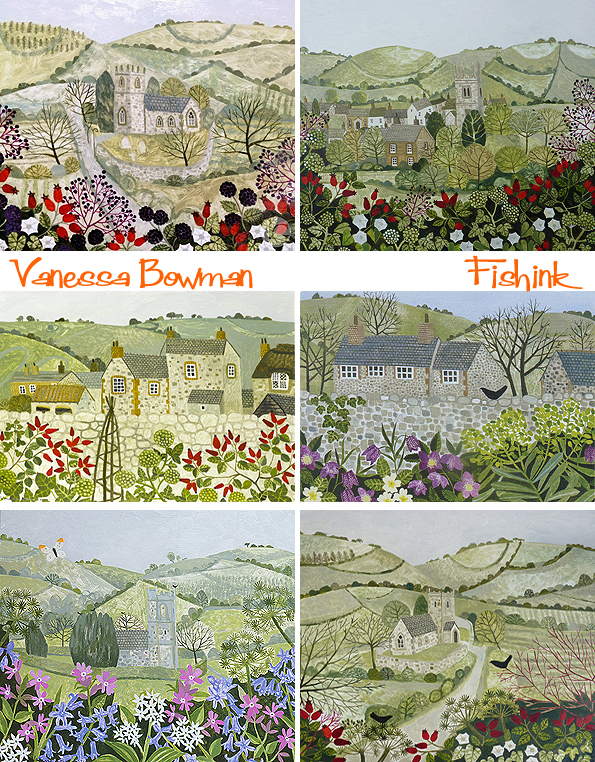
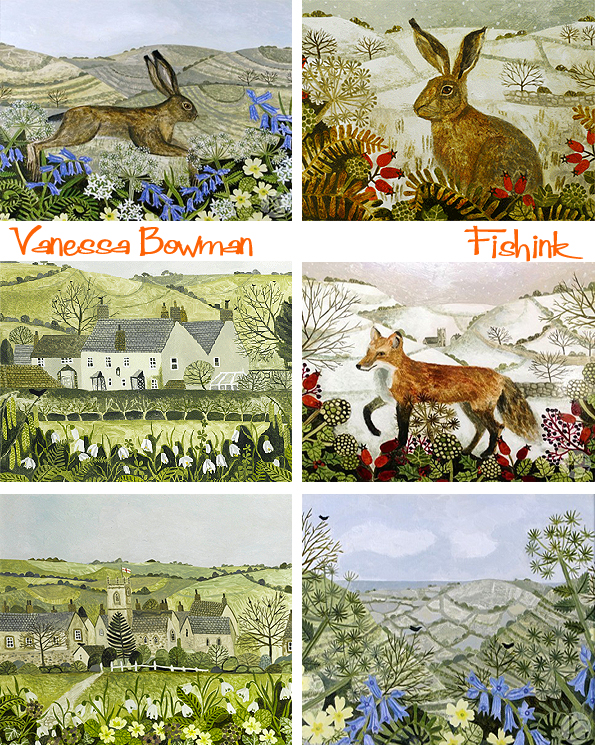
Vanessa’s landscapes observe the pattern and texture of the countryside around her home. She paints features left by the working of the land, punctuated by seasonal land marks – such as skeletons of trees in winter or hedgerow flowers in summer. Detailed foregrounds of vibrantly coloured berries or hips, delicate snowdrops or cow parsley lead the eye into an intimate portrait of the Dorset landscape.
Do you have any preference for painting still life over landscapes or do you vary it depending on the time of year or when you feel like a change of subject ?
I enjoy equally painting landscape and still life, each presenting different challenges. I often paint a landscape to have a change of scene from my still life painting, which I mostly paint. I am drawn to the same things in a landscape, with areas of semi- abstraction in the painting in say a hillside, alongside detail of the flowers in the hedgerow in the foreground. In winter there is the sparseness of the landscape with its skeleton trees alongside dashes of colour in berries and hips. I enjoy painting this when in the garden there are few flowers or plants to draw inspiration from.
When you’re painting landscapes do you prefer to work from the real thing, photographs, sketches, memory or perhaps the imagination ? How important is it to you that your landscape is a real scene ?
When painting landscape I work into a sketchbook, sometimes from a photograph, but interpreting also from memory in order to pare down an image and get more of a sense of place or season, rather than a realistic representation.
Where do you see your paintings going in the future ?
In the future I would like to develop more abstract work and explore the possibilities of oil paint further. At art school I painted in quite an expressive, painterly style and I would like to get explore that again- to look at the joy of simple colour, mark-making and texture.
Beautiful explosions of the countryside here, I love the feeling of nature spilling out of the frame into the room. Many thanks for your time and thoughts about your work Vanessa. I look forward to see which country lane you work may lead you to next !
Mid Week Mix and Fishinkblog on Instagram
Since about 2008, I’ve been collecting images from the internet that have caught my eye. Way back then, I wasn’t so diligent in keeping records as to where images came from, or who had painted, photographed, illustrated or indeed created the artwork in the image. So I apologise in advance for their lack of referencing, but to be honest, it was purely about seeing groups of imagery together, that for whatever reason, I enjoyed.
As I have managed to amass quite a few of these ‘collaged sheets’, I thought I would share them with you, in the hope that they may also provide some inspiration to you the readers, from their shape, colour, texture or out and out randomness : )


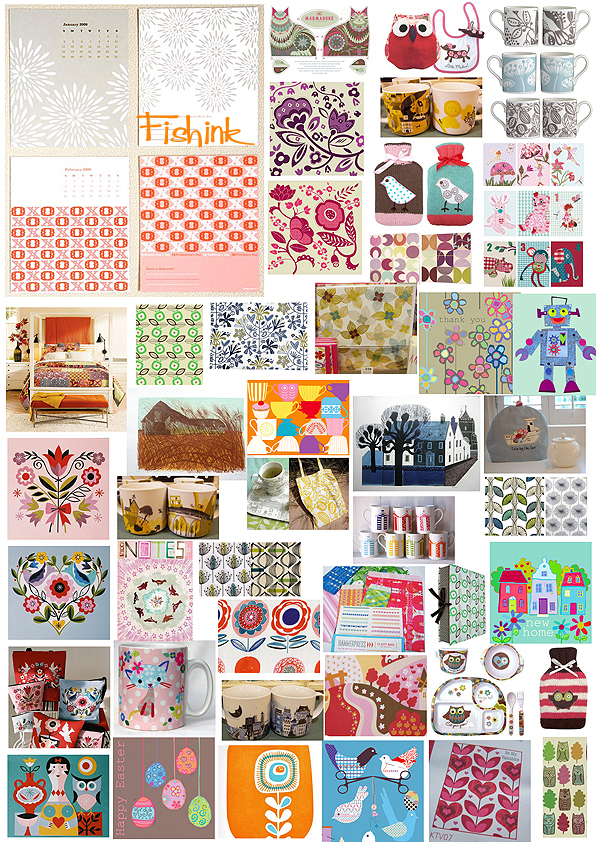


Do let me know your thoughts and which images catch your eye for whatever reason.
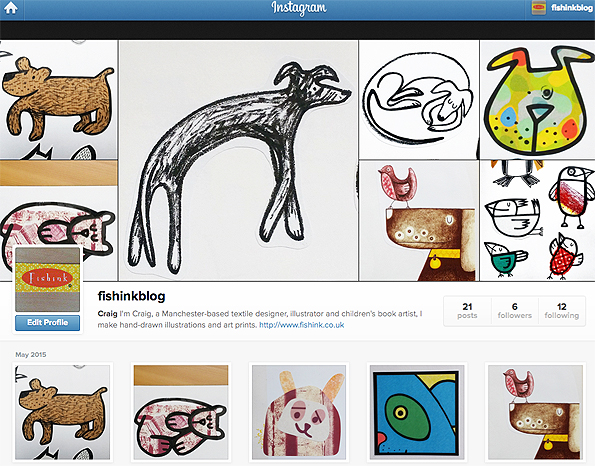
Also I’d like to mention that I’ve just started an Instagram page for Fishink Blog.
The link is (https://instagram.com/fishinkblog) or you can click on the button on the right of my site.
It’s early days but I’ll be building up the collection every week, so if you lovely folk would like to follow me, or leave a comment or see more of my artwork, then please pop on over and check it out today. I’ll look forward to sharing more of my own illustration with you.
Have a great Midweeker : )

 fishinkblog.com