Rena Gardiner Artist and Printmaker
Welcome to Monday on Fishink Blog, as I’m brimming with new news about two great publications coming out this month, I’ve decided to dedicate this week solely to books.
Back in December of 2013, I wrote a post about the artist Rena Gardiner and really got to know and appreciate her beautiful work. Little Toller Books have just announced the release of a new book called ‘ Rena Gardiner Artist and Printmaker ‘, which looks to be something quite special, and what’s more, it’s available as of tomorrow.
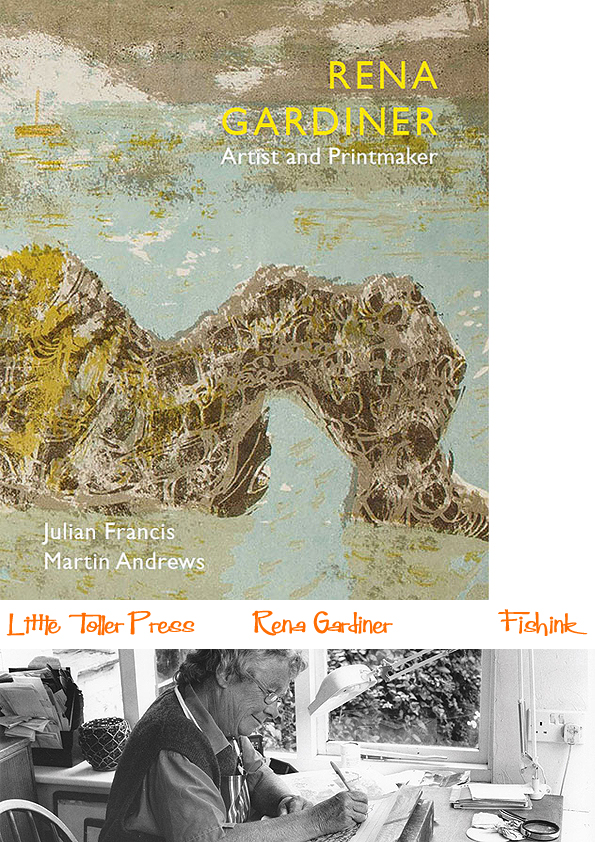
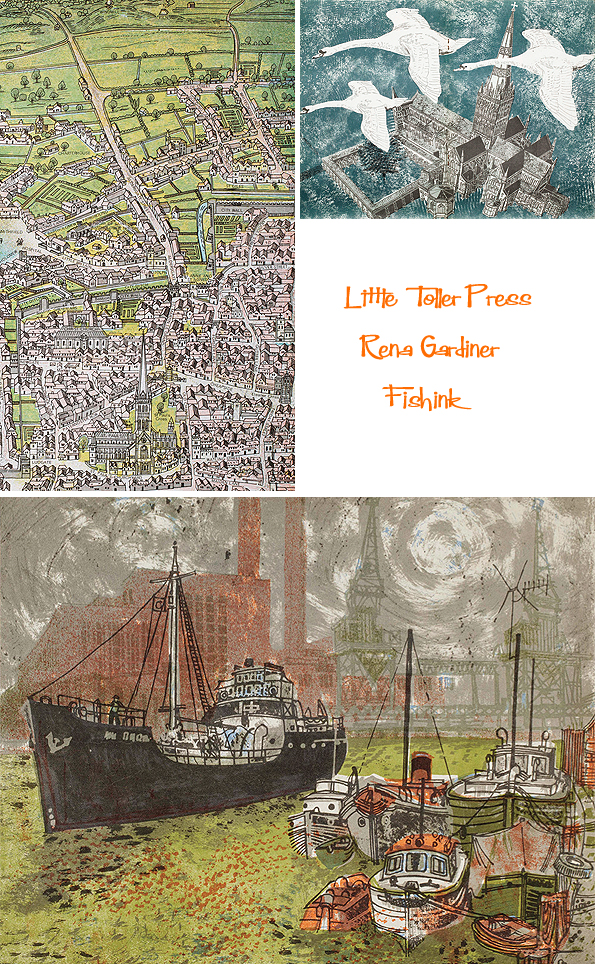
This first book on the artist and printmaker Rena Gardiner (1929–1999) is long overdue. Her guidebooks to historic places, buildings and the countryside have an idiosyncratic style that is unique in post-war British art. Her principal achievement was some 45 books, all of which she wrote, illustrated and printed herself, and of which no two copies are the same. But her legacy also includes paintings, pastels and lino-cut prints. Her collectors and admirers are many, and in recent years a new generation of artists and printmakers have discovered her work, helping to spread the word and foster the recognition she merits.
Rena Gardiner dedicated her life to her art, doing so alone in a thatched cottage in the heart of Dorset. Combining the great tradition of British topographic artists with the rich era of autolithography of the 1940s and 1950s, she created her own very personal and individual visual style. An unsung heroine of printmaking, uninterested in publicity or fame, she created an artistic legacy that is instantly recognisable for its exuberant use of colour and texture.
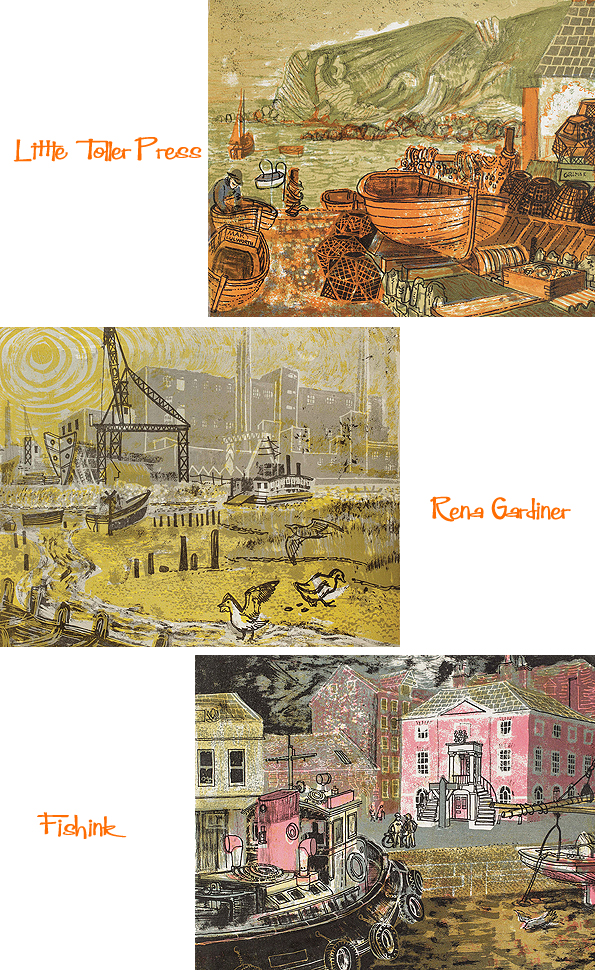
Rena Gardiner is fortunate in the two authors responsible for this celebration of her work, which includes nearly 200 illustrations – many of which have never been published before. Both Julian Francis and Martin Andrews have long been Rena’s champions. As well as tracking down lost paintings and rare copies of her books, Julian Francis has contributed a meticulous list of her books, leaflets, cards and prints. In 1993 Martin Andrews spent a day with Rena Gardiner, talking to her and photographing her at work, and is thus admirably qualified to provide both the biographical background to Rena’s career and an account of a printing technique that was uniquely her own.
Little Toller Books was born in 2008 as an imprint of the Dovecote Press, a family-run publishing company that has specialised in books about rural life and local history since 1974. Little Toller was started with a singular purpose: to revive forgotten and classic books about nature and rural life in the British Isles.
I also discovered a fascinating 25 minute lecture about Rena and her working methods, by Martin Andrews (one of the books authors).
You can buy a copy of this book here for the very reasonable price of £20 (plus £4 p&p). There’s over 160 pages and the first 50 books ordered will be signed by Julian and Martin. With a release date of April 1st, you’d be a fool not to ! Let there be no doubt that my copy is already on it’s way.
Fishink walks and new artwork.


The weather of late, has been kinder and warmer, so we’ve been making the most of it and getting out for walks whilst the the round yellow ball in the sky is visible…. of course the dog always wants to join in. We set off for Wythenshawe Park, where I have been before, but only just realised thanks to my blog, that the last time was over a year ago.
Often I find the most exciting things to see, are happening either above my head, or below or my eye line. I’m always looking everywhere to be sure that I don’t miss any of nature’s treasure.

I’ve photographed this fish and frog previously, but they still made me smile when I came across them again.
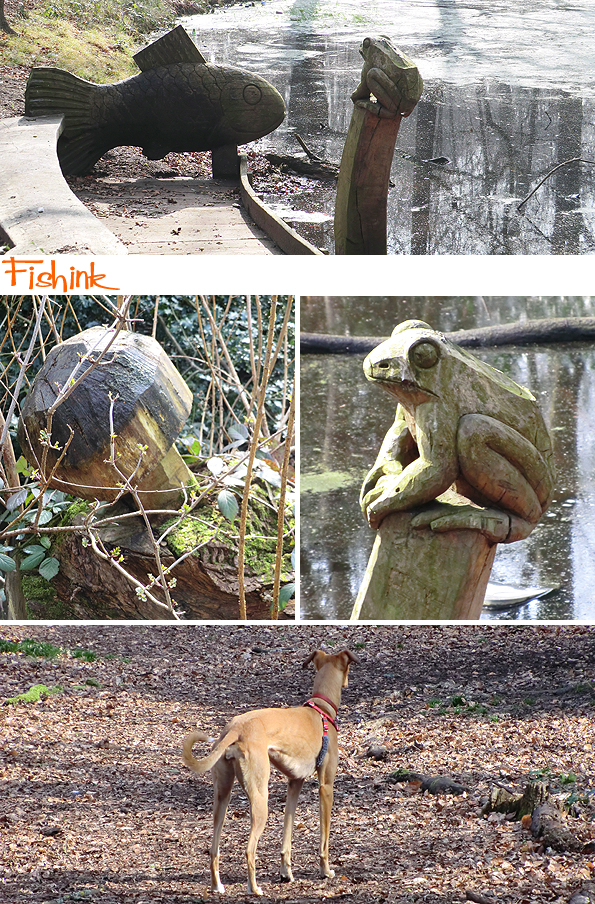
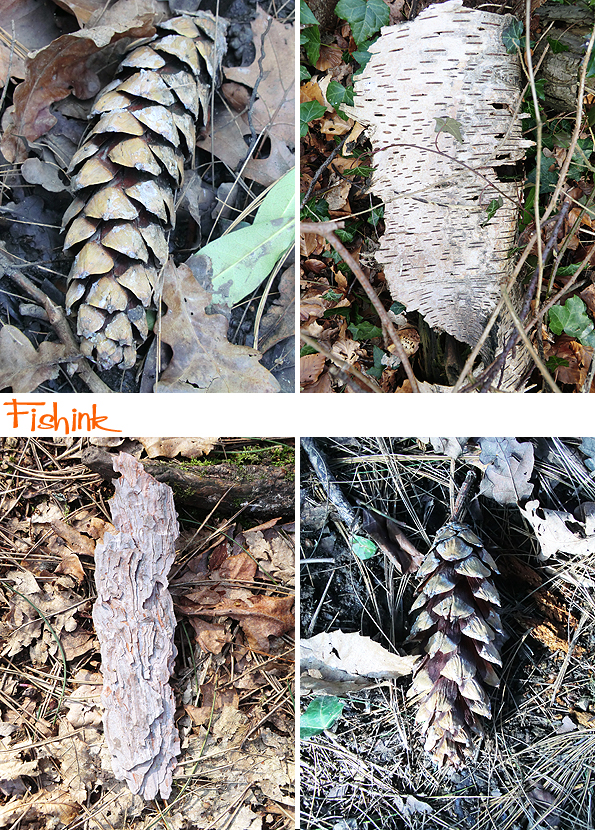
Huge beautiful cones and morse-coded or Ordnance-Survey-mapped, pieces of bark, lie waiting to be discovered.
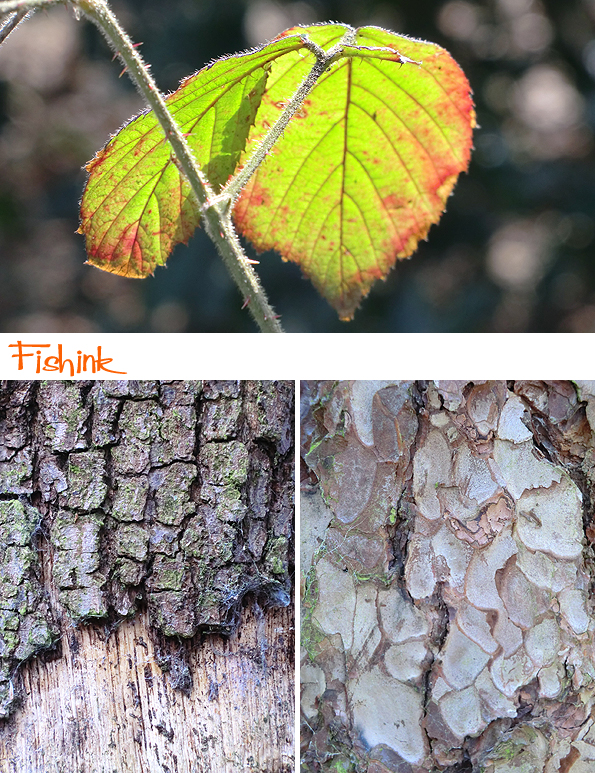
I love seeing the sun shining through leaves and trees, it’s like illuminated, coloured, sparkly lights in the forest.
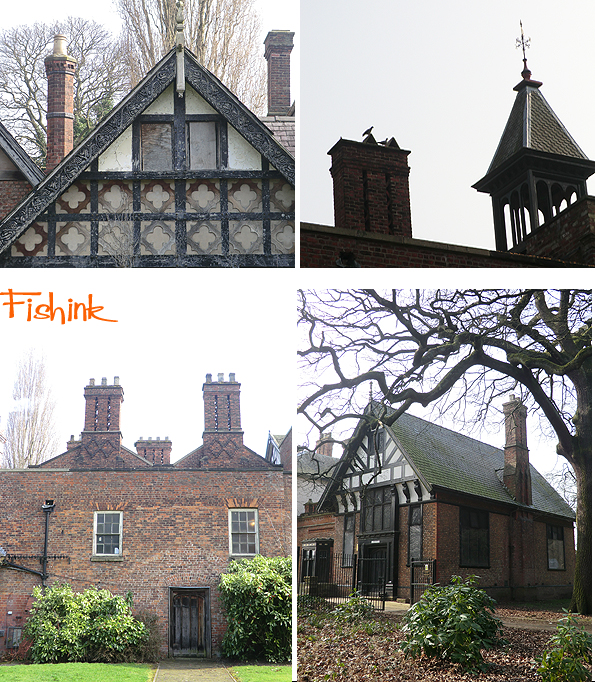
Wythenshawe Hall, is sadly in need of a lot of TLC. It would look amazing once resoted, but probably also needs an amazing amount of funding in order to do so.
How lucky to be out amongst the birdsong. Boo thinks so too, however she’s slightly more obsessed with the squirrels and bouncing around like a young gazelle !

Trees doing their own form of yoga or perhaps expressional dance.


There was a carpet of dry pine needles (above) which swirled in circles and scrunched beneath our feet. This gate made me think of Tom’s Midnight (or The Secret) Garden. The contrast of these furry yellow buds against the blue sky, shouted to be photographed. Along with the bench which appears to be a little down at heart !
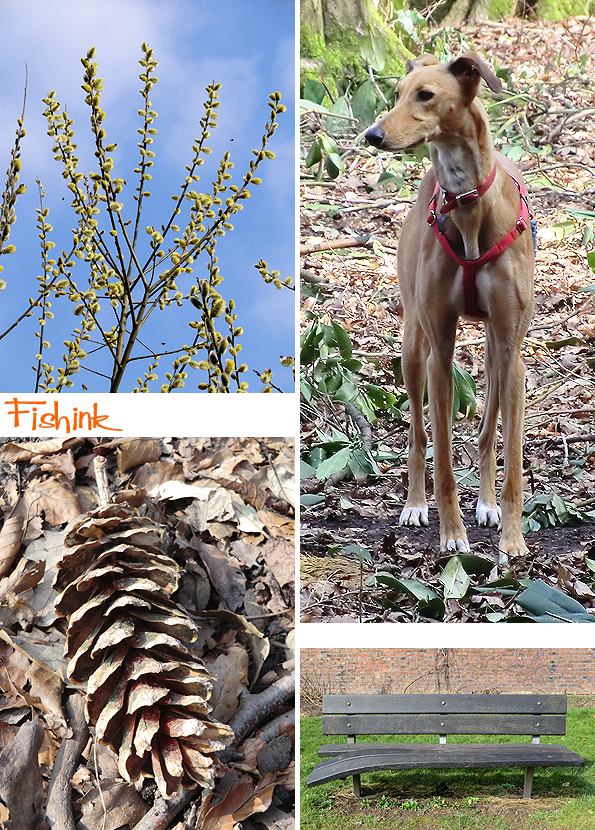
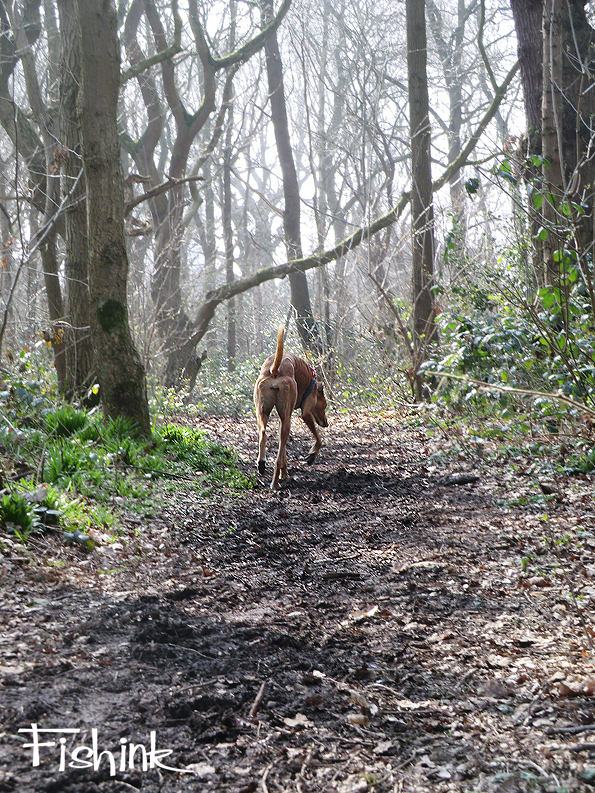
Finally, I really liked this photograph of Boo, off foraging, with the sun shining through the layered and twisted forest. It encapsulated my feelings for this spring-like day.
I found a couple of beautiful, delicate treasures on my doorstep this week.
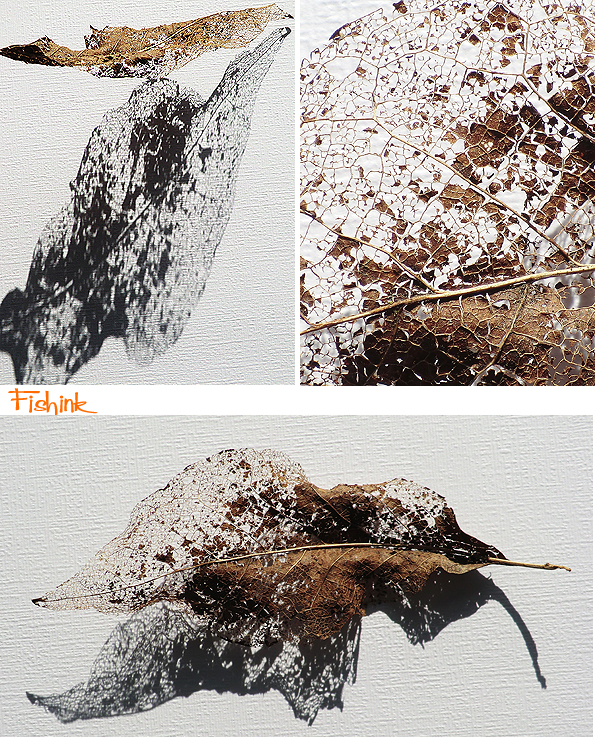
Someone described the top right, leaf close up, as an aerial view of a city, and I think the sycamore seed (below) looks like a whole forest. Isn’t nature amazing !

I’ve also been busy working on some new, much larger artwork, also inspired by nature.
The artwork itself is 30 x 30 cms and the frames are 50 x 50 cms. They’re both available for purchase at £140 each (plus p&p) and are original, one-off collages, signed by myself. This first illustration is called “Gone Fishing ” and it depicts two bears in the woods, roasting their days catch over a log fire.
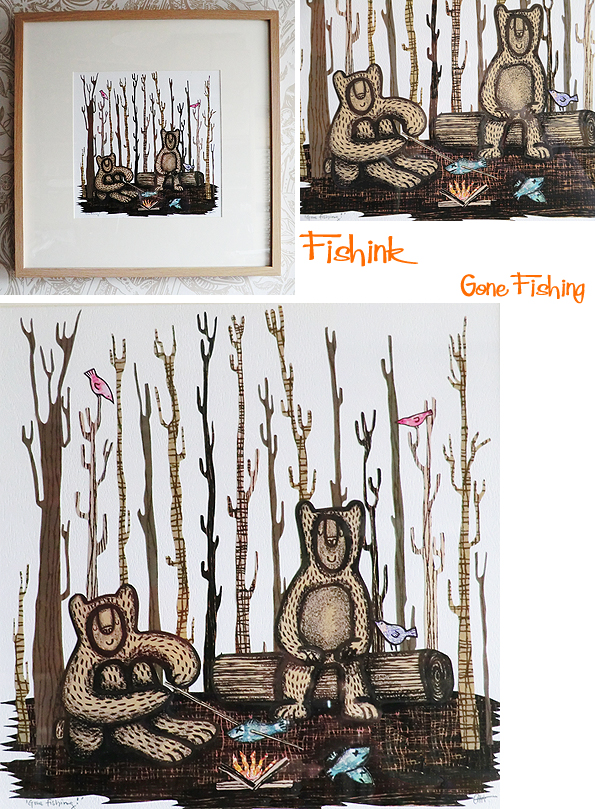
The second piece is called ” Nesting In The Cornfield ” and shows a huge comfy Hen, bedded down in the surrounding corn. Let me know if you might be interested in either piece or perhaps a similar, commissioned piece for your home.

What have you seen lately to show that Spring maybe on it’s way ? Please leave me your thoughts. Happy weekend.
Mid Week Mix
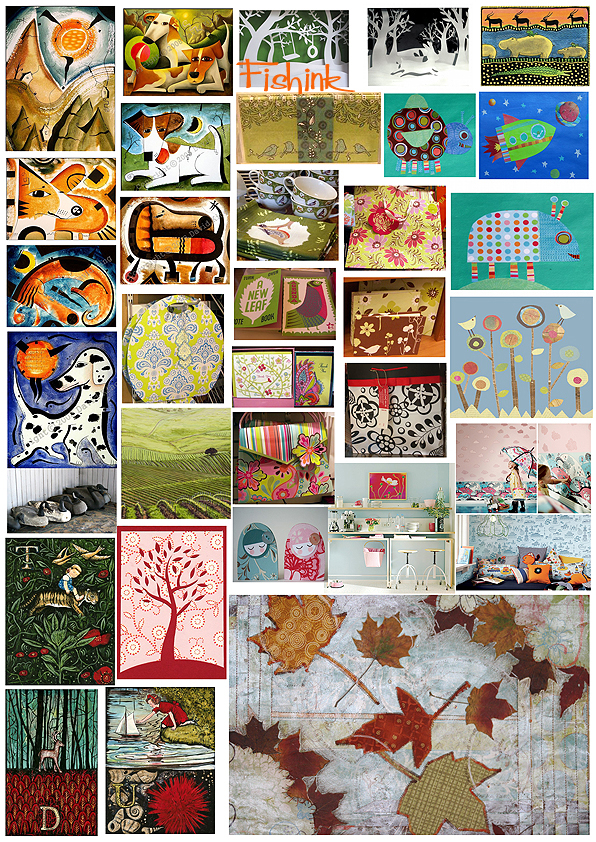
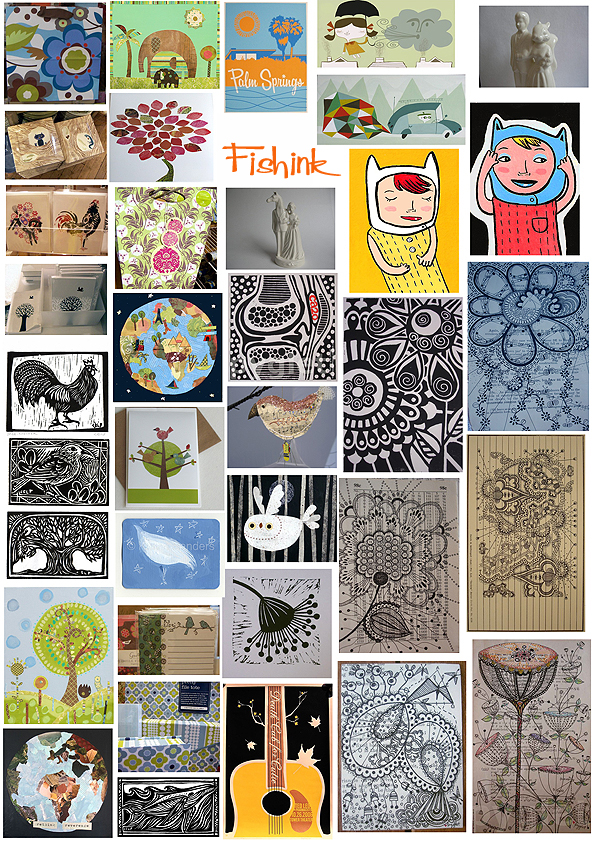
Since about 2008, I’ve been collecting images from the internet that have caught my eye. Way back then, I wasn’t so diligent in keeping records as to where images came from, or who had painted, photographed, illustrated or indeed created the artwork in the image. So I apologise in advance for their lack of referencing, but to be honest, it was purely about seeing groups of imagery together, that for whatever reason, I enjoyed.
As I have managed to amass quite a few of these ‘collaged sheets’, I thought I would share them with you, in the hope that they may also provide some inspiration to you the readers, from their shape, colour, texture or out and out randomness : )
We start with a few from Mark Hearld, to whet your appetite.



Do let me know your thoughts and which images catch your eye for whatever reason.
Partial Eclipse in Manchester to Polish Ceramics

It was a magical start to the day with the partial eclipse of the sun in the morning. Like a cheshire cat smile in the sky I was treated to glimpses of this heavenly spectacle. A solar eclipse occurs when the Moon passes between Earth and the Sun, thereby totally or partially obscuring Earth’s view of the Sun. In most of the UK we experienced about 83% of the eclipse, however many areas were totally cloud covered so the sun wasn’t visible … lucky me eh !

There was a very giddy group of school children on the tram on the way into Manchester. The stop announcer said ‘ The next stop, will be Trafford Bar ‘ and one little girl said to her neighbour, ‘ Did that lady just say chocolate bar ? ‘ and her neighbour said ‘ I like chocolate bars ‘, ‘ So do I ‘ said the first girl. I just smiled and looked out of the window as the conversation carried on for the next few minutes in the same vain.

Firstly a quick look around Manchester City Art Gallery, where I discovered the dresses of Media and Textile Artist Andrea Zapp. Sadly her exhibition finished yesterday but I’ve captured the essence of it for you here. All of the silk clothing is hand-made.
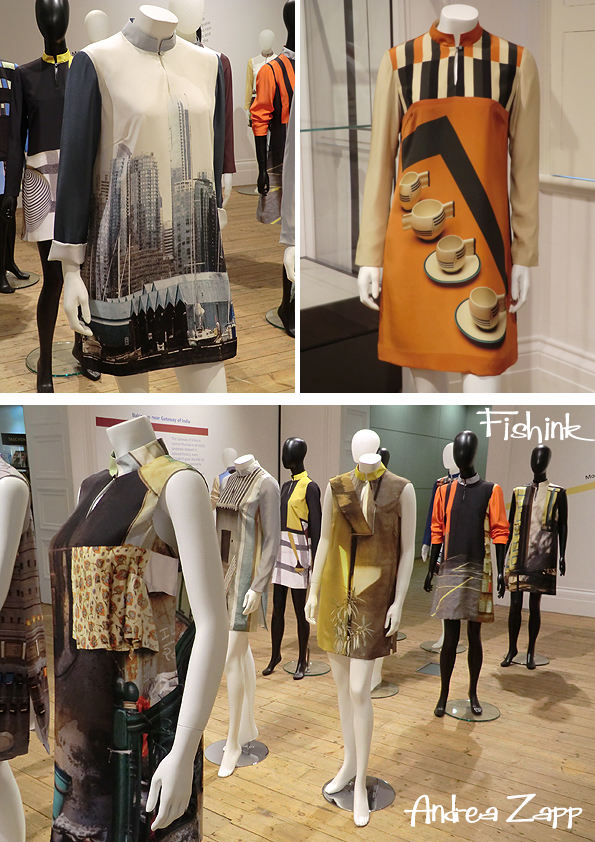
Andrea has used scenes and photography from her global travels. Urban views, rural panoramas, miniature scenarios and objects from the galleries own decorative arts collection. Each dress also features in a unique online map interface, that enables you to view the original location and background story for each photographic artwork, including it’s GPS coordinates !
It was great to see the photographic images, next to an image of the completed dress. Great colour and movement.

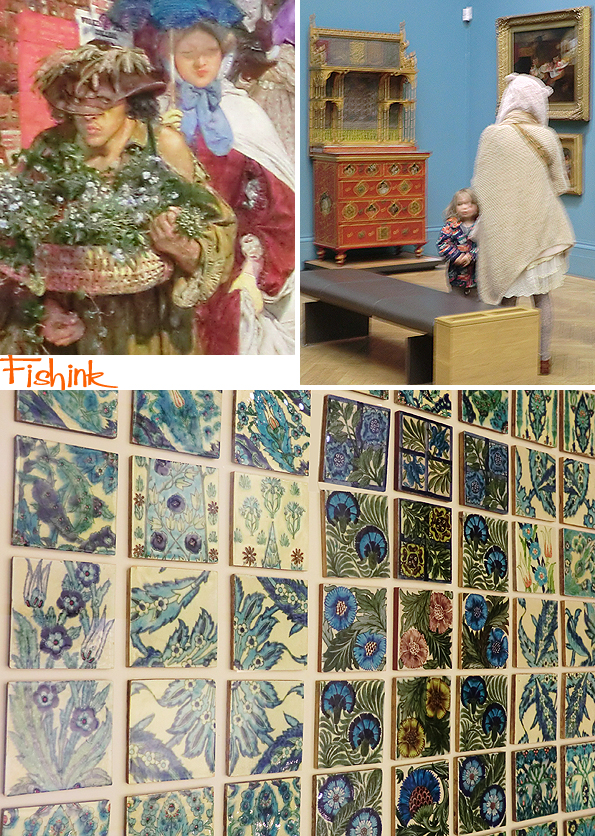
Sadly quite a few of the rooms were closed in the gallery as the exhibitions were changing, but it did mean that I saw some things that perhaps I wouldn’t normally have visited. This plate made in Valencia about 1680 and these beautiful tiles and bowl by William De Morgan around the 1890’s.

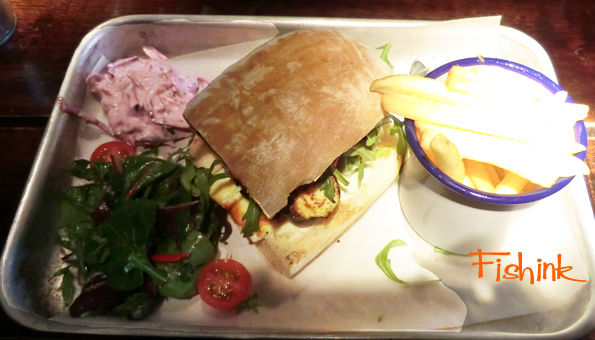
A brief interlude for some well deserved (and rather yummy) food in Terrace Bar on Thomas Street in the Northern Quarter.
Then just look what I discovered in Waterstones bookshop. A beautiful reminder of the work of Emily Sutton on the cover of ‘ The Incredible Journey ‘. Annabel Large’s cover for ‘ Tarka the Otter ‘ is also a winner in my view. Did you know this book was first published back in 1927 ! Great to see them both as fresh reprints.
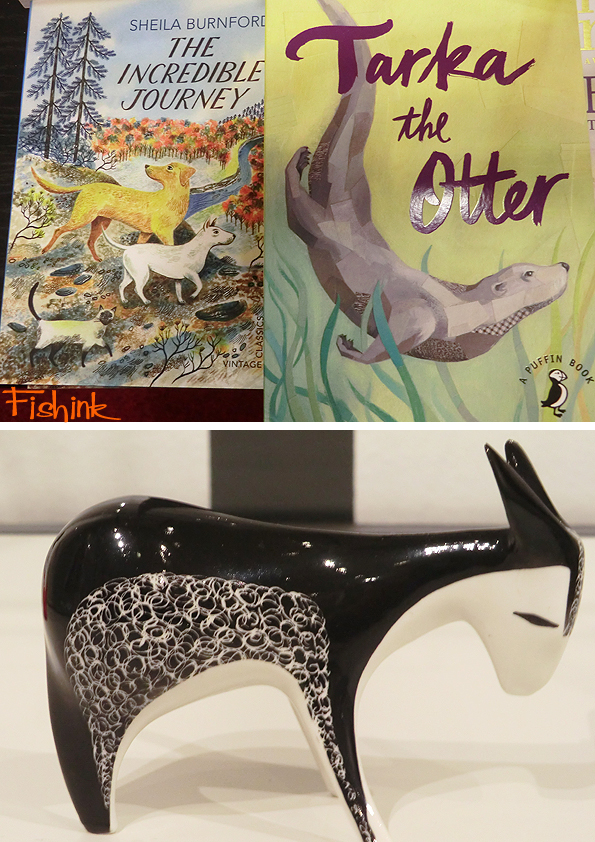
Also from the Art gallery, this fabulous donkey by Polish ceramist Lubomir Tomaszewski. Which led me onto one of my internet research trips to excitedly discover more.
These figures are one of the best examples of the golden age of Polish design. Over the years, they have become icons of the style of the 50’s and 60’s. The leading Polish designers working at the Institute of Industrial Design (or IWP).
The ceramics known as the ‘History Figures’ began in 1956, when the IWP recruited Henry Jędrasiak, Lubomir Tomaszewski, Hanna Orthwein and Mieczyslaw Naruszewicz. It was this team of four designers, sculptors, who changed and defined the style of small sculptures produced at the factory and contributed to the high level of pottery produced in Poland. During the seventeen years of existence of the Department of Ceramics and Glass in IWP designed and implemented for the production of approximately 130 designed figurines.
I think their simplicity and beautiful use of minimal lines are reasons as to why the ceramics have remained so popular.
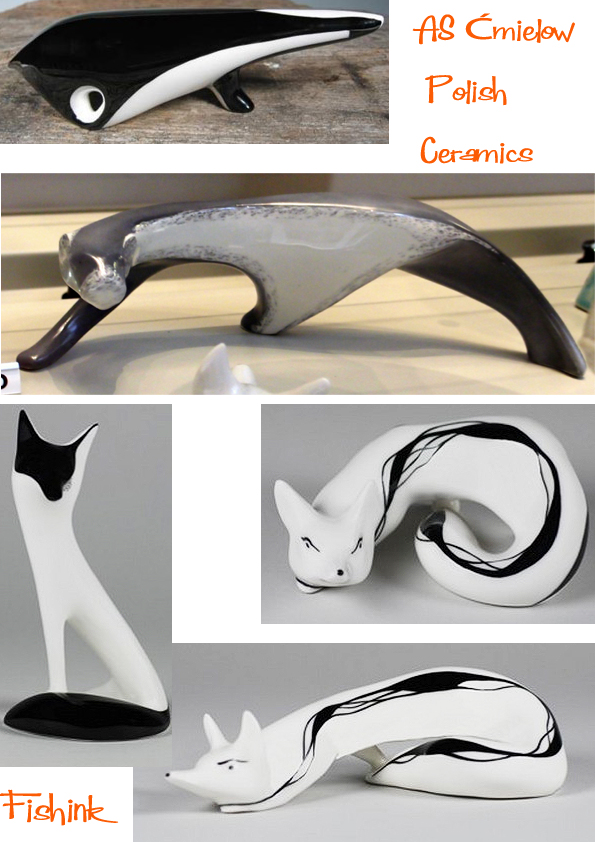
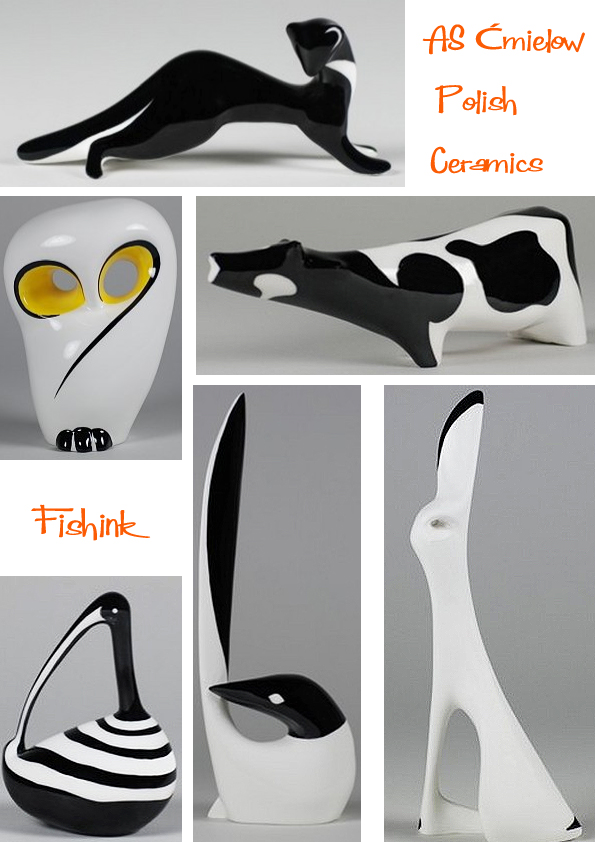
The four designers proved that the porcelain figurine can be a small work of art, and also at the same time, the perfect addition to a fashionable modern interior. Having little (similarly-styled) competition in the world of porcelain figurines, they caused a sensation in the exhibitions and trade fairs not only in Poland, but also in the USA, Japan, France, Germany and Russia.


Throughout the 1960’s they produced all the major labels porcelain and earthenware in Poland (in Ćmielów). Also the famous Ćmielowska Dawn label. The original forms and models, are still used today in the production of the Porcelain Factory at AS Ćmielów.

What amazing shapes and visual interpretations of these animals !
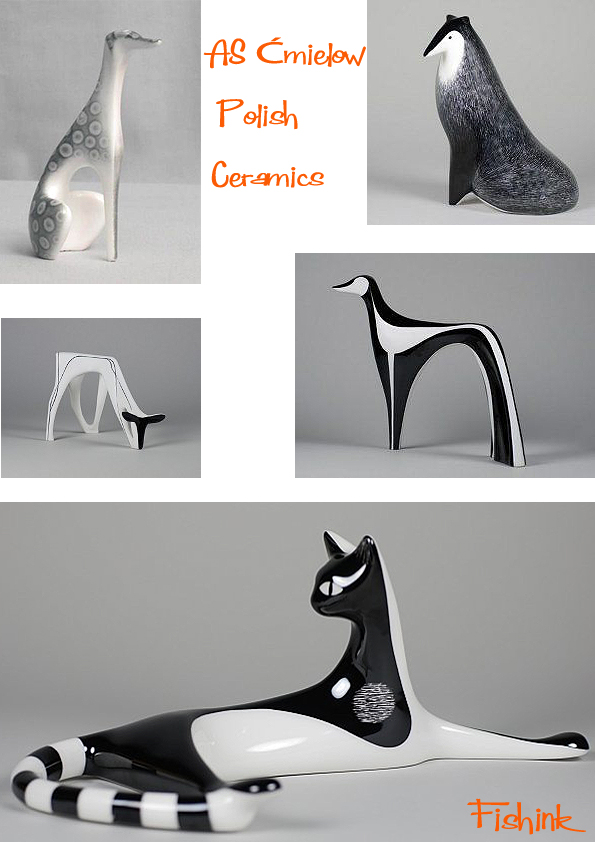
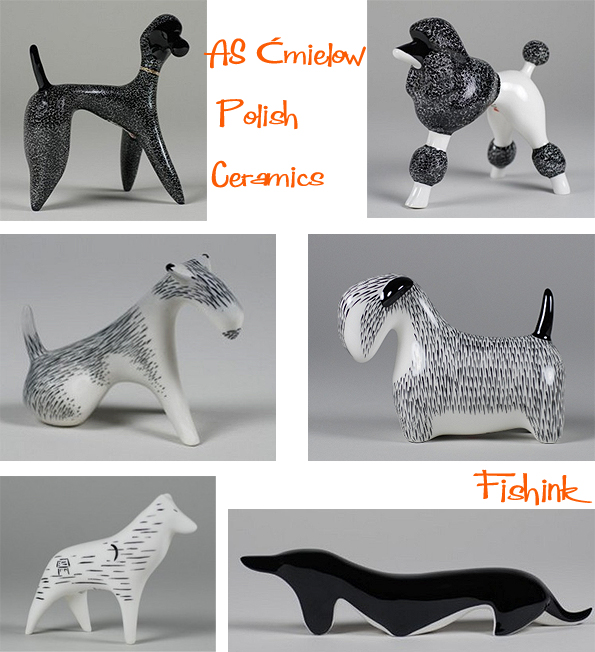
You can view more in this collection of ceramics here. If you enjoyed this you may also like the work of Jonathan Adler.
So now Fishink blog readers, you can now appreciate how my post travels from eclipses to Poland, just by the sighting of a piece of ceramics in Manchester ! Beautiful work, I’m so glad I saw it. Do you know of anything from a similar time and style ? Please share your thoughts with us all.
Brian Wildsmith Animals and ABC’s Part 2

Welcome back to part two of my post about Brian Wildsmith. Who, by the way, is considered to be one of the greatest children’s illustrators worldwide. The British Library Association recognised his first book, the wordless alphabet book ABC (Oxford, 1962), with the Kate Greenaway Medal for the year’s best children’s book illustration by a British subject. The biennial Hans Christian Andersen Award conferred by the International Board on Books for Young People is the highest recognition available to a writer or illustrator of children’s books. Wildsmith was one of two runners-up for the inaugural illustration award in 1966 and one of three runners-up in 1968.
I decided to add a few of his editions to my own library and was delighted to see , close up, just how decorative and textural his work really is. It’s sometimes hard to appreciate the layers and depth to his illustrations online.

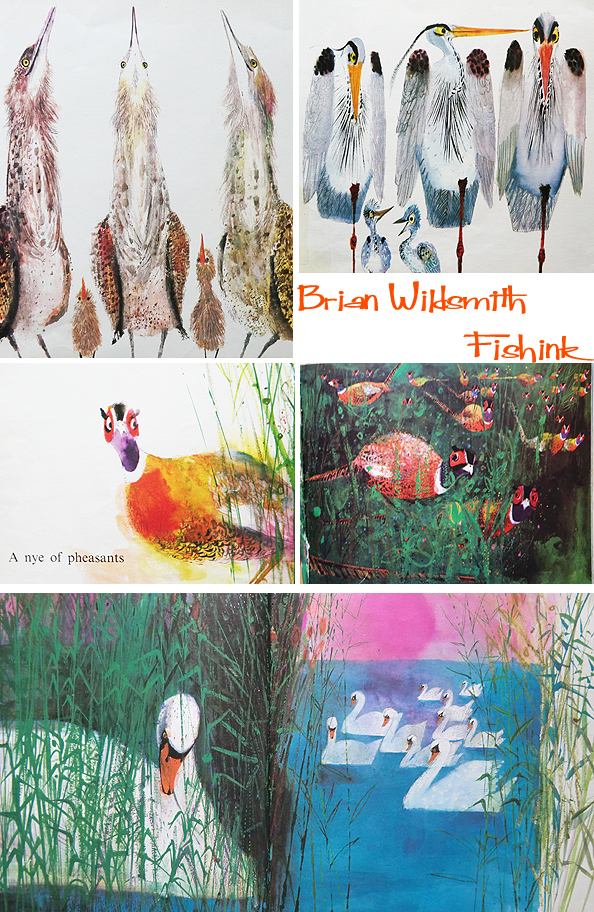
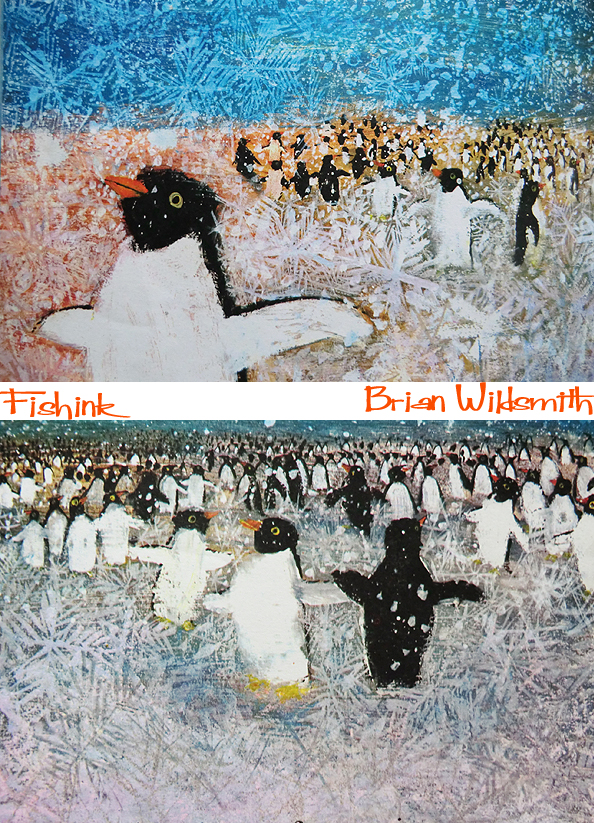
I’ve tried to capture a little of his textures here.
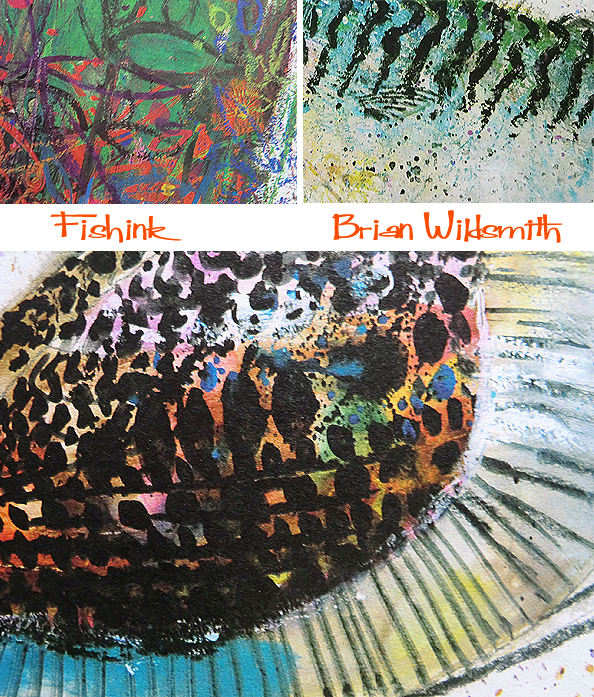
This snowflake-encrusted Arctic landscape, is perfect to suggest the penguins frosty environment, and what a clever way to do this too.
I also love the scratchy mark-making surrounding some of his other creatures.
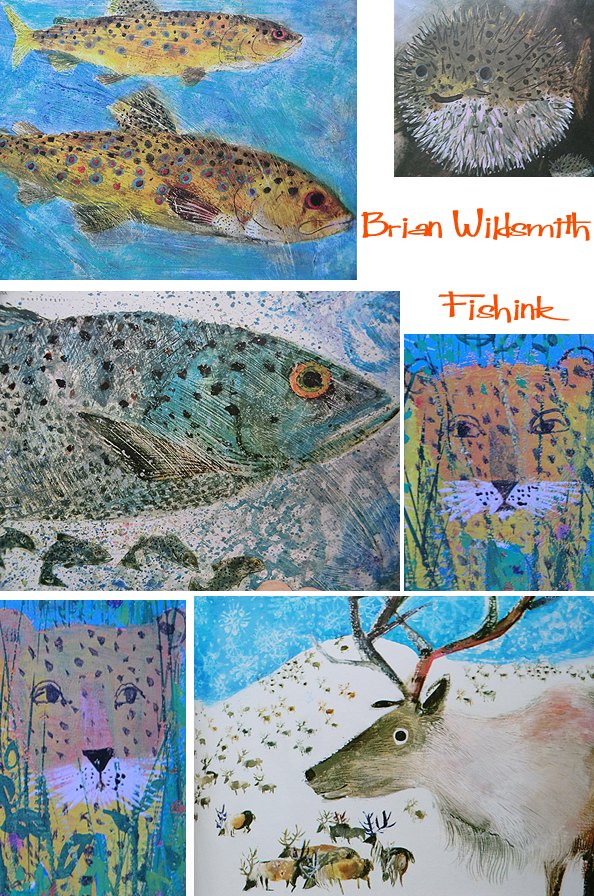
Each different animal’s skin appears to be carefully considered and a suitable method for painting it is used. For me, this illustration and style of brush strokes, perfectly captures the grey, leathery, elephant hide or the strong, thick fur of the Brown Bear.

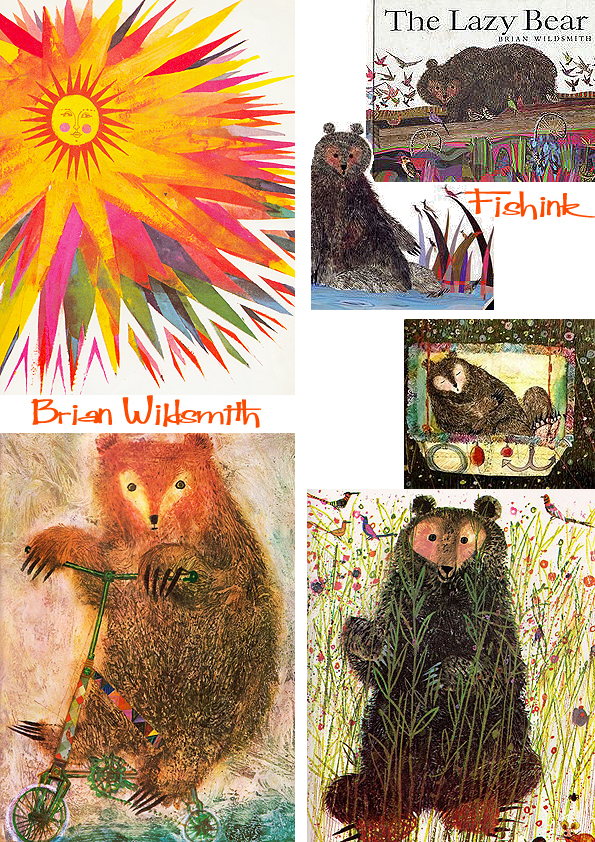
What a fab sight to see him riding a little bicycle, great claws too. A few of his 80+ book covers.


In 1994 a Brian Wildsmith Art Museum was opened in Izu-kogen, in the south of Tokyo, Japan. About one and a half million people visited an exhibition of his work in 2005. Eight hundred of his paintings are on loan to the museum.
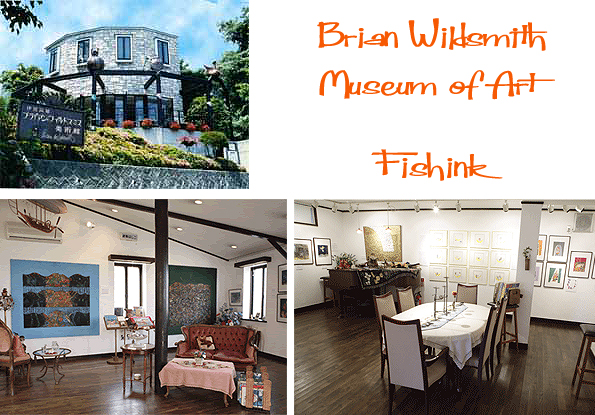
The museum opened with the cooperation of Mr. Brian Wildsmith. The atmosphere of the interior and the exterior of the museum is made to look as much as possible like his atelier/house in Southern France, the place of his activities today. In addition to the original picture book illustrations that have been produced, they keep and manage all the invaluable records relating to Wildsmith including posters, illustrations for stage designs, large-scaled paintings, drawings produced during his art school years, works by his family, memorial photographs and small articles.
Sounds like a place well worth visiting if you’re a fan… I’ll put it on my list : ) What a pity that we don’t have one in the UK. There’s an interesting article here in The Independent from 2010. Which of Brian’s work is your favourite ? Happy Friday and Partial Solar Eclipse day !
Fishink’s 900th Blog Post !!!!! and the Mid Week Mix

Occasionally I find it useful to take stock of where I am in the ‘wild’ world of blogging : )
I noticed, as I was constructing something for today, that this is my 900th post …. (which means I’ve only another 100 to go to reach a real milestone). I’m delighted that the Fishink ‘appreciative family’ is growing daily, here’s a few numbers that you might find interesting to know.


A cool 569 of you are following Fishink and therefore receive a personal post to your inbox every time I publish an article on my blog.
Also we now have 800 followers on Facebook, and a staggering 1,450 on Twitter !! Impressive eh ?
Of course this wouldn’t be possible if it wasn’t for you fine folk who regularly tune in, comment, and help spread the word, please keep doing just that, it’s great to hear from you and to read your thoughts and comments, and helps make the lonely task of post writing much more fun : )
Don’t forget you can also help out by spreading the news about Fishink Blog to your friends or by buying a little something from the Fishink shop too, believe me every little helps : )
Ok, onwards and upwards for this weeks Mid Week Mix.
Since about 2008, I’ve been collecting images from the internet that have caught my eye. Way back then, I wasn’t so diligent in keeping records as to where images came from, or who had painted, photographed, illustrated or indeed created the artwork in the image. So I apologise in advance for their lack of referencing, but to be honest, it was purely about seeing groups of imagery together, that for whatever reason, I enjoyed.
As I have managed to amass quite a few of these ‘collaged sheets’, I thought I would share them with you, in the hope that they may also provide some inspiration to you the readers, from their shape, colour, texture or out and out randomness : )


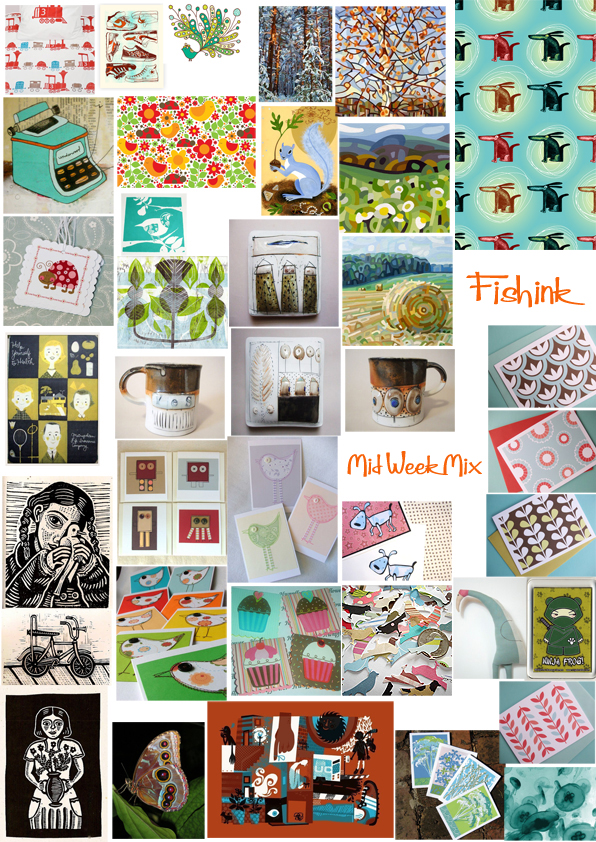
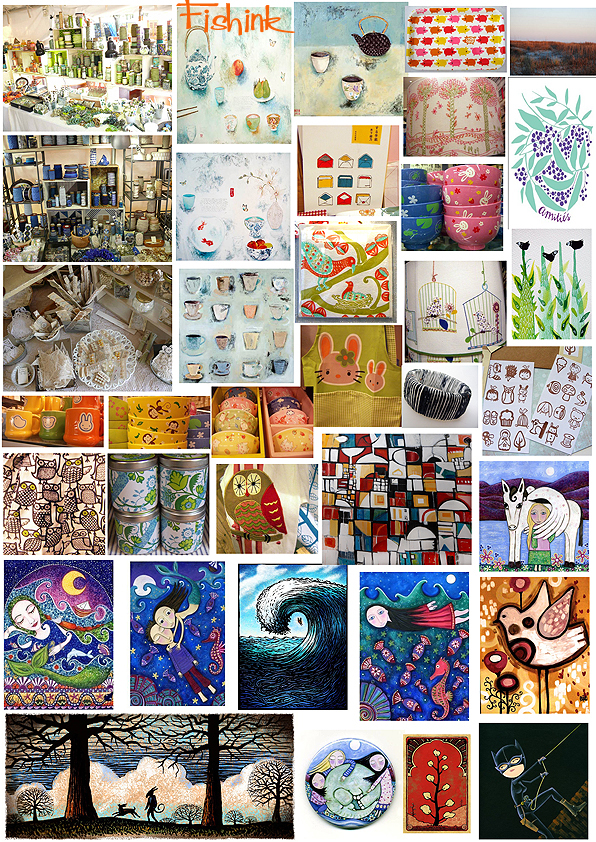
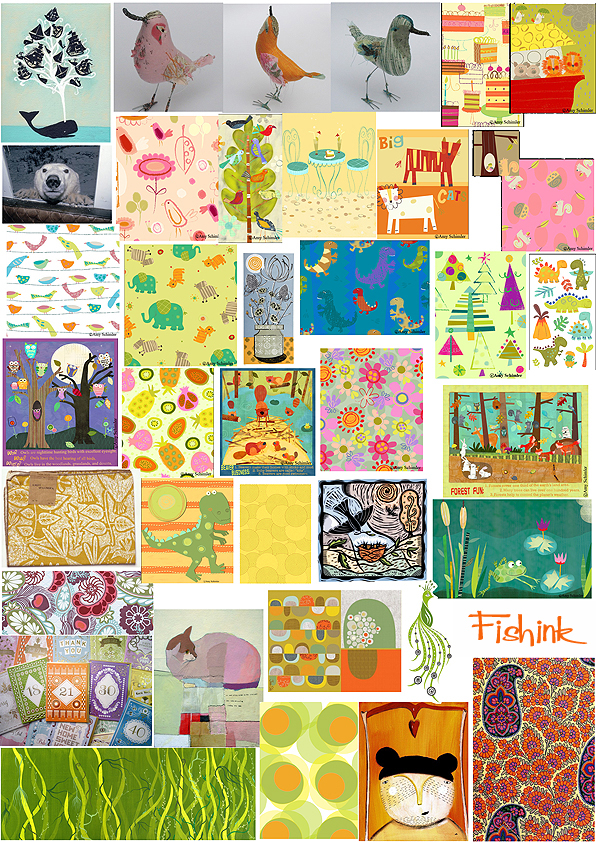
Do let me know your thoughts and which images catch your eye for whatever reason. More about the wonderful Brian Wildsmith on friday too. Enjoy !
Brian Wildsmith Animals and ABC’s Part 1
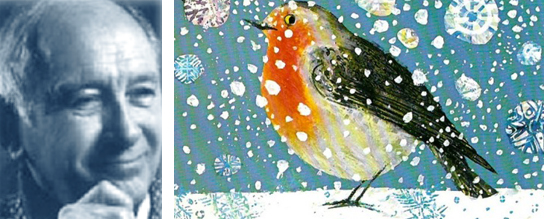
Brian Wildsmith was born on 22 January 1930 in Penistone, a small market town in the West Riding, now in South Yorkshire, England. He was educated at the De La Salle College for Boys in Sheffield, but from the age of seventeen studied at the Barnsley School of Art (1946–1949). It was also while he was seventeen that he met Aurelie, daughter of the chef at Wentworth Woodhouse, whom he would later marry. From Barnsley he won a scholarship to the Slade School of Fine Art in London, where he studied for three years (1949–1952). His work is always about shape, texture and most importantly, explosion of colour !
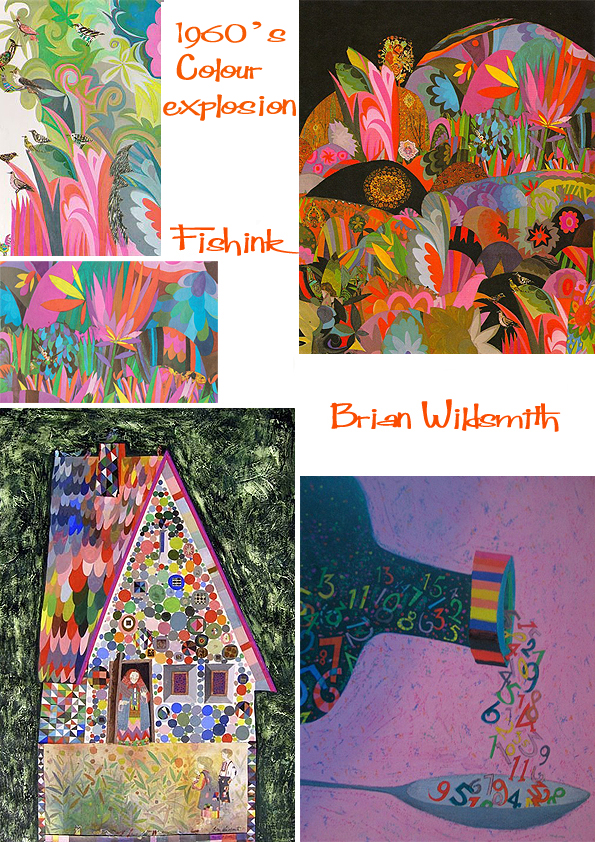
From being raised in a small mining village in Yorkshire, England, where, he says, “Everything was grey. There wasn’t any colour. It was all up to my imagination. I had to draw in my head…”

On leaving the Slade School he did National Service in the British Army. In 1955 he married his wife Aurelie, and in the same year began teaching at Selhurst High School (1955–1957). At this time he began designing book jackets for the publisher John Murray and others, and line illustrations for children’s books published by Faber and Faber, Penguin Books, Oxford University Press and others. His work as a line draughtsman continued from 1957 to 1964. From 1960 to 1965 he also taught for one day a week at Maidstone College of Art (now part of Kent Institute of Art & Design).
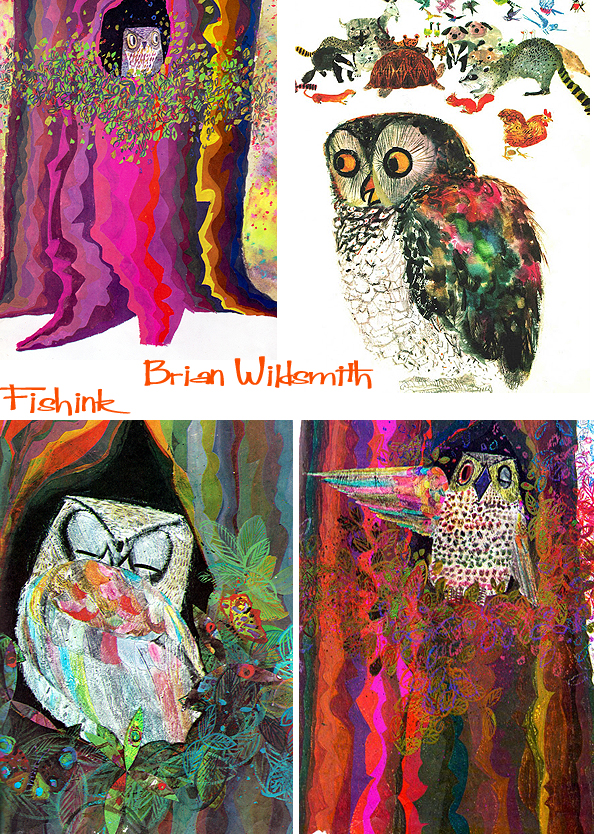
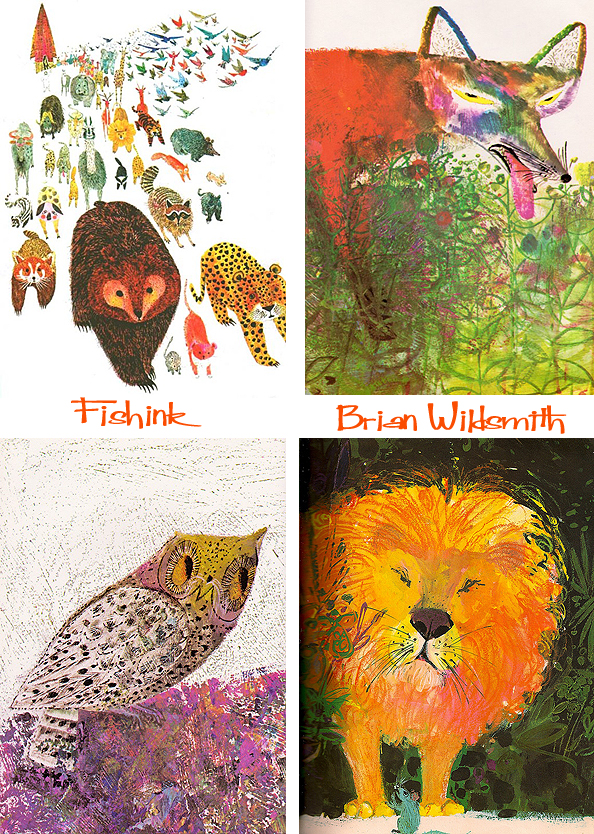
Wildsmith’s first love was for painting and he was eager to illustrate books in colour. Mabel George of Oxford University Press, whom he first met in 1957, gave him his first opportunity when she commissioned from him, as an experiment, some illustrations for Arabian Nights (1961). When the experiment was a success, she commissioned ABC (1962), for which he won the Greenaway Medal. Since then he has worked with a succession of sympathetic editors, including Antony Kamm and Ron Heapy.
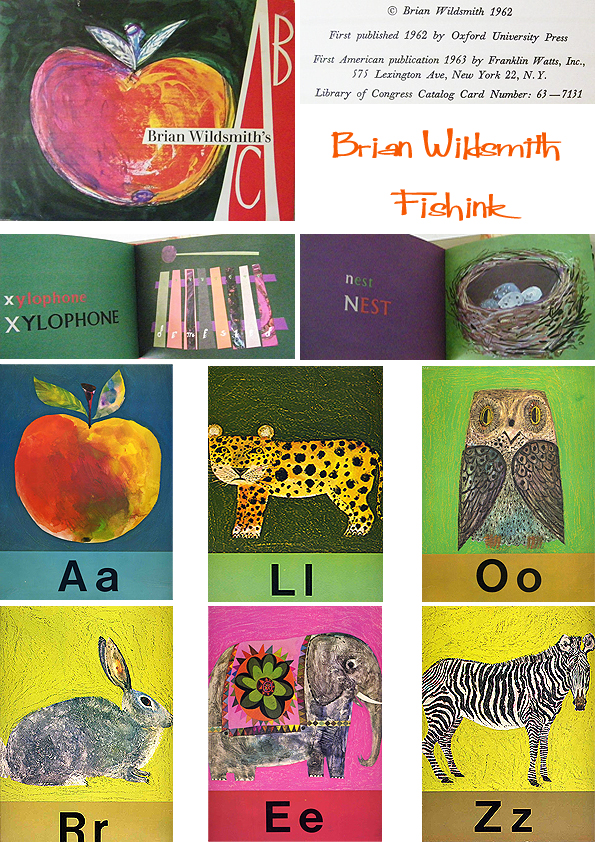
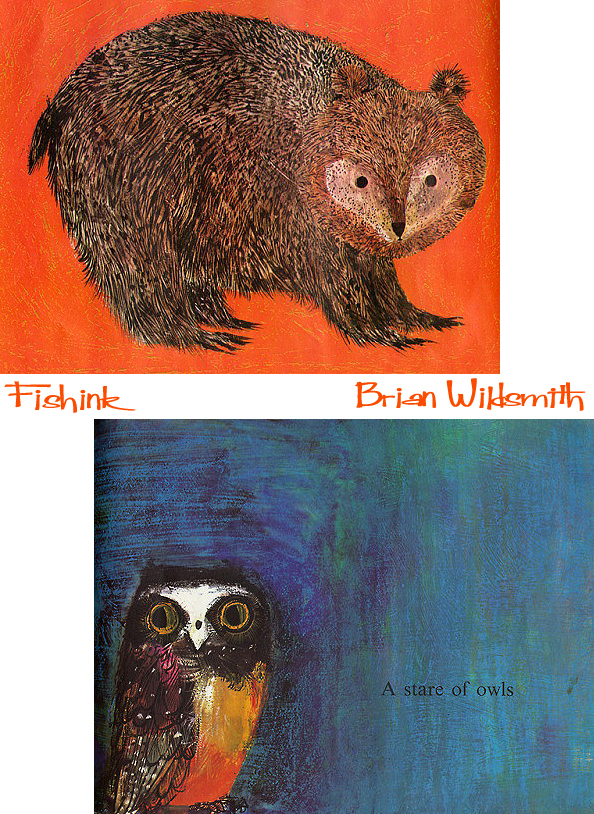
Wildsmith is considered as one of the greatest children’s illustrators. The British Library Association recognised his first book, the wordless alphabet book ABC (Oxford, 1962), with the Kate Greenaway Medal for the year’s best children’s book illustration by a British subject.
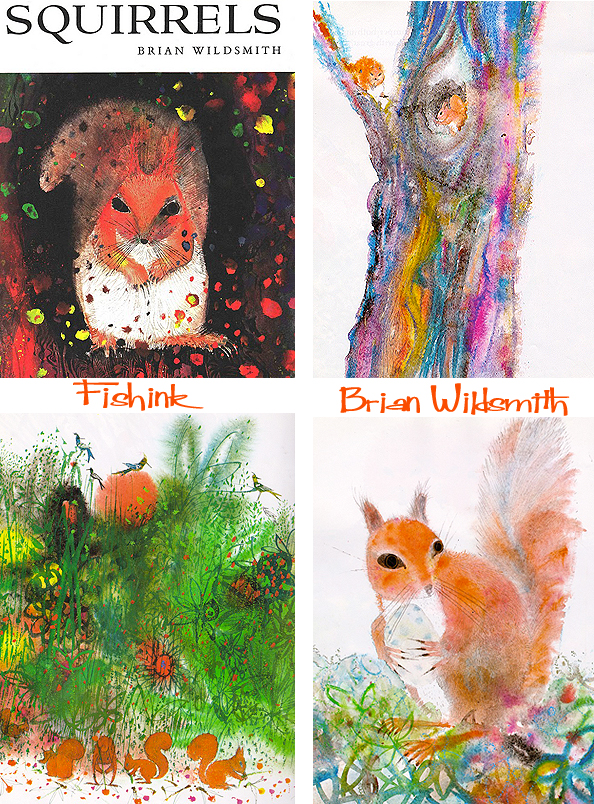
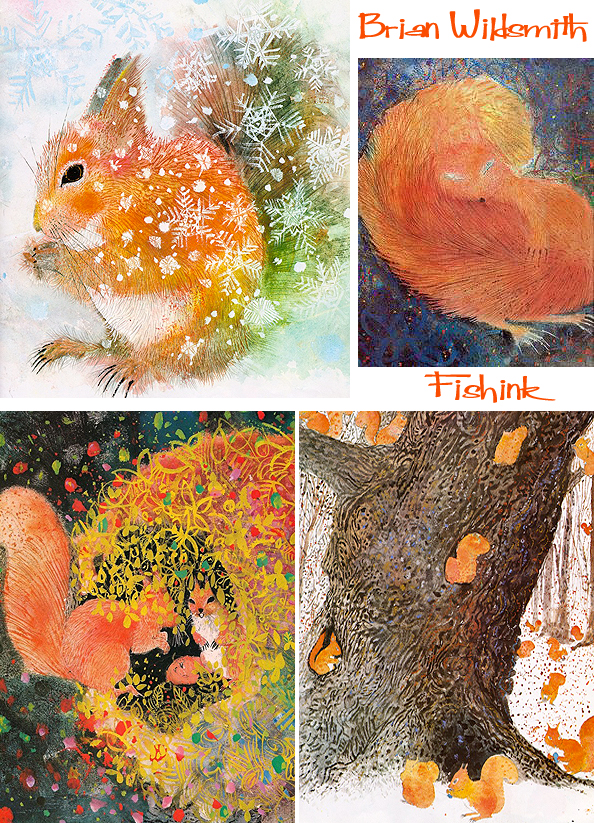
From 1971 Wildsmith has lived in France at Castellaras, a hill village near Cannes and Grasse, with his wife, Aurelie, and their four children, Clare, Rebecca, Anna and Simon. His son, Simon (b. 1965), is a printmaker, and lives near Cahors.
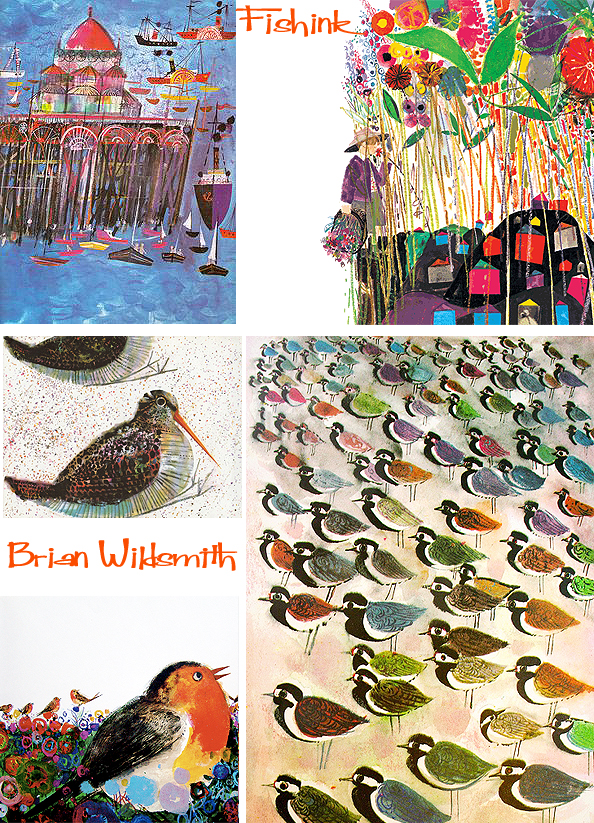
Such a rare talent and great to see a lifetimes work using artists materials and not digital media. Part 2 on friday.


Mid Week Mix
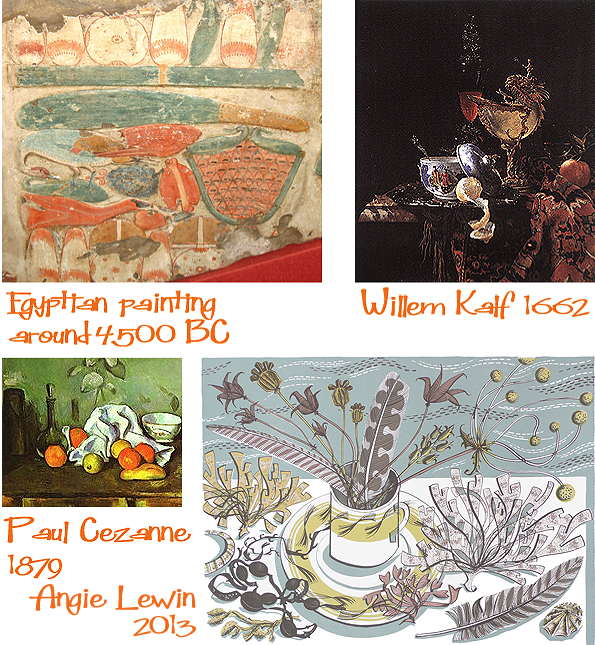
Since about 2008, I’ve been collecting images from the internet that have caught my eye. Way back then, I wasn’t so diligent in keeping records as to where images came from, or who had painted, photographed, illustrated or indeed created the artwork in the image. So I apologise in advance for their lack of referencing, but to be honest, it was purely about seeing groups of imagery together, that for whatever reason, I enjoyed.
As I have managed to amass quite a few of these ‘collaged sheets’, I thought I would share them with you, in the hope that they may also provide some inspiration to you the readers, from their shape, colour, texture or out and out randomness : )

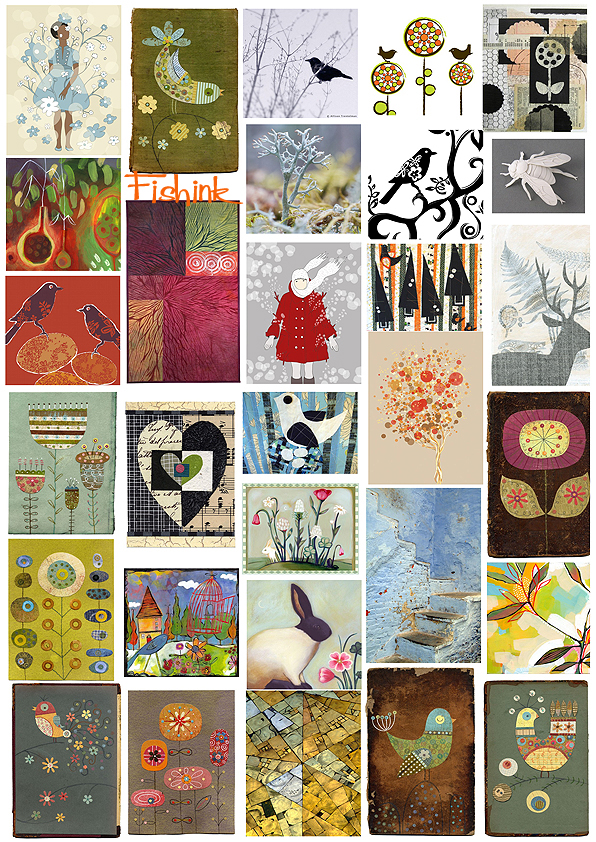


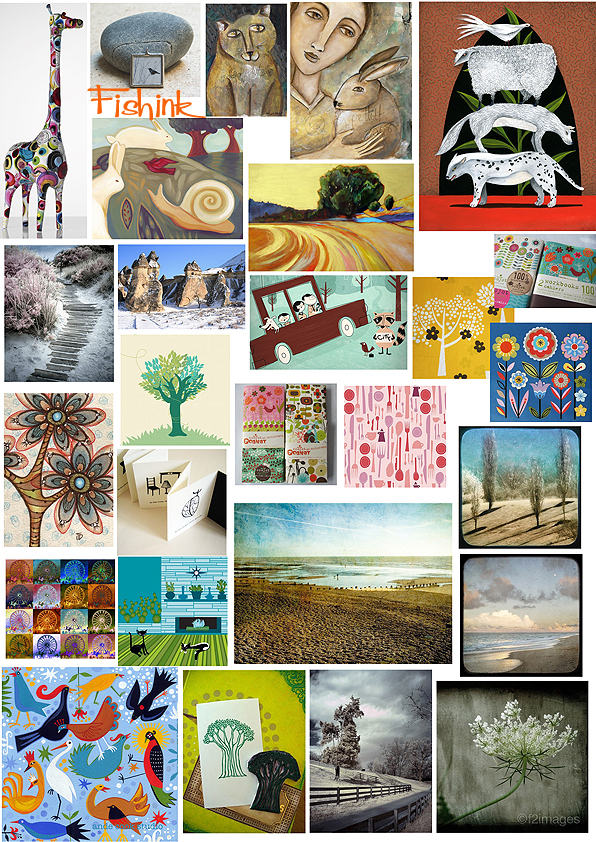
Do let me know your thoughts and which images catch your eye for whatever reason. Enjoy !
Teressa Ong One Foxy Illustrator !
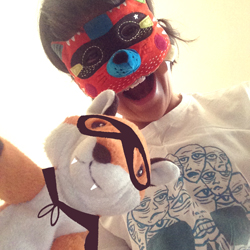
Teressa Ong is a young (masked) illustrator (/ Superhero ?) who works for Paper Plane. In her spare time she creates modern-retro masterpieces ! I caught up with her recently to ask a few questions.
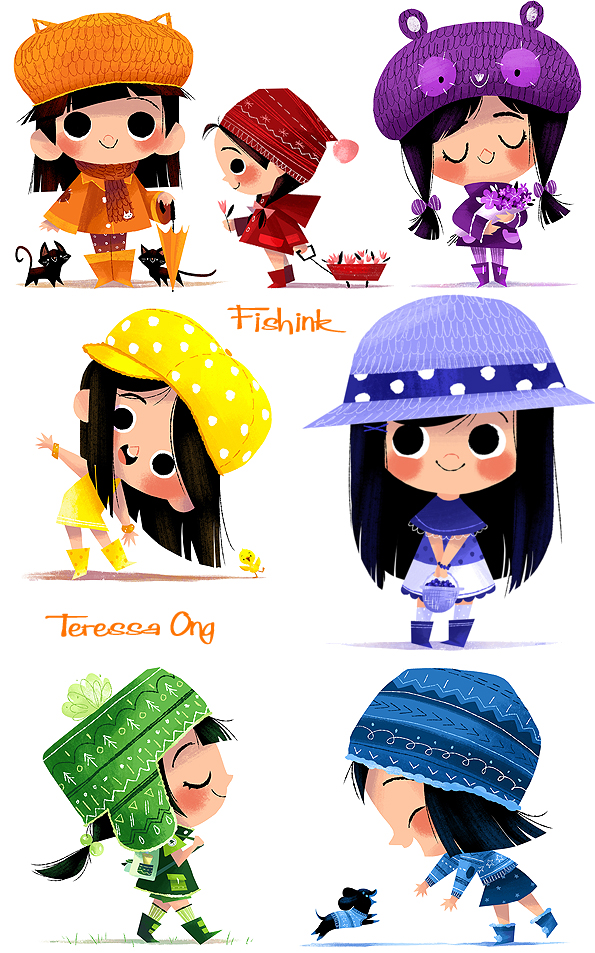
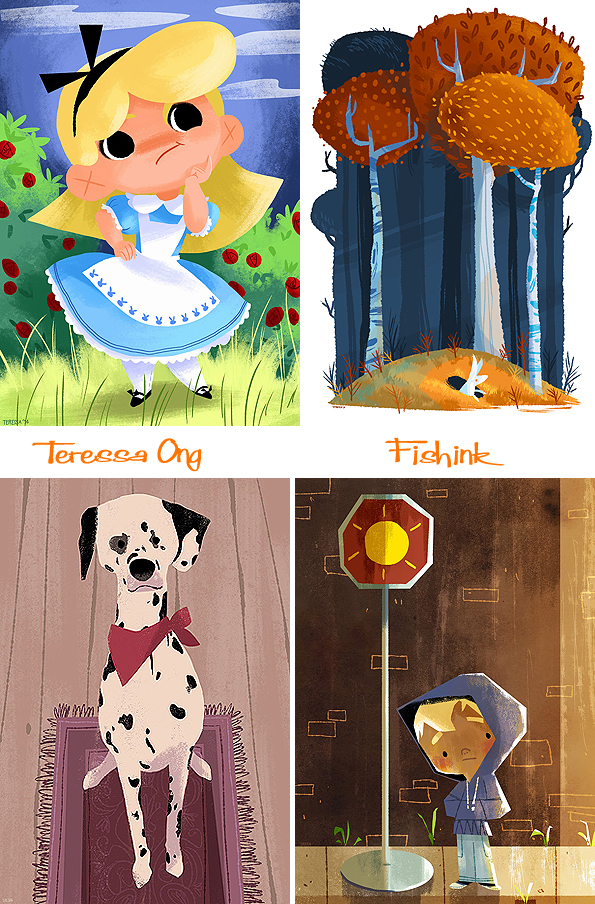

You seem to have quite a few fox and bear related illustrations, were these for specific projects or just because they made you smile to work on ?
It’s definitely because they make me smile! I’ve always kinda struggled with thinking about a subject/coming up with ideas, so even though I still love the drawing process, I wouldn’t be as excited as compared to if I were to scribble a fox watching tv now. Trying to stop myself from drawing foxes and bear cubs can be a problem at times.
Currently, I think I only have 2 projects (both personal projects) with fox(es) and bears in them . I want to create a short story/picture book type thing with a fox character as another personal project at some point.

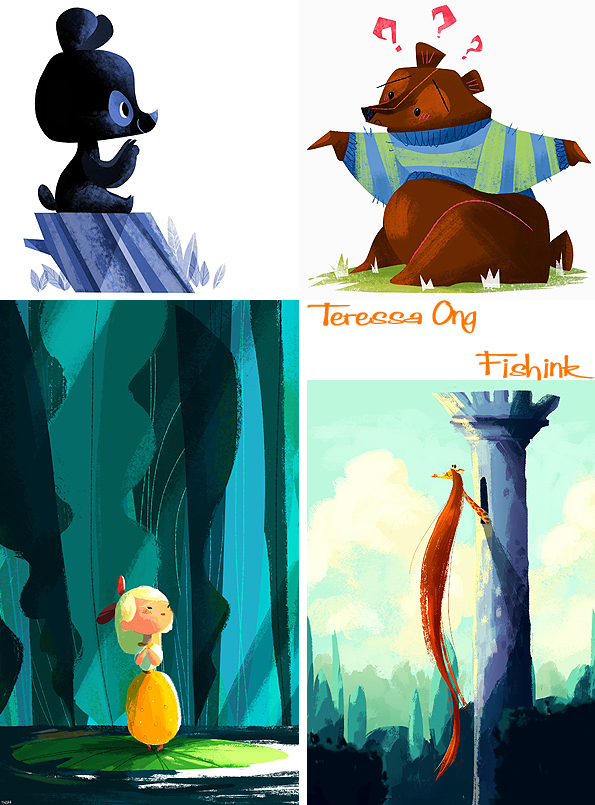
Is your work mostly digital or do you work with scanned pieces and gouache to add depth and texture to your work ?
I wish I did more traditional paintings but most of my work is digitally done. Kyle T Webster’s photoshop brushes really help me a big ton with adding textures and is probably one of the reasons why I work digitally more often nowadays. It’s rare for me to work traditionally and digitally for the final illustration. I think I find it a hassle, haha ! I do admire mixed media works though, they are really fascinating to look at.


Who do you do work for most often and can you describe what might be classed as a typical working day for you ?
I haven’t done a lot of client work and I’ve only worked on one client project at my current workplace and most of the projects I’ve done are targeted for kids. A typical work day would start with me trying very hard to resist a second bowl of cereal while having a bowl of cereal before heading to work. I’ll spend the day (9:30 to 6:30ish) painting up illustrations for any project that I’ve been tasked with, mostly short stories. Occasionally sneaking in a doodle or two.


BOOKS! Especially children books. :B I’ve worked on a couple at work which I had a lot of fun with but I still don’t know much about making them so I’d love to hang around the children’s book community for a while and maybe one day I’ll be able to come up with a nice one of my own. Getting to be part of an animation project is a little wish (especially a stop motion project, the dream!), designing for an animation and seeing my designs come to life or getting to help create miniature props would be so exciting! But despite graduating with an animation diploma, I still don’t feel quite ready to be part of an animation project just yet.


I am so terrible at giving advice (nervous laugh) but here goes: do as much personal work as you can, draw what you love, have lots of fun with them and get to know more people in the illustration/animation/artsy family because they are very lovely and helpful people. Oh, and cute cats are a big thing on Instagram. Just sayin’. *wink*
Many thanks Teressa for the fun and honest answers and for being part of the Fishink community too. Keep creating the wonderful work, and we’ll keep our flippers crossed and look out for a foxy book in the near future : )


 fishinkblog.com