Helen Shere’s handmade silver jewellery, travelling to the Great Northern Contemporary Craft Fair.

I just wanted to remind you that The Great Northern Contemporary Craft Fair is on in Manchester between the 4th and 7th of October 2012. I will be attending the show on the 5th and hopefully taking note of a few new names, faces and amazing artwork to show you whilst there. You can see what went on last year by looking here, here and here too. One of the designers about the exhibit there is Helen Shere.
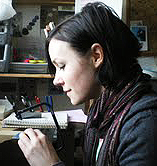
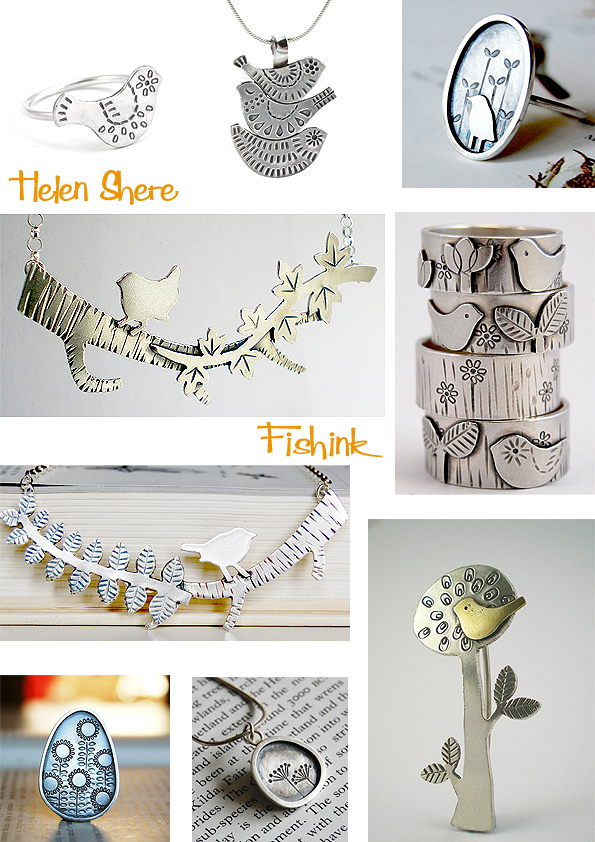
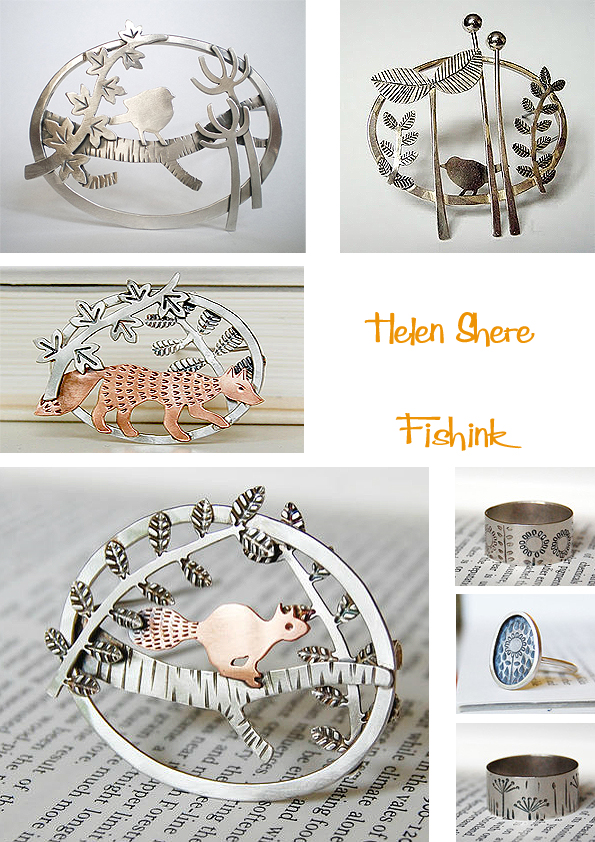
Helen is based in Nottingham where she has a studio and creates her jewellery from cutting and stamping silver sheet and wire. The collections are mainly in silver, with accents of copper and brass for colour and texture. Helen uses detailed pattern to draw on the surface of the silver, using techniques such as stamping and oxidising, creating an individual look and feel to the jewellery.

Helen told me ” I am a self taught jeweller and I tend to incorporate new techniques into my designs as my skill level develops. When I began making I looked for simple techniques which allowed me to be illustrative and found the work of contemporary paper cut artists such as Helen Musselwhite and Rob Ryan an inspiration. I was drawn to mid century illustration and contemporary illustrators who have been influenced by mid century styles. Pattern & fine detail also play a role in my jewellery.” I really like the way that she composes her pieces, the score lines, to give added depth, the arrangement and subject matter are all pleasing to the eye.
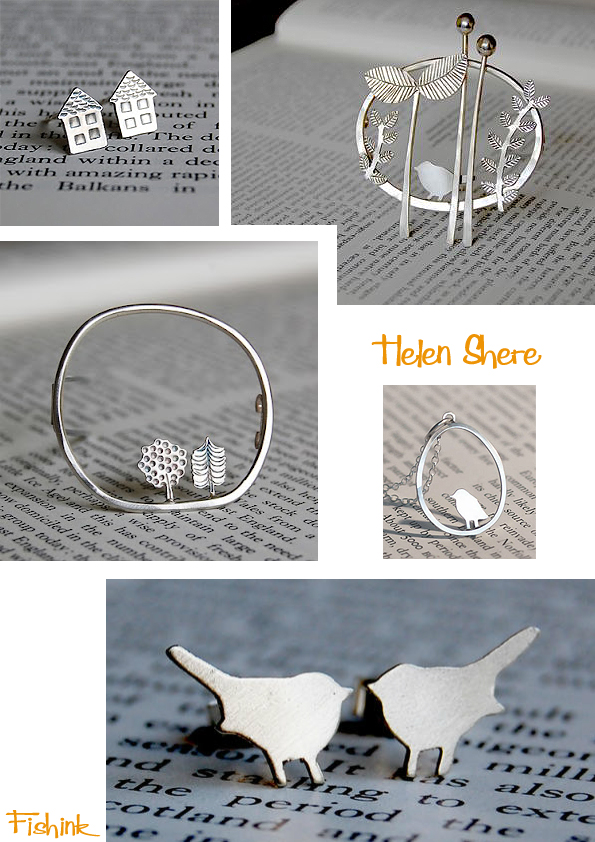
She goes on to say ” As for the future, I want my work to evolve in a more three dimensional way. I have been experimenting making little boxes in the studio which I am keen to develop into finished items. More recently, I became interested in making things with moving parts. I would just love to make tiny automata which may or may not be wearable. I have a book of Heath Robinson’s ‘Contraptions’ which is a joy and if I could incorporate his sense of playfulness into a miniature delight, I would be a happy lady !” I’m looking forward to seeing those too. Great work Helen and I’ll pop and say hello at the GNCCF on the 5th, the best of luck.
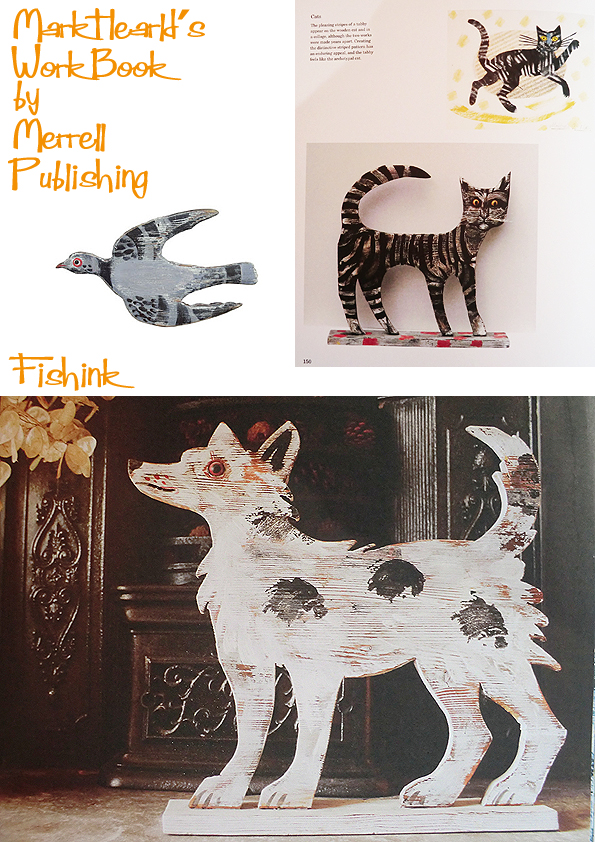
Mark Hearld’s Work Book.
Today I can bring you the much awaited news of Mark Hearld’s Work Book being released on October 26th. I was lucky to get a sneaky preview from the guys at Merrell Publishers, and I’m so excited that I did, because it’s a fascinating book.

First of all the book is beautifully bound and the quality of it’s pages, speak of the riches to come lol. This is an amazing account of Mark’s prolific and artistic outpourings. His sculptures, ceramics, collage, screen-prints, lithographs are all documented and grouped into nature-related themes introduced by Mark, who narrates the story behind some of his creations and discusses his influences. He explains his particular love of collage, which he favours for its graphic quality and potential for strong composition.


Under the headings of ‘Birds and Beasts’, ‘Winter’, ‘Venice’, ‘Marine Life’, Mark’s beautiful images lead us through the landscapes he creates, either in collage, print, lino or simply paint and pencils. With some detailed photographs explaining how his illustrations develop and come to life.


Other chapters take the viewer on a trip through Mark’s illustrations, book jackets, sculptures and ceramic work.


If you are new to Mark’s work, then there’s a great little video about it below.

If you’re as excited as I was about Mark’s work then you can grab a pre-order copy of the book here and if you like Mark’s fabrics and fancy a lampshade made from one of them, have a look at the work of Revill Revill too, such beautiful ideas. Thanks again to Mark at Merrell for the chance to review this wonderful publication.

Angie Lewin Watercolours at The Scottish Gallery

One of my favourite artists is back in the limelight bringing out some exciting new paintings. A wonderful exhibition of Angie Lewin’s watercolour paintings is on with our friends at The Scottish Gallery in Dundas Street, Edinburgh. Here’s a selection of what you may find there.


It’s Angie’s usual attention to detail and line but with the subtlety of watercolours instead of Lino or woodblock printing. The exhibition is on from 08 Sep 2012 – 03 Oct 2012, so you’ve still got a few weeks if you hurry. Angie Lewin will be in the gallery on Saturday 22nd of September, signing copies of her recent book Plants and Places by Merrell Publishers between 12-2pm. Get along there and treat yourself to a signed copy, it’s a beautiful publication !

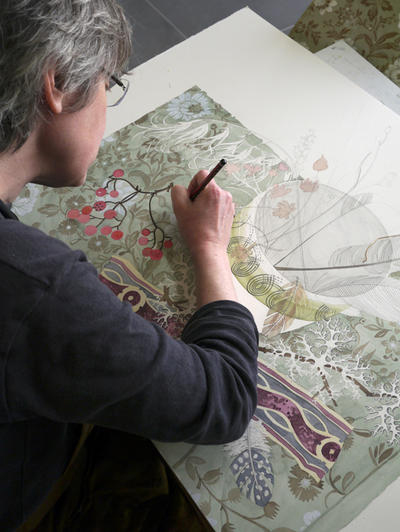
Angie Lewin in her studio in Speyside. Thanks to Simon Lewin at the St Judes Gallery for use of his images.
Trina Schart Hyman Fairy and Folktale Illustrator
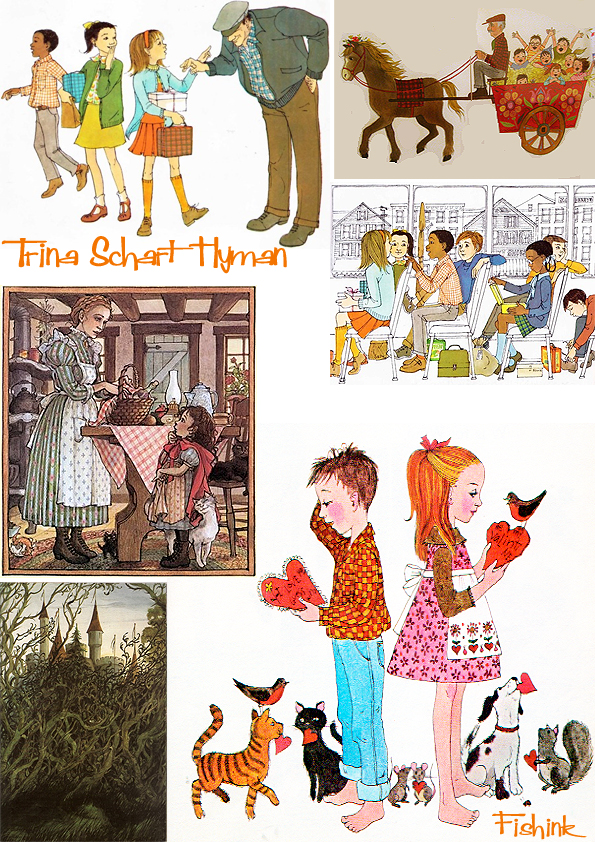
I first came across the work of Trina Schart Hyman through a Children’s novel from 1969 by Ruth Nichols called ‘The Walk Out Of The World’.
Here are some of her images from it.


Trina was born on April 8, 1939 in Philadelphia, Pennsylvania to Margaret Doris Bruck and Albert H. Schart. She grew up in a rural area of Pennsylvania learning to read and draw at an early age. She credits her mother for instilling in her the joy of books by reading to her from the time she was an infant. She spent a whole year wearing a red cape that her mother had made for her because her favorite story was Little Red Riding Hood. In the book ‘Self Portrait’ she says ” Little Red Riding Hood was so much a part of me that I actually became her. My mother sewed me a red satin cape with a hood that I wore almost every day, and on those days, she would make me a “basket of goodies” to take to my grandmother’s house. (My only grandmother lived in Rhode Island, three hundred miles away, but that didn’t matter.) I’d take the basket and carefully negotiate the backyard going to Grandmother’s house. My dog, Tippy, was the wolf. Whenever we met, which in a small backyard had to be fairly often, there was an intense confrontation. My father was the woodsman, and I greeted him when he came home each day with relief and joy.”

Trina’s father fueled her imagination by telling her magical tales about the origins of the universe. He also brought her to the Philadelphia Art Museum on days when they had to drive into the city to visit the orthodontist. About this time, her younger sister Karleen was born. When Karleen was old enough, they shared elaborate fairy adventures together, mostly concocted by Trina to amuse little Karleen. Although she skipped first grade, Trina never felt like she was a good student, preferring to doodle rather than do the assigned work. It wasn’t until she enrolled at the Philadelphia art school in 1956 that she blossomed. “It was there that I found out about the great book illustrators of the early 1900s: Arthur Rackham, Edmund Dulac, and the crazy Pre-Raphaelites in England; and Howard Pyle, N. C. Wyeth, and the serious students of the Brandywine School here in American. Their romantic and magical storytelling pictures inspired me and gave me courage. I was determined to follow in the footsteps of these artists and to carry on their tradition.”
In 1959, she married mathematician and engineer, Harris Hyman, and they moved to Boston where he had gotten a job. She continued studying at the Boston Museum School of Fine Arts. After graduation in 1960, Trina and her husband moved to Stockholm, Sweden where he attended the university and worked for IBM part time. During the two years that they lived there, Trina studied at the Konstfackskolan (Swedish State Art School), and illustrated her first children’s book called Toffe och den lilla bilen (Toffe and the Little Car). Whilst Living in Sweden Trina received her big break when Astrid Lingren, author of Pippi Longstocking, offered her a job illustrating children’s books, primarily fairy tales.

The manuscript of Trina’s first children’s book was written in Swedish, which she had to translate before drawing the illustrations. Upon returning to Boston, Trina met Helen Jones, the children’s book editor of Little, Brown Publishing. Jones was instrumental in helping and guiding Trina’s career. The Hyman’s had a baby girl, Katrin, in 1963, who Trina describes as being the most “stubborn, aggressive, opinionated baby” that she had ever seen. After a brief move to New York in 1965, her and her husband divorced in 1968, and Trina and Katrin moved to Lyme, New Hampshire with friends. She would work late into the night while everyone slept, and her friend Nancie would get up early to get the children off to school. Soon, they bought an old farmhouse there. Distrustful of technology, Trina proudly admits to not owning a “mind-destroying, soul-sucking” television, or any other convenience remotely technological. Making a solemn vow at the time of her daughter’s birth, she chose instead to fill their home with hundreds of good books and took the time to read them. She credits this practice with teaching her daughter to read at the age of four.
By 1971, she was approached by the editors of a new children’s magazine called Cricket, and became their art director until 1979. She hired quality illustrators and was instrumental in forming the early style of the magazine, which, no doubt, contributed to its reputation as one of the finest children’s magazine on the market today. Trina received the Caldecott Honor Medal in 1984 for Little Red Riding Hood, which is still one of her favorite stories. The following year, she received the Caldecott Medal for Saint George and the Dragon, written by Margaret Hodges, and in 1990, again she received an Honor Medal for Eric Kimmel’s Hershel and the Hanukkah Goblins. A Child’s Calendar by John Updike, was also voted a Caldecott Honor Book in 2000. It was not until her daughter’s marriage to a man from Cameroon, that Trina realized that all of her heroes and heroines were white. She began to see a need for multicultural children’s books. She was able to convince writer and friend Lloyd Alexander to change the setting of her book “For The Fortune Tellers” to Cameroon by changing only a few words in his manuscript. She had been to visit Katrin twice while she lived in Cameroon and had fallen for the beautiful countryside and its people.
Sadly Trina passed away in 2004. She illustrated over 150 books.
Ramsbottom Festival 2012, I am Kloot . Admiral Fallow . The Leisure Society . Session A9
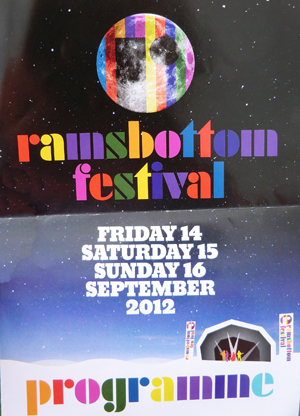
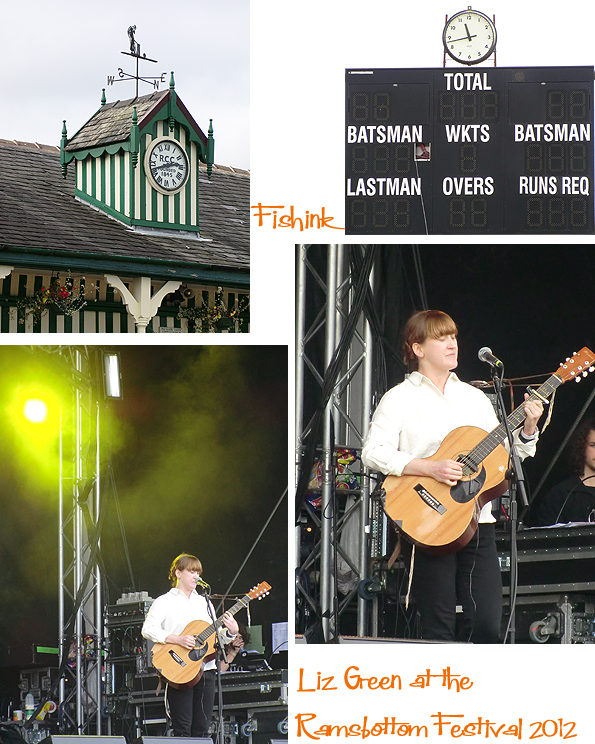
Following on from seeing The Waterboys last year at the Ramsbottom Festival, I wanted to revisit the experience and there was certainly a great musical line up to allow me to do just that. Starting for me with quirky folk singer Liz Green.
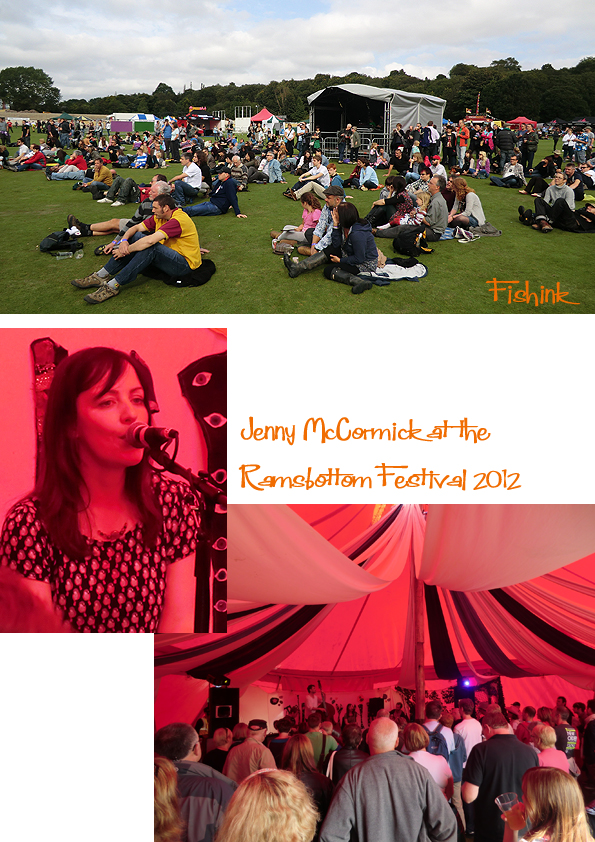
Then the beautiful singing of Jenny McCormick in the smaller stage and Ladybird tent (very red tones inside).
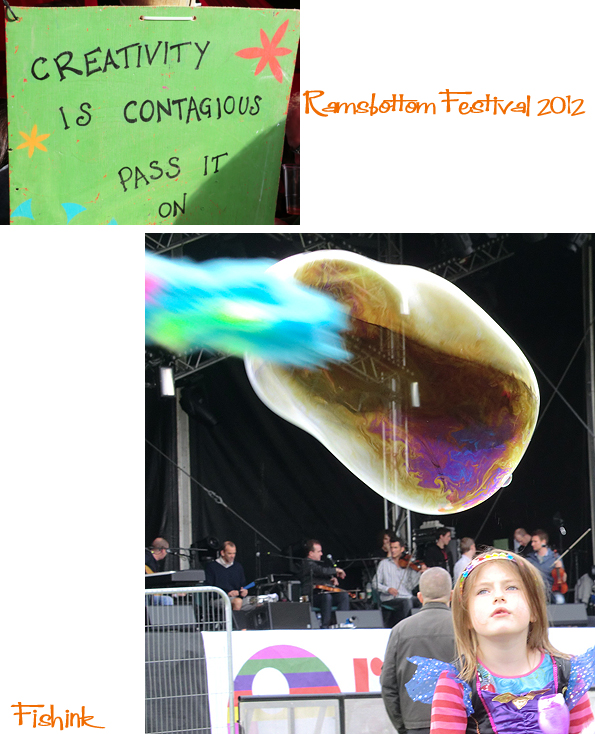
There was plenty for the kids to amuse themselves with …


and for the adults too, including cooking demos, free tastings and an appetising selection of food tents.

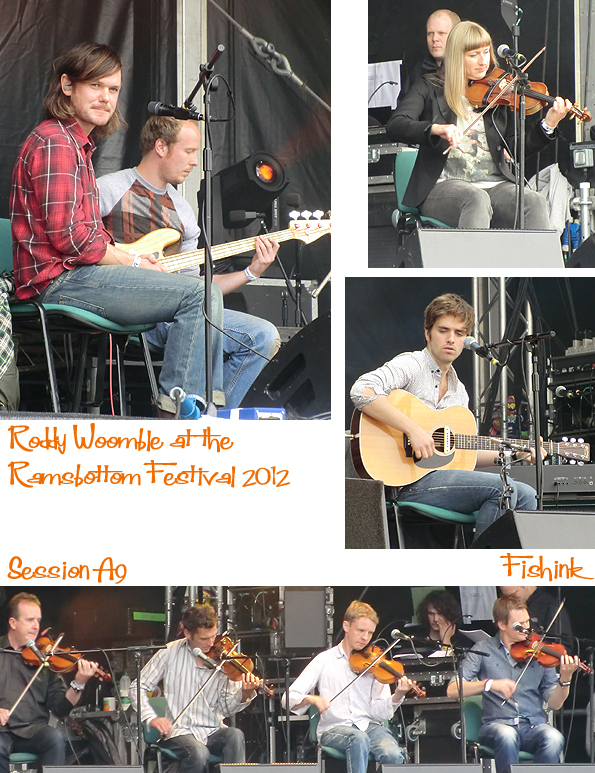
More music from Roddy Woomble and scottish reel playing 7-piece band Session A9.
The evening rose to a climax with music from The Leisure Society, Admiral Fallow both new to me and both well worth a listen, and the headliners were Manchester band I am Kloot who brought the event to a wonderful close about 11pm. A great festival, family friendly, low key and inclusive and all for just £20! Roll on next year
I like the sentiments here.
Irma Gruenholz A model illustrator

Irma Gruenholz lives in Madrid and models her illustrative 3-D creations out of clay.
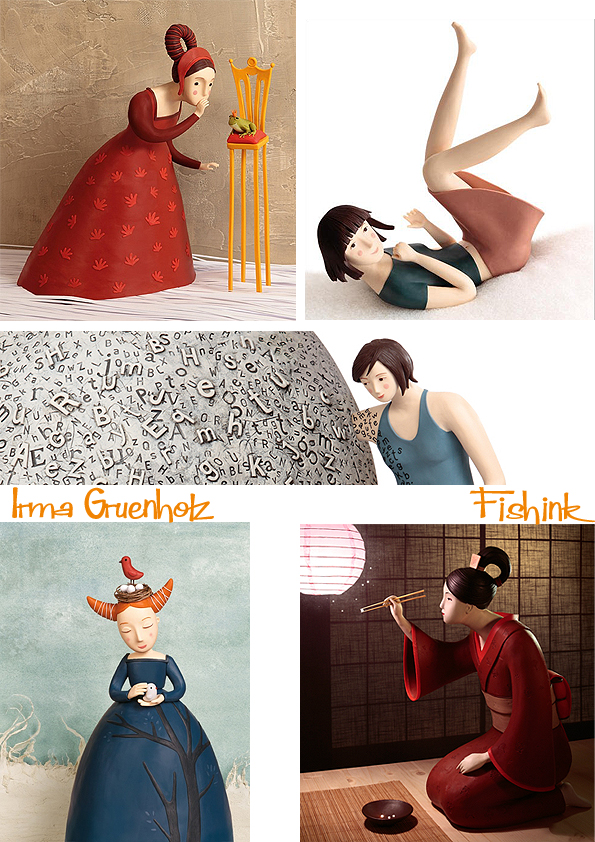
She has a good eye for portraying the essence of a scene and also great modelling skills to present her ideas to such a high level of finish.

There’s both humour and darkness to her work, as in the human ‘chick’ above and the evil child catcher below.
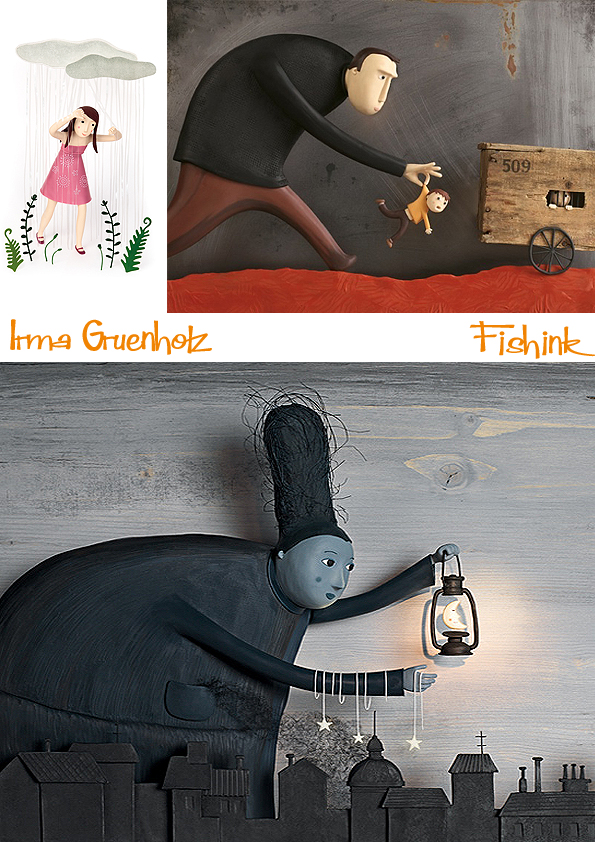
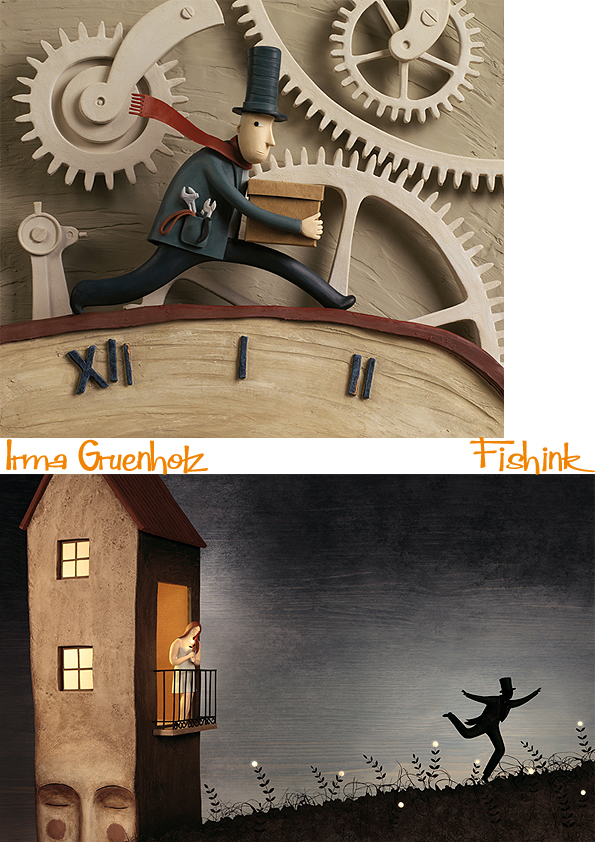
She has depicted famous works of art …

and tales of great adventure and everyday life. I love the decorative and textural swirls on grandma’s dress here.
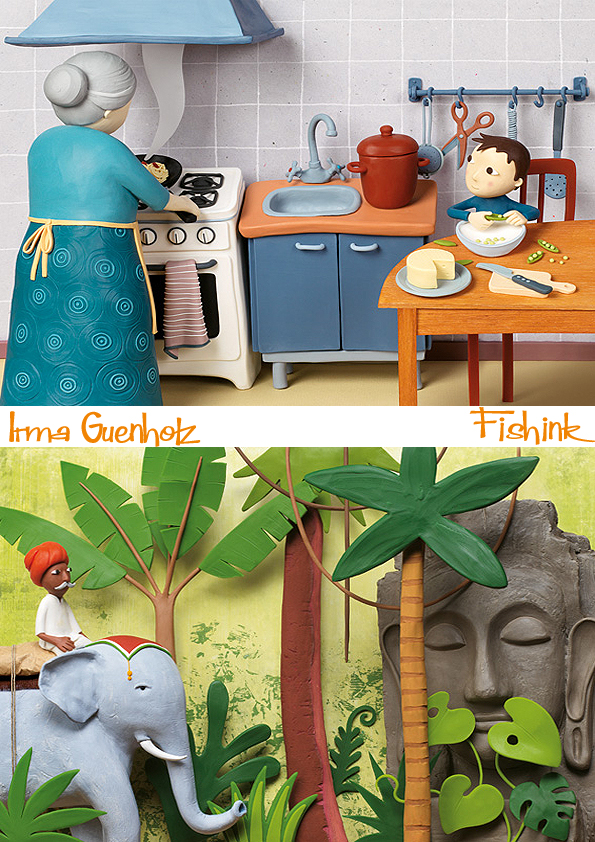
It’s only when you see a breakdown of the elements that go into the construction of one of her pieces, can we start to realise just how much work is involved in each finished model.

Once an illustration is finished, it is photographed and delivered to clients in high resolution digital format. If the model needs a hard and rigid finish, she uses polymer clay.
Irma also prepares 3D models in polymer clay for customer presentations, prototypes and custom props. More info on her blog.
Helen Borten A chance chat with a famous Children’s Illustrator.
I’m so excited.

No this is not a cue for the Pointer Sisters to burst into song ! lol Do you remember a blog in july about Helen Borten, the creator of some amazingly wonderful children’s illustrations from the 1960’s ? Well I managed to track her down and she kindly answered some questions exclusively for you, the readers of Fishinkblog ! WOW !
Ok let’s get started. Helen do you know how many books you may have actually worked on ?
” I wrote 9 but I can’t give you an exact number of those I illustrated for other authors–between 20 and 30 is my best guess ”

How did you start as an illustrator ?
” I went to art school from high school on a 4-year full scholarship; got my first children’s book assignment after 3 years of book jackets, record album covers, adv. design, all freelance, all gotten by showing samples of my work. ”
What was life like working as a female illustrator in the 1950’s and 60’s ?
” Funny you should ask that. Trudging my portfolio around in NYC from art director to art director there were some flitations but only once was I chased around a desk! (I escaped) The second escape was from a sofa in an apt. “meeting” I was stupid enough to go to. That was more traumatic because this guy (a famous Italian designer) had promised me the cover of “Interiors”, the foremost interior design magazine of the time, and I had just delivered the sketches he’d asked for and that I’d agonized over for two weeks! All, as it turned out a ploy to get me in bed !! ” (Oh dear, so the series ‘Madmen’ isn’t that far off the mark then !)
How did you first get ‘discovered’ as an artist ?
” The first childrens’ book I illustrated, “Little-Big Feather”, wound up on the NY Times Ten Best-Illustrated Childrens Books of 1956. From then on, other publishers took notice: my work was included in the AIGA (Am. Institute of Graphic Arts) show; 2 or 3 times in the international mag “Graphis” including its big annual, and then, another biggie: the first book I wrote and illustrated, “Do You See What I see?” , which was on the NY Times Ten Best Childrens Books of 1959″.


Who did you look to for inspiration or was your style purely your own ?
” Antonio Frasconi, a wonderful woodcut artist, was my inspiration. He may have done only one childrens book but when I saw it I not only loved it but realized here was a field open to “non-commercial” art. Other fine artists were entering it at that time, Leonard Baskin comes to mind, and it sort of resolved an inner conflict (I had wanted to be a painter). My styles were my own. But “purely”? That’s a claim–considering how unconscious so much influence is, no one can make. They evolved because experimenting with something new was more interesting than repeating myself. ”

Did you have ideas of your own for the books ?
” Yes I was given the text, size of book , number of pages and number of colors. All the layouts, print size, type face, the entire design of the book was my own. I never met, spoke to or heard from Branley or any other author. (Ditto for any other illustrators.) Based on my own experience, unless you were doing your own pictures, the field was completely compartmentalized; art directors chose the artists and authors had no say in it. ”

I wish to thank Helen for the time she spent in replying to my long list of questions, I think I got a little carried away with the number I asked !
How fab to be able to find Helen through the internet. I feel like I’ve ‘met’ one of my heroes today 🙂

Lizzie Finlay A workshop about children’s picture books at SCBWI

On Saturday I was very lucky to hear local author and illustrator Lizzie Finlay, give a talk about writing successful children’s picture books at the SCBWI.
The SCBWI stands for The Society of Children’s Book Writers and Illustrators and was formed in 1968 by a group of Los Angeles-based writers for children. It is the only international organization to offer a variety of services to people who write, illustrate, or share a vital interest in children’s literature. Local organiser of the Manchester SCBWI, Steph Williams, had kindly invited me along and I was so glad that she had. Along with fellow illustrator Melanie Williamson, Lizzie (who was a little camera shy) steered the group of about 15 of us. through the main do’s, and the not so many don’ts involved in putting a great children’s book together. It was fascinating.
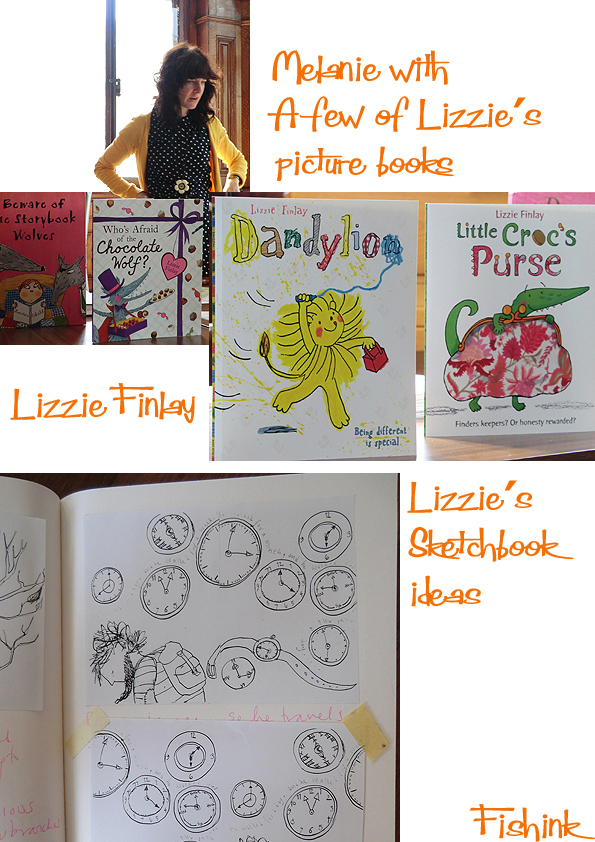
Lizzie was so charming, engaging and enthusiastic in talking about her world as an author and illustrator, that the room warmed to her instantly. She had graciously brought some sketchbooks along for us to see, (always a favourite of mine) and let me take some images to show you too. I loved seeing the different approaches to illustrating an image and the little notes and neat scribbles as reminders or prompts for her ideas to perhaps add later on.

Lizzie narrated her first book to us ‘Dandylion’, whilst Melanie held up large versions of each page. Afterwards she broke down some of the different structures and patterns that are usually found within the story and helped us think about the key ingredients we should be aiming to include in our children’s books.
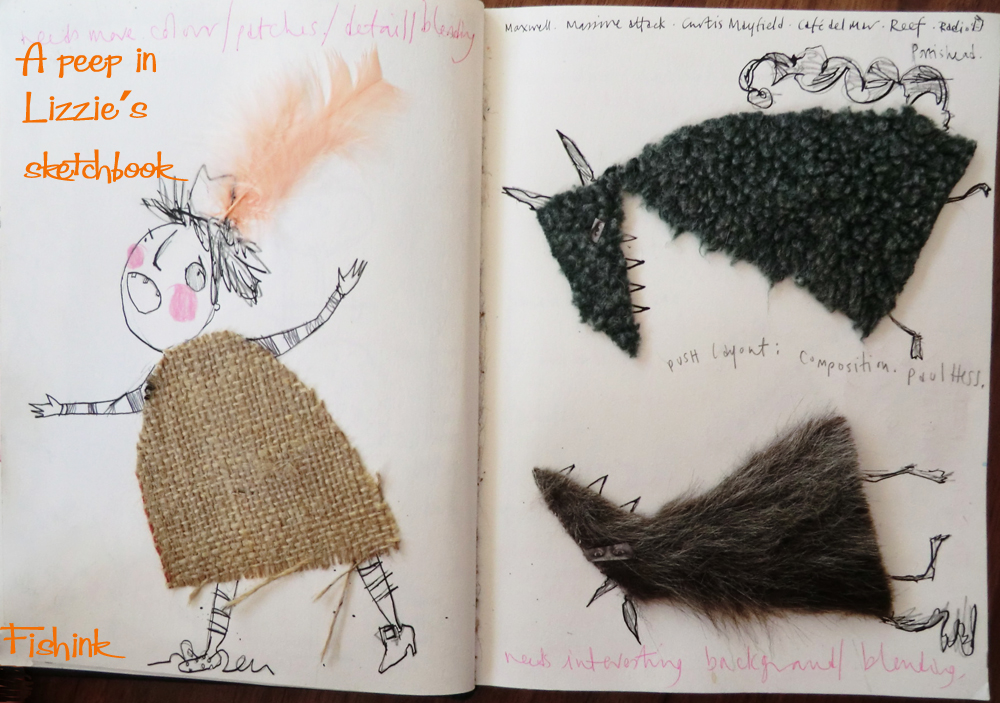
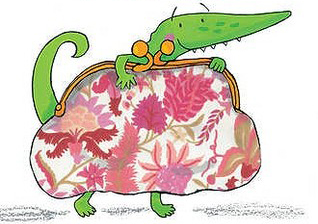
I think for me it was exciting to meet someone who was actually doing what I would like to do, and who still seemed invigorated and refreshed by the process. Lizzie has also written ‘Little Croc’s Purse’, the soon to be released ‘ Who’s Afraid of the Chocolate Wolf ‘ and is presently working on her fourth book about a polar bear.
Many thanks to Steph, Lizzie and Melanie for creating a truly inspirational afternoon.
Fishink Walks Dunsop Bridge
This week we took in a walk around the area called Dunsop Bridge. It was a cool but sunny day, with some dramatic light throughout the 10 mile route. How’s this for a view with lunchtime sandwiches ?


It was a mixed day of sun and cloud, but there wasn’t a drop of rain so you won’t hear me complaining lol. A good day for spotting wildlife too.
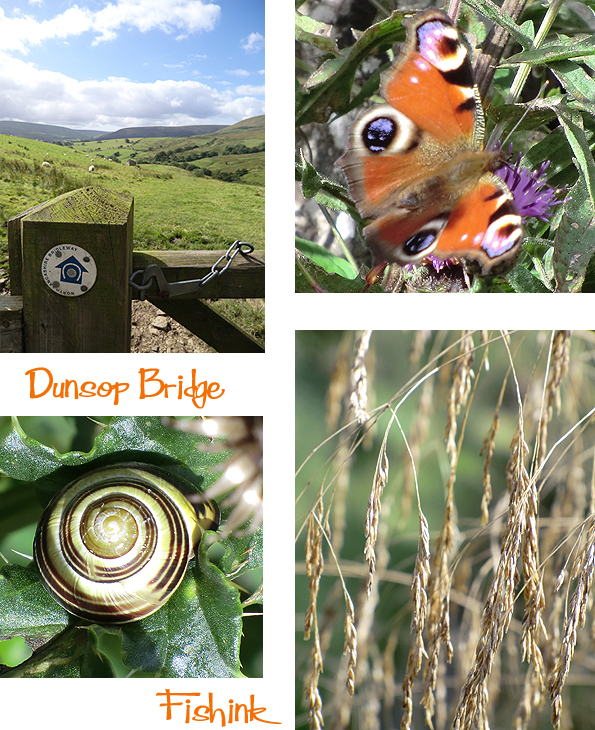
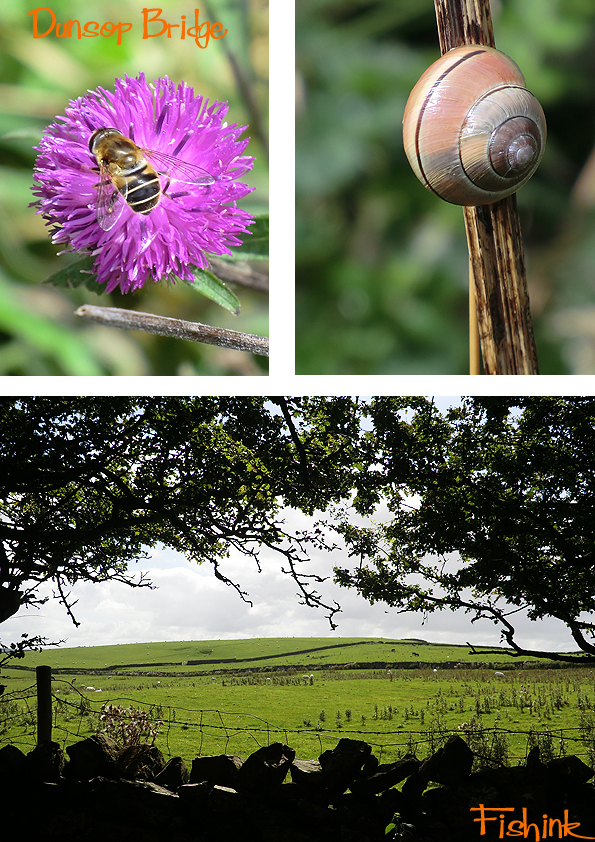
A day for noticing detail, small shapes and then also large, travelling, landscape lines too.


Someone was making hay whilst the sun shone, but it wasn’t me. I did notice a whole field of cows with white midriffs which was a little odd.

Apart from getting caught in the peakbogs on the moor tops, the rest of the footpath was relatively dry, and there were some wonderful moments of dramatic light and colour.

Much debate surrounds the exact position of the centre of Great Britain. Dunsop Bridge was officially recognised by the Ordnance Survey in 1992 as the neareset village to the centre of the British Isles and BT marked this by placing its 100,000th telephone box on the village green. The lovely stone cafe below was sadly closed by the time we had finished our walk, and the ducks were all asleep on the riverbank opposite. We stopped off for a drink in Waddington on the way back instead, another beautiful village.

A great afternoon out.
Mina Braun Printmaking from Germany to Edinburgh
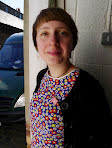
Mina Braun is a talented artist who’s presently living in Edinburgh. She kindly answered some questions I had for her for the Fishinkblog readers.
How did you start on your path to being an illustrator and what factors along the way have led you to take such a ‘colourful’ and nature inspired palette ?
I studied visual communication at the Kassel Academy of Art in Germany for a certain period, but decided to continue studying abroad and eventually moved to Edinburgh, where I completed a BA and Masters in illustration.During my studies I discovered printmaking and fell in love with it, especially with screen printing, dry point and etching. I always loved drawing and like working with pens and pencils; however, screen printing opened up my work to using more colour. Printmaking has since become an important part of my professional practice. After graduating I joined the Edinburgh Printmakers and gradually started to sell my work in shops and galleries, which has opened up opportunities to show my work to a wider public. I received my first commissioned work whilst being a student, designing album covers for the Scottish musicians James Yorkston and Orkestra Del Sol. I have since designed more cover illustrations, including a commission by the Edinburgh Book Festival. Since I was a child I love being outdoors and my ambition to move to Edinburgh was very much motivated by wanting to spend time in the beautiful Scottish countryside, which has influenced my work. I have always been inspired by the realm of folk and fairy tales and by themes revolving around forest mythology and nature; hence my work often features trees and animals. A common theme in my work is characters flying or dreaming, with their environment transforming around them.

Who’s work has been an influence on you and who would you most like to work with, given the chance ?
Most of my inspiration comes from picture books and I also really like short animations. For me one of the greatest picture books of all times is “Where the Wild things are” by Maurice Sendak. I am very inspired by artists who tell stories that address children and adults alike. Illustrators I admire for this particular gift and who I would love to work with are Shaun Tan, Kitty Crowther and Chiara Carrer. Two short animations that inspired me are “The Village” by Mark Baker and “Father and Daughter” by Michael Dudok de Wit . If the writer Angela Carter was still alive, it would be fantastic to work with her and illustrate her stories.

How do you start collecting ideas when you’re given a new brief ? sketches ? internet ? real life drawing ? or do you mainly work for your own portfolio, drawing what inspires you ?
A lot of the work I create is my own work which I sell to galleries or create for myself, but I have also been working on a few commissions this year. Ideas could come from anything like listening to a song, reading a story or going for a walk and seeing something interesting, but a lot of ideas come from constant doodling. For me the most important place to start thinking is my sketchbook. I usually start with sketching a few ideas and the end product will, most of the time, develop from one of my first ideas.

What mediums do you mostly work with? Describe a typical day for you ?
A typical day working on my artwork would either be in the studio or in the print-workshop. In my studio I spend a lot of time experimenting in my sketchbook, working on the light-box or on my computer. The most important mediums for me are ink pen and pencil, which is what I use for all my sketches. Those sketches then transform into prints or digital work as well. I really enjoy working with colour pens and pencils too.

Are there other areas that you’d like to take your design work into? I can see it working well as animations for instance.
Being involved in short animations would definitely be amazing! As a student in Kassel I was involved in animation projects and I loved it. Other than that I am open to various creative areas; my main interest however revolves around visual storytelling and printmaking.

What are your future aspirations and what are you working on now?
My biggest future aspiration is to work as a book illustrator. At the moment I am trying to take some time to work on some personal projects illustrating stories, which I hugely enjoy! And now where summer is almost over it is also time to start thinking about making new prints for the Christmas period.
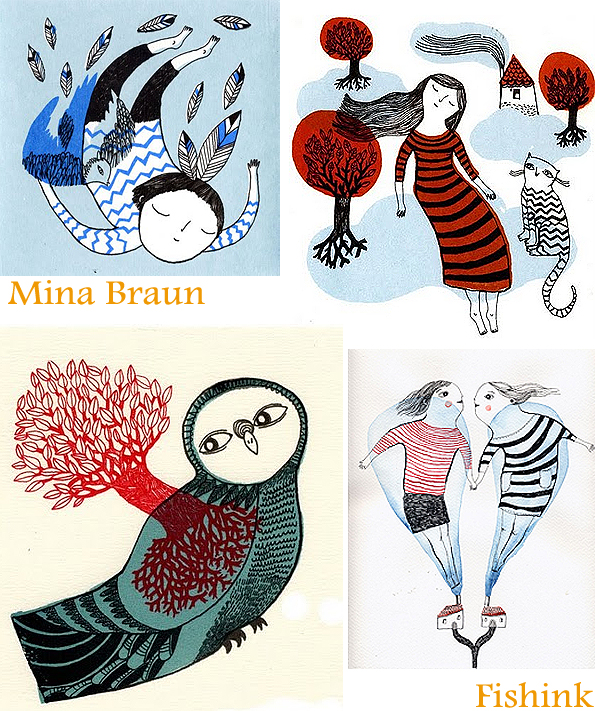
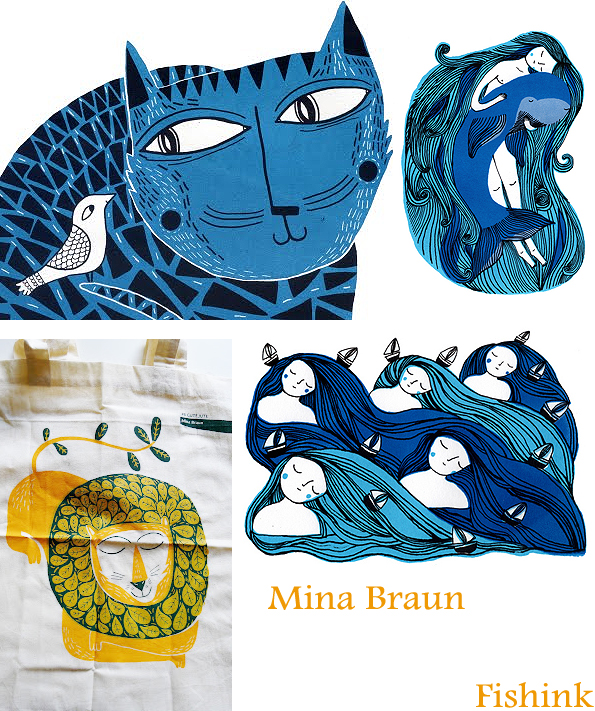
Here’s a few of Mina’s past prints that first caught my eye. Beautiful characters and I love the one entitled ” In The Flowerfield “, it’s so full of summery joy.

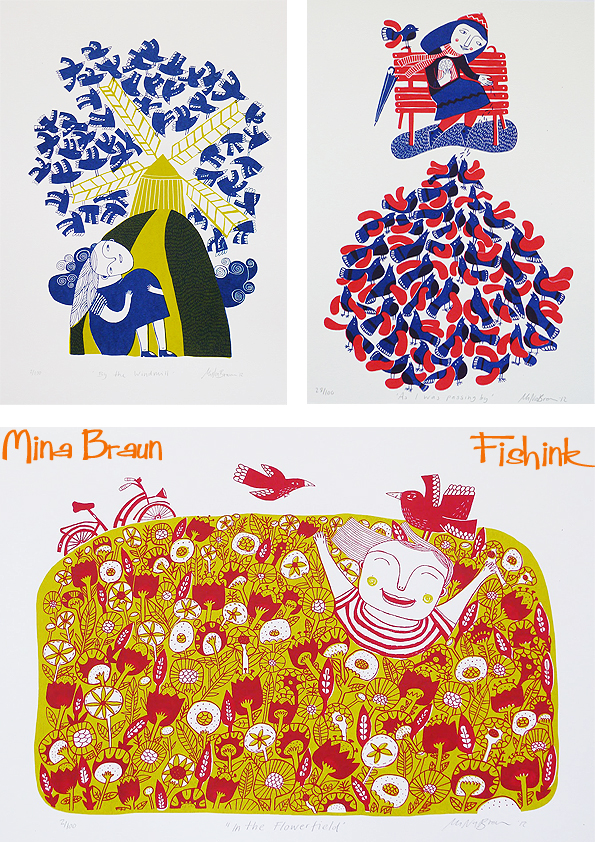
There is more info and images on Mina’s blog and two of her latest pieces of work below.
The top one is for Scree Magazine and the lower illustration is for a client called Rosa Martens from the Netherlands, and is a cover illustration for her thesis.
Great to see such a variety of work Mina, thanks again for your help in making this post possible.


 fishinkblog.com